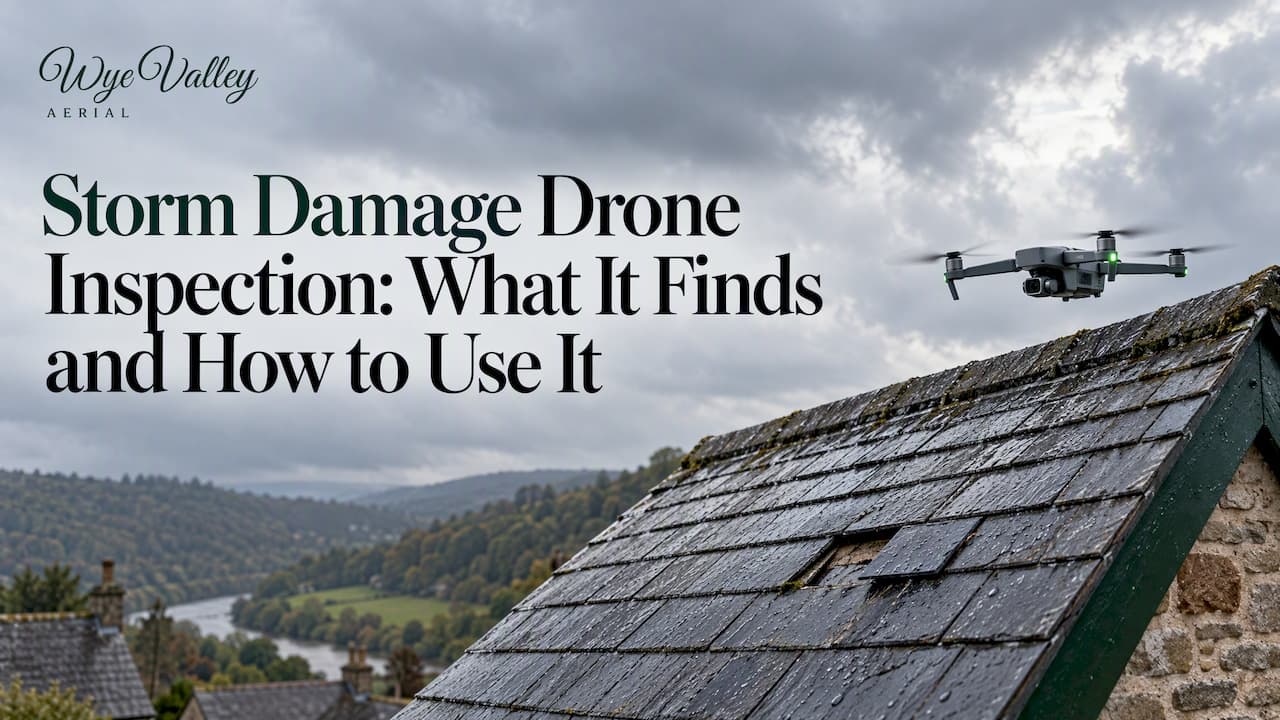
A storm damage drone inspection is a quick, ladder-free way to see what a gale has done to your roof, chimney, gutters and walls. A pilot flies a camera drone around the building and records every slope and edge in close detail. You get a set of photos and video to show your insurer, your roofer or your managing agent. It does not replace a roofer's hands-on check, but it tells you where to look first and gives you evidence while the damage is fresh.
Below we explain how it works, what it can and cannot show, how to use the images with an insurer, and what to ask a pilot before you book. We fly across the Wye Valley, including Monmouth, Ross-on-Wye, Chepstow, Coleford and Lydney, so the examples are ones we see on local roofs.
TL;DR
- A drone inspection records a storm-hit roof and exterior from several angles without anyone climbing up, so it is safer and faster than a ladder check.
- It shows visible damage such as slipped or missing tiles, ridge movement, chimney and flashing problems, and blocked or displaced gutters. Hidden faults may still need a roofer on site.
- Tell your insurer as soon as you can, make temporary repairs only where needed, and keep your receipts. Dated drone images give you a clear record to send.
- Check that your pilot holds the right UK qualification, carries insurance and has permission to fly from your site.
- Treat the drone survey as step one, then have a roofing professional confirm and repair.
Table of Contents
- How a drone inspection after a storm works
- What a drone can spot on a storm-hit property
- What a drone cannot see
- Why it is safer than going up a ladder
- Using drone images with a home insurance claim
- UK rules a storm inspection pilot must follow
- Choosing a storm damage drone inspection pilot
- Our view: observe first, repair second
- Book a storm survey in the Wye Valley
- Frequently asked questions
- Sources
How a drone inspection after a storm works
A drone inspection uses a remotely piloted, camera-equipped aircraft to photograph and record a building's roof and exterior from multiple angles. The point is to document visible damage quickly and safely, without sending someone onto a roof that may be unstable.
In practice a visit usually follows this order:
- Briefing. You tell the pilot what you are worried about: a slate you saw land on the lawn, a stain on a bedroom ceiling, a chimney that looks different.
- Site check. The pilot looks at the surroundings, neighbouring properties, people nearby, trees and overhead lines before launching.
- Overview pass. A higher flight captures the whole roof and the surrounding ground, which also shows where debris has landed.
- Close passes. The drone moves in on each slope, the ridge, hips and valleys, chimneys, flashing, skylights, solar panels and gutters.
- Delivery. You receive the stills and video by download link, usually with the problem areas easy to pick out.
The whole flight is often short. What takes time is doing it methodically, so every part of the roof is covered and nothing is missed because the light was poor or a slope was awkward to reach.
What a drone can spot on a storm-hit property
From what we photograph around the Wye Valley, the most common things a drone survey reveals after high winds are:
- Slipped, cracked or missing tiles and slates, often along the edges and ridge where wind lifts first.
- Ridge and hip tile movement, including mortar that has cracked or fallen away.
- Chimney stack problems, such as damaged pots, loose flaunching, cracked pointing or lifted lead flashing.
- Flashing and lead work that has peeled back around chimneys, dormers, valleys and abutments.
- Gutters and fascias that have pulled away, sagged or filled with debris, which we cover in more detail in our piece on gutter inspection by drone.
- Debris and fallen branches resting on a roof, in a valley or against a wall.
- Flat roof and outbuilding issues, such as lifted felt edges or pooling water on garages, extensions and barns.
- Solar panels that have shifted, cracked or been struck by debris.
A drone is particularly useful on steep roofs, tall buildings, listed or period properties where you would rather not put a ladder against old stonework, and large estates, hotels or agricultural buildings where there is a lot of roof to cover.
What a drone cannot see
A camera shows surfaces. Some storm damage sits beneath them. Thermal cameras can identify temperature anomalies and moisture-related patterns under suitable conditions, but small cracks, loosened fixings and damage beneath roofing materials may still need a physical inspection.
That is why a sensible plan has two stages. The Association for Drones describes the most effective approach as observation followed by professional verification: the drone identifies candidate damage, and people on the ground confirm it before repair decisions are made.
In practice that means:
- If the images show a clearly missing tile or a collapsed gutter run, you can often get a roofer to quote straight from the photos.
- If you have an internal leak but the roof looks fine from above, the drone narrows the search, and a roofer then checks underlay, battens and fixings on site.
- If the roof is old, the survey helps a roofer arrive with the right materials and a clear scope.
Physical access remains necessary for lifting tiles, testing membrane integrity or taking samples, and deeper problems may need invasive investigation. A good drone report says what it can show and what still needs a closer look. It does not pretend to be a full structural survey.
Why it is safer than going up a ladder
Storms leave roofs in uncertain condition. Loose tiles, weakened battens and wet surfaces make a climb risky even for a confident DIYer. The Health and Safety Executive's advice is to assume a roof is fragile unless you are certain it is not, and it notes that inspections can be done from ground level or from a mobile elevating work platform.
A drone gives you a ground-level route for the first look. Nobody has to step onto a damaged roof just to find out what is wrong, and a roofer who does need to go up can plan access, edge protection and materials with the images in hand.
Two practical points from us:
- Keep people clear of the damaged area. If you can see tiles hanging or a chimney leaning, keep children, pets and visitors away from the ground beneath until it is made safe.
- Do not climb up to check what the drone has already shown you. Use the images, and let a qualified roofer decide what physical access is safe.
If you want to understand the cost side before you book, our guide to what a drone roof inspection costs in the UK sets out what typically affects the price.
Using drone images with a home insurance claim
The Association of British Insurers' storm guidance is plain: contact your property insurer as soon as possible, and if necessary arrange temporary emergency repairs to prevent further damage, keeping the receipts. The same page explains that policies are designed to cover sudden and unforeseen damage, not general upkeep. That distinction matters when you assemble evidence.
Drone images help in three ways:
- They show the scene as it was. Dated photos of a freshly displaced ridge or a fallen branch on a roof make it clear the damage is recent.
- They cover areas nobody can safely reach. Your insurer or loss adjuster sees the whole roof, not just what is visible from the garden.
- They support your roofer's quote. A clear set of images lets a roofer describe the repair precisely, which can cut back-and-forth.
What to do, in order:
- Ring your insurer and report the damage.
- Take your own ground-level photos from the garden or street, without climbing anything.
- Arrange emergency measures only where water is coming in or there is a danger, and keep every receipt.
- Book a drone survey so the roof is recorded before repairs begin.
- Send the images to your insurer with your claim reference, and keep the originals.
Whether a claim is paid depends on your policy and your insurer's assessment. Images do not guarantee an outcome, so read your policy wording or ask your insurer or broker what evidence they want. We cover what makes a useful set of photos in five photo checks for drone inspection reports.
UK rules a storm inspection pilot must follow
Storm jobs are often urgent, but the rules still apply. Any pilot you hire to fly over or around your property should be able to tell you which category they operate in and why.
For operations that fall under the CAA's PDRA01 authorisation, the CAA sets out that pilots must hold a valid UK Flyer ID and an RPC-L1 or GVC. The Operator ID must be displayed on the aircraft, insurance must meet UK Regulation (EU) 785/2004, and any airspace restrictions must be followed. The same page explains that an A2 CofC supports closer operations under A2 where applicable, while a GVC is commonly used to support Specific-category authorisation.

Our own pilot holds an A2 CofC, flies with full insurance, and plans each flight to CAA rules. For a fuller explanation of who can legally be paid to fly over a roof, see drone operator qualifications for paid roof jobs.
Permission to fly from your site
Flying from privately owned land needs applicable permission, and operators must not trespass. That is straightforward when you own the house, but it matters for rented homes, shared buildings, hotels and estates. If you manage several properties, tidy site access management makes it easier to arrange who can enter, when, and with what paperwork. Our article on drone filming over private property explains the rules on neighbours' land and privacy.
Other things that affect whether and how a flight can go ahead include proximity to people, nearby airspace, the pilot's competence, record keeping and data protection. A pilot who has thought about these will usually produce a short risk assessment; see what a drone filming risk assessment must cover.
Choosing a storm damage drone inspection pilot
After a big storm, demand rises and quality varies. Use this checklist before you agree to anything:
| Question | What a good answer sounds like |
|---|---|
| What qualification do you hold? | A named UK qualification such as an A2 CofC or GVC, and a clear explanation of what it allows |
| Are you insured? | Yes, with cover appropriate for commercial drone work, and they can say so in writing |
| Do you have permission to fly here? | They ask you for permission and check neighbours, airspace and people nearby |
| What will I receive? | Stills and video delivered digitally, with problem areas identifiable |
| What can't the survey show? | An honest account of hidden damage and when a roofer must still check |
| How is the price set? | A fixed quote given before the flight, not an open-ended charge |
For property managers, landlords and hotel or estate teams, what UK property teams must ask before a drone building inspection goes into more depth, and the hotel drone policy checks cover flights where guests are present.
Our view: observe first, repair second
We have been called out after high winds to roofs that looked fine from the lawn and were far from fine from above. The reverse also happens: a worrying stain turns out to be a single slipped tile. Either way, the first job is to see the whole picture without putting anyone at risk.
That is why we fly every storm job as a methodical survey, not a quick glance. We agree the shots you need in advance, cover every slope, ridge, chimney and gutter run, and give you edited stills and video by download link. Our pilot holds an A2 CofC, flies with full insurance and follows CAA rules, and we will reschedule for weather without fuss, because a safe flight in poor conditions is not possible.
We also tell you plainly where the drone's view ends. If something needs a roofer on the roof, the images make that visit shorter, better planned and easier to quote. The drone does the looking, and your roofer does the fixing.
Rhys
Book a storm survey in the Wye Valley
If a storm has left you wondering what is happening up there, we can fly your property and send you a clear record of the roof and exterior. Our roof and building check is quoted individually, with a free fixed quote before we fly, and we cover Monmouth, Ross-on-Wye, Chepstow, Coleford and Lydney.

See the roof and building check and our other services, or get in touch through our main site to describe the damage and arrange a flight. If you are weighing up the figures first, our guide to drone roof inspections for property owners explains what is included and how we keep flights compliant.
Frequently asked questions
Can a drone find hidden storm damage?
A drone shows what is visible on the surface, such as displaced tiles, damaged flashing and ridge movement. Thermal imaging can flag temperature or moisture patterns in suitable conditions, but small cracks, loose fixings and damage under roofing materials may need a hands-on inspection. We treat the drone as the first step that tells a roofer where to look.
Will my insurer accept drone photos?
Insurers decide what evidence they need, so ask yours before you book. The ABI advises contacting your insurer as soon as possible and keeping receipts for any emergency repairs. Dated, clear images of the damage can support your claim, but they do not guarantee a payout.
Is it safe to fly a drone after a storm?
It can be, if the wind has dropped and the pilot has checked the site, airspace and people nearby. Flights are postponed when gusts or rain make them unsafe. We reschedule for weather, so you are not pressed into a poor-conditions flight.
Do I still need a roofer if the drone finds damage?
Usually yes. The drone records and locates the problem, while a roofer carries out the repair and checks anything the camera cannot see, such as underlay and fixings. Giving your roofer the images beforehand often makes the visit quicker and the quote more precise.
Do I need to be at home during the flight?
It helps, because we need your permission to fly from the property and you can point out the areas that worry you. For rented or managed buildings, make sure the owner or agent has agreed access beforehand.
Sources
- Storm Damage Assessment Drone Guide, Association for Drones
- Storms, Association of British Insurers
- Fragile roofs: What you need to know as a busy builder, HSE
- PDRA01 overview, UK Civil Aviation Authority
- CAA UAV Regulations Explained for UK Operators, Dronedesk