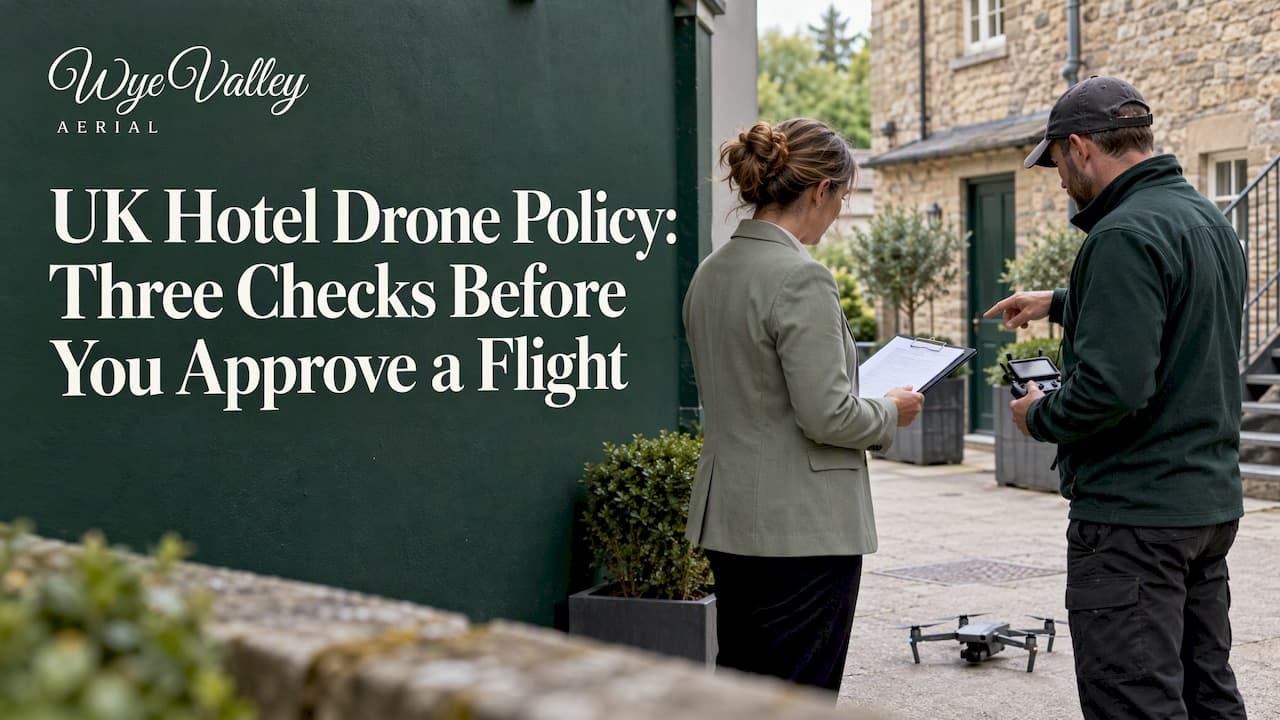
Allow drone flights on hotel land only when a senior manager has approved them in writing in advance. Before approving, insist on three things: the operator's CAA documentation and insurance, a site-specific risk assessment, and agreed take-off areas that keep flights away from excluded guest areas. Check Flight Restriction Zones and NOTAMs for anything large.
TL;DR:
- Require Operator ID, Flyer ID, competence evidence such as A2 CofC or applicable Operational Authorisation, commercial public liability insurance, and a signed agreement.
- Keep drones at least 50 metres from uninvolved people unless a CAA exception or Specific Category authorisation applies, and never allow flights over crowds.
- If a drone may capture personal data, complete a DPIA, provide guest notice, restrict access to footage, and define how long it is retained.
- Allow indoor flights only with controlled access, suitable netting or screening, a written safety plan, and a hall controlled by one organiser.
Table of Contents
- What should you check before you say yes to a drone request?
- What should a short hotel drone policy include?
- Which CAA flight rules must operators follow on your site?
- How do you protect guest privacy and meet UK data law?
- How do you vet a drone contractor and what evidence should you keep?
- How should you tell guests and staff about a flight?
- What extra controls apply to indoor flying and large outdoor shoots?
- What training do hotel staff need around drone operations?
- How do you handle guest questions and complaints about drones?
- How should drone activity be coordinated with hotel security?
- When should you adjust your drone policy for seasons and events?
- A supplier's view: what a professional operator should bring
- How can Wye Valley Aerial Imaging help your hotel run a compliant drone shoot?
- FAQ
- Sources
What should you check before you say yes to a drone request?
When a booking or request lands on your desk, run through this list. If any line fails, the answer is "not yet".
- Confirm written authorisation from senior management and a signed operator agreement before any flight is scheduled.
- Verify the operator's Operator ID and Flyer ID, the pilot's competence (an A2 CofC or evidence of an Operational Authorisation), and current public liability insurance.
- Ensure take-off and landing will happen on hotel land, outside excluded guest areas, and ask for a site-specific risk assessment and flight plan.
- Check the current CAA-approved airspace maps for Flight Restriction Zones, and ask for evidence of any NOTAM for larger shoots or events.
- Agree the permitted hours and the exact areas that are off limits, such as the spa, balconies and bedroom windows.
- File everything in the events file the same day, so you can show what was agreed if a guest or neighbour complains.
This mirrors the approach in group drone policies, which require pre-authorisation by senior management, evidence of Flyer ID and Operator ID, proof of competence, public liability insurance, and a completed activity plan and risk assessment before any flight.
What should a short hotel drone policy include?
A hotel policy does not need to be long, but it does need to be specific. Adapt these clauses to your venue.
- Scope. State who may request flights (staff, contractors, guests and third parties) and that prior written permission from a senior manager is required in every case, with no verbal approvals.
- Documentation. List what must be supplied before approval: Operator ID, Flyer ID, proof of insurance, and evidence of pilot competence or an Operational Authorisation where one applies.
- Excluded areas and hours. Name the zones where flying is never permitted, such as guest terraces, the spa and rooms with windows onto the grounds, and set the times of day flights may take place.
- Risk assessment. Require a written, flight-specific risk assessment and a site briefing from the operator before they arrive.
- Data handling. Set out what may be recorded, who holds the footage, how securely it is stored and how long it is kept.
- Recordkeeping. Retain signed operator agreements, risk assessments and insurance certificates in the events file.
- Breach and withdrawal. Reserve the right to stop any flight at any time, for any reason, and say so in the agreement.
The CAA's guidance for venues supports using a written agreement that sets out scope, timing and excluded areas.
Which CAA flight rules must operators follow on your site?
You do not need an aviation background to enforce the basics. You only need to know what to ask for and what to refuse. These are the rules to build into every agreement:
- The pilot keeps the drone within unaided visual line of sight at all times.
- The drone must stay within the applicable CAA height limits.
- A horizontal separation of 50 metres from uninvolved people is maintained, unless an A1/A2 exception or Specific Category authorisation applies.
- Take-off and landing zones are marked on hotel land, so the pilot is never tempted to launch from a neighbour's field or the public road.
- Near an aerodrome or in controlled airspace, the operator shows evidence of Flight Restriction Zone and NOTAM checks and any clearance needed.
- Indoor flights happen only with controlled access, netting or screening where appropriate, and only when the space is under exclusive control.
A designated take-off point matters more than it sounds. Production guidance points out that without a private take-off point on your land, a pilot may trespass, so ask operators to name their zones on the flight plan.
Pro Tip: Ask the pilot to walk the take-off and landing zones with your duty manager before the first flight, and photograph them for the events file.
How do you protect guest privacy and meet UK data law?
A drone with a camera records people, and that makes your hotel a potential data controller. The CAA's privacy rules make clear that drones must not hover over or photograph private guest areas, including balconies, spas or accommodation windows, without explicit consent. Imagery that could identify individuals may also be subject to the UK GDPR, a point the CAA's drone code on privacy reinforces for commercial recording.
The Information Commissioner's Office sets out a practical route in its guidance on unmanned aerial systems.
- Ask whether the drone is genuinely needed, and if personal data could be captured, complete a Data Protection Impact Assessment.
- Record only what is necessary, store it securely, restrict access and keep it for a short, defined period.
- Tell guests where you can, through signage, event briefings and your website privacy notice.
- Write privacy requirements into the operator agreement so the pilot is bound by them.
- Use technical mitigations: start recording only once the drone is at altitude, narrow the field of view, or mask private areas in the footage.
The ICO expects a DPIA wherever a drone may capture personal data, along with signage, an accessible privacy notice, secure storage and limited retention of footage.
That expectation is written into the ICO's own checklist, so treat it as the baseline rather than a nice extra.
How do you vet a drone contractor and what evidence should you keep?
Vetting is where you protect the hotel from liability. A professional supplier will expect these requests and answer them quickly. Be wary of one who does not.
- Request copies of the Operator ID and Flyer ID, plus competence evidence such as an A2 CofC, or a Specific Category Operational Authorisation where applicable. The CAA's page on flying drones for work explains that operators must register where required and that remote pilots need the right qualifications.
- Insist on valid public liability and third-party insurance that explicitly covers commercial drone operations.
- Require a flight-specific risk assessment and a site briefing, and store all documents in the events file.
- If take-off or landing would be on third-party land, confirm the operator holds landowner permission and any local authority permits. The local authority filming guide notes that landowner permission is needed and that councils may attach conditions to commercial drone filming permits.
If you are weighing up quotes, our article on what CAA costs sit behind a drone photography quote explains why insurance and compliance affect supplier pricing.
How should you tell guests and staff about a flight?
Advance notice can help guests understand why a drone is being used. A little notice goes a long way.
- Give advance notice where practical, and publish a short privacy notice or event page explaining that a drone will be used.
- Put temporary signage near the take-off and landing areas and in any public space the flight affects, and brief front-of-house staff before the shoot starts.
- Provide a simple complaints route, and make sure every team member knows how to escalate a privacy or safety concern to the duty manager.
- Schedule flights for lower-occupancy periods where possible, such as mid-morning on a midweek day, to limit the number of guests affected.
What extra controls apply to indoor flying and large outdoor shoots?
Indoor flying and flights near crowds call for careful risk assessment and additional controls.
- For indoor operations, require exclusion zones, appropriate netting or screening and a written site safety plan. Flights should only take place when the hall is under the control of a single organiser.
- At events, never permit flights over crowds who cannot move away quickly, and ask the operator for a crowd safety plan.
- Large outdoor shoots may need NOTAMs or liaison with local authorities. The operator should supply evidence of any notifications or permissions, and the CAA's page on filming and event notification confirms that organisers remain responsible for complying with national regulations and considering landowners.
Indoor use also needs strict control to prevent damage to the building fabric and collisions, which is why the hall must be under single control before a propeller turns.
What training do hotel staff need around drone operations?
Your team does not need to fly drones, but anyone who may meet a pilot or a guest asking about one should know the policy. Build a short briefing into induction and refresh it before any approved shoot.
Cover four things. First, the basics of your policy: flights are allowed only with written senior approval, and any unannounced drone should be reported rather than challenged. Second, how to recognise an authorised operator, who will carry their Operator ID and a copy of the agreement and should be able to name the approved zones. Third, what to do in a problem: radio the duty manager, keep guests clear of the take-off area and never try to catch or grab a drone. Fourth, how to record an incident, including time, location and what was seen.

Front-of-house, security and events staff need the fullest briefing, while housekeeping and kitchen teams need only the reporting route. Keep a signed attendance record in the events file. A short talk before a shoot, using the checklist earlier in this guide, can help prepare those who will be on site that day.
Staff should also know where the limits of their role lie. They are not expected to judge whether a flight is legal in aviation terms. Their job is to check that the approved paperwork exists, keep guests safe and call the manager when something does not match the agreement.
How do you handle guest questions and complaints about drones?
Expect two kinds of enquiry: curiosity ("what is that for?") and concern ("are you filming my room?"). Both deserve a calm, consistent answer, so give your team a short script and a clear escalation point.
For curiosity, explain who is flying, why and for how long, and where guests can read the privacy notice. For concern, listen first, then confirm which areas are excluded from filming, and offer to speak with the duty manager or the operator on site. If a guest believes they or their room were recorded, log the details, tell the operator to pause, and ask the data protection lead to review the footage before it is released or stored.
Record every complaint, however minor, along with the outcome. Patterns matter: if several guests raise the same worry, the signage or timing probably needs changing. The UKHospitality guest security guidance reminds hotels to think about the full data lifecycle, including how footage is stored and shared, and to make sure routine marketing content does not reveal guests' presence or location.
Finally, never promise that a guest will not appear in any image. Promise instead that excluded areas will not be filmed and that footage is stored and shared only as your privacy notice states.

How should drone activity be coordinated with hotel security?
Security should know about every approved flight before it happens, not discover it from a guest. Treat the flight like any other contractor visit.
Share the agreement summary with the security lead: date, times, pilot name, vehicle details, take-off zones and excluded areas. Agree a point of contact on the day, and have the pilot check in and out at reception or the security desk. Security can then walk the perimeter, keep guests and vehicles clear of the launch area and stop the flight if conditions change.
Drones are also a security matter in their own right. Decide in advance who responds to an unauthorised drone over your grounds: record the time and location, take photographs if safe, and call the police where there is a threat to safety or privacy. Do not try to disable or intercept a drone. The UKHospitality principles on guest security encourage building drone controls into wider procedures, covering access arrangements, staff briefings and the effect of technology on guest privacy and security.
Review incidents with security after each season so lessons feed back into the policy.
When should you adjust your drone policy for seasons and events?
A single policy can flex without being rewritten each time. Decide in advance which conditions tighten the rules, then apply them consistently.
In summer, terraces, lawns and pools are busy, so restrict flights to early mornings or weekdays and widen the excluded areas around guest spaces. Weddings and large events need more care: confirm the 50 metre separation from people not involved in the flight, plan flights before guests gather or after they have moved indoors, and ask for a crowd safety plan. Our article on the UK 50 metre rule for wedding drone video shows how that distance shapes real event filming.
In winter, shorter days, wind and low cloud make flights less predictable, so build in flexibility to reschedule at no penalty to guests. Roof and building checks are often better done outside peak occupancy, and our guidance on questions to ask before a drone building inspection helps you plan those.
Some venues go further. The Excel London drone guidance shows how a venue can decline non-commercial outdoor flying and permit commercial flights only in exceptional circumstances with written landlord authorisation. Your own policy can set similar limits for peak dates.
A supplier's view: what a professional operator should bring
From the operator's side, a compliant booking should feel easy for you. A qualified pilot arrives with their Operator ID, a flight-specific risk assessment, a flight plan, proof of insurance and a shot list tailored to your site. They agree timings and excluded areas with you beforehand, brief your team, fly at quiet times and deliver edited assets securely, so footage never sits unprotected.
Hiring a qualified local operator means the paperwork, the privacy care and the disruption control are handled before the first flight. We work from the Wye Valley, and our pilot holds an A2 CofC, so ask any supplier, including us, to show you the same evidence before you agree anything.
— Rhys
How can Wye Valley Aerial Imaging help your hotel run a compliant drone shoot?
We provide aerial imagery tailored to your hotel’s needs. Our services include:
- Property stills
- Stills and a short film
- Half day on site
- Full day
- Roof and building checks

Our pilot holds an A2 CofC and we follow CAA rules on every job, with flight plans and briefings tailored to your site. We build shot lists around your needs and deliver edited assets via download link. Quotes are free, and you can check the area we cover before you get in touch to request yours.
FAQ
Do UK hotels need permission to allow drones on their land?
Yes, in practice a hotel should give written permission before any flight takes off from or over its land. Landowner permission is needed for take-off and landing, as the local authority filming guidance explains. Record the approval in your events file.
What documents should a drone operator show a hotel?
Ask to see the Operator ID, Flyer ID, proof of pilot competence such as an A2 CofC or Operational Authorisation, and current public liability insurance. Request a flight-specific risk assessment too. The CAA guidance on flying drones for work sets out registration and qualification expectations.
Can a drone fly over hotel guests?
Generally not. Operators should keep the drone away from uninvolved people and never fly over crowds who cannot move away quickly. Where a flight is planned near guests, require a safety plan and agree the excluded areas in writing.
Does a hotel need a DPIA for drone filming?
If the drone could capture personal data, a Data Protection Impact Assessment is recommended. The ICO's drone guidance asks organisations to justify the need, give notice and limit how long footage is kept.
Who is responsible if a drone causes damage at a hotel?
Responsibility for damage depends on the circumstances, which is why valid insurance and a signed agreement matter. Your policy should require proof of insurance before the flight and keep it on file. A clear agreement also helps the hotel show it took reasonable steps.