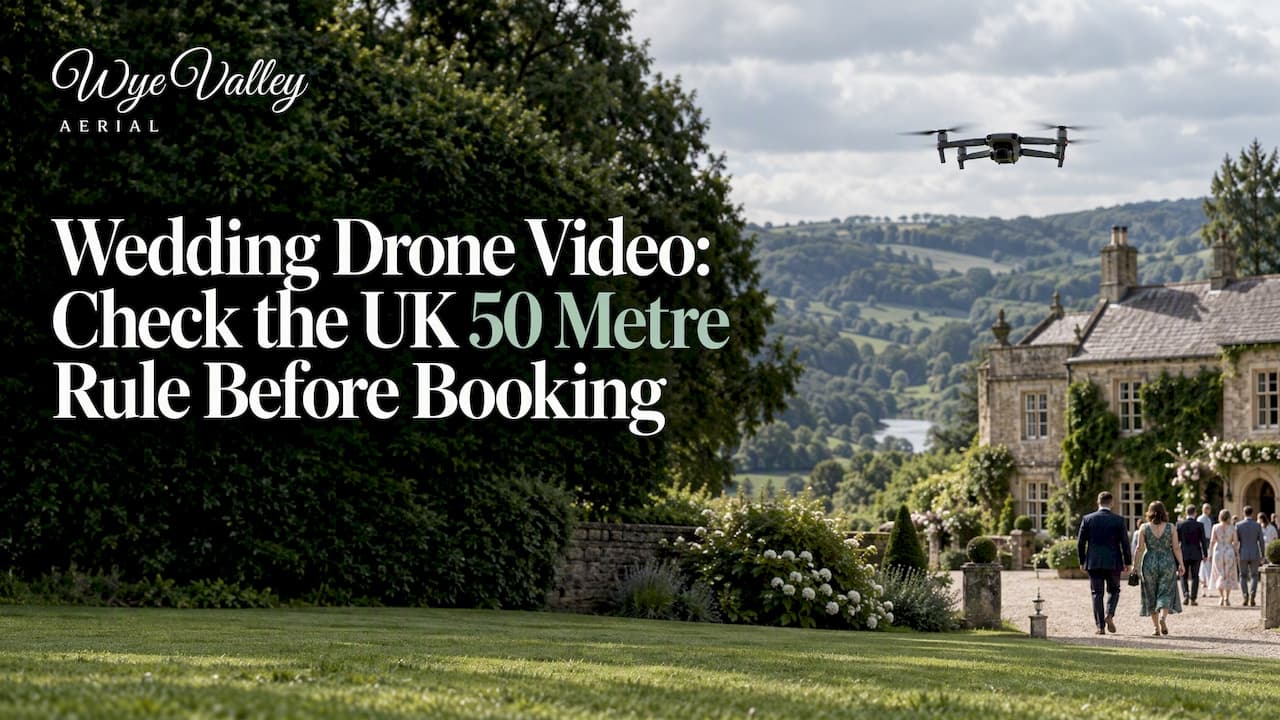
A drone can transform a wedding film, giving you sweeping venue shots and guest-arrival footage no ground camera can match, but only when the site and legal permissions allow it. The first thing to check is where you can fly under UK drone rules, since crowd size and venue layout can restrict close flying. Once you know the site works, contact a compliant local operator such as Wye Valley Aerial Imaging for advice and a free quote.
TL;DR:
- Standard UK rules require 50 meters from uninvolved people, and crowded gatherings restrict close flights; a general wedding announcement does not count as consent.
- Check venue policy and airspace separately: some stately homes, churches, and National Trust properties may ban drones, while airports, military zones, and city centers add restrictions.
- Routine coverage is quoted by site, time, travel, editing, and permissions; example packages for 30 drone light shows start at about £6,500.
- Aerial clips usually total under two minutes in a five to ten minute highlights film, and intimate weddings often need only one flyover.
- Book early and give the pilot venue details, guest count, hazards, and timings; keep a flexible flight window because unsafe weather can cancel filming.
Table of Contents
- What wedding drone video is and where it fits in your film
- Benefits of adding drone footage to your wedding film
- Legality, permissions and safety: what UK rules mean for wedding drone flights
- Typical costs, what affects a quote and what a quote should include
- How to plan and brief a drone operator: practical steps and a shot checklist
- Weather, safety and contingency: how pilots decide to fly
- Wye Valley Aerial Imaging: credentials, operating practice and what clients receive
- Post-production: editing, colour grading and music for aerial footage
- Client communication and planning your personalised shot list
- Limitations and restrictions on drone use at different venues
- Author's view: when to use aerials sparingly and when to feature them heavily
- How to book Wye Valley Aerial Imaging for your wedding
- FAQ
- Sources
What wedding drone video is and where it fits in your film
Aerial footage is a set of specific shots woven into a conventional wedding film, not a separate production. A skilled pilot captures short, deliberate clips that bookend or punctuate the ground footage, usually totalling under two minutes in a five to ten minute highlights edit.
Common aerial shots include:
- A venue flyover showing the full grounds, gardens or coastline as an establishing shot.
- An arrival approach following the car, boat or carriage as guests reach the venue.
- A group shot from above, gathering everyone in one frame without ladders.
- Landscape inserts used as transitional cutaways between ceremony and reception scenes.
Routine aerial capture like this is different from a drone light show, where multiple drones fly a choreographed display after dark, usually as a standalone entertainment feature rather than part of the film. Editors typically slot aerial clips at the open and close of a highlights video, and trim them further for a 30 to 60 second social media cut.
Benefits of adding drone footage to your wedding film
Aerial shots earn their place when they do something ground footage cannot.
- They show scale and setting: a manor house, vineyard or coastal venue reads completely differently from above.
- They add cinematic motion through smooth reveals and establishing shots that ground cameras cannot replicate.
- They capture full group photos without scaffolding or ladders, useful for larger guest lists.
- They produce short, shareable clips that work well for social media highlights.
Aerials add limited value at small, indoor-only ceremonies with no outdoor grounds, where there is simply nothing for a drone to reveal.
Pro Tip: Ask your pilot to film the venue approach during guest arrival rather than during the ceremony itself: it avoids any crowd restrictions and still delivers a striking opening shot.
Legality, permissions and safety: what UK rules mean for wedding drone flights

UK drone law is the first filter for any wedding booking, not an afterthought. Under standard open category rules, the CAA requires at least 50 metres horizontal separation from people not involved in the flight, and guidance treats dense gatherings as "assemblies of people", meaning crowds that cannot disperse quickly. A packed ceremony or dancefloor often falls into that category, which restricts how close a drone can legally come.
Operators who need to fly nearer to guests or within recreational and residential areas usually rely on PDRA01 authorisation, a specific permission with its own separation minima and safeguards rather than a blanket licence to fly anywhere. Privacy matters too: filming guests closely without consent raises GDPR considerations, and current CAA Drone Code guidance requires an observer for any FPV flying.
A general wedding announcement does not count as consent for close aerial filming; guests remain "uninvolved" unless specific permission or operational control is in place.
The practical outcome is straightforward: some ceremonies will legally rule out close-up aerials entirely, so pilots plan buffer zones, approach shots and wide establishing footage instead of flying over the crowd itself.
Typical costs, what affects a quote and what a quote should include
Pricing for routine wedding aerial capture varies with how much time the pilot spends on site, how many locations are involved and what authorisations the job needs. A short add-on alongside your main videographer costs less than a half-day booking covering arrivals, ceremony grounds and reception exteriors, and a full-day booking across multiple locations costs more again. These are separate from drone light shows, which sit in a different pricing bracket: example packages for multi-drone wedding light shows start from about £6,500 for a 30-drone display, reflecting the scale of equipment and planning involved.
What pushes a quote up or down:
- Whether the venue needs a specific authorisation such as PDRA01.
- Number of drones and pilots required on the day.
- Time on site, travel distance and insurance cover.
- Editing turnaround, number of revisions and whether an evening show is added.
A proper quote should state flight time, editing and delivery format, and what happens if the date needs rescheduling for weather.
How to plan and brief a drone operator: practical steps and a shot checklist
Book your drone operator as early as you book your photographer, particularly for a peak summer date when availability tightens months in advance. Give the pilot a venue plan, ceremony timings, an approximate guest count and any known hazards such as power lines, tall trees or nearby roads, plus a named contact for the day itself.
Coordinate arrival and rehearsal windows with your photographer and videographer so the drone slot does not clash with posed photographs or the ceremony processional. A short dedicated aerial window, usually planned around guest arrival or just before the ceremony, keeps disruption to a minimum.
A shot list you can paste into an enquiry email:
- Wide flyover of the venue and grounds on arrival.
- Approach shot following the wedding car or procession.
- Establishing shot of the ceremony location before guests are seated.
- Group shot from directly above during a scheduled gap.
- Landscape or sunset insert for the closing sequence.
Share this list early so the pilot can flag anything the site or rules will not allow.
Weather, safety and contingency: how pilots decide to fly
Most professional pilots will not fly in wind speeds that exceed the drone's rated limits, in heavy rain, or in poor visibility that affects obstacle avoidance, since these conditions compromise control and footage quality alike. Before any flight, a pilot runs a safety check covering battery condition, airspace restrictions and an up-to-date site assessment.
Contingency planning typically includes an alternate time window earlier or later in the day, or a rebooking policy if conditions make flying unsafe. These thresholds mean aerials are often captured in a flexible slot rather than a fixed moment in the timeline, so building in some leeway around the ceremony helps.
Wye Valley Aerial Imaging: credentials, operating practice and what clients receive
We operate every flight following CAA procedures on separation distances, airspace checks and permissions before any wedding booking is confirmed. We carry insurance and prepare a flight plan for each site in advance, so couples and planners know exactly what has been checked before the day arrives.
Our wedding-focused packages include stills and a short film, half-day and full-day coverage, each quoted individually once we understand the venue and shot list. We provide a quote for enquiries, so you can compare options before committing to a date.
Post-production: editing, colour grading and music for aerial footage
Aerial clips go through the same post-production pipeline as the rest of a wedding film, but with a few specific steps. Raw drone footage is first stabilised and checked for exposure consistency, since lighting shifts quickly when a drone moves between sun and shade over a venue.
Colour grading brings the aerial footage in line with the ground footage so the two cut together without an obvious shift in tone, particularly important when blending a bright outdoor flyover with warmer indoor reception clips. Editors typically grade the drone footage second, matching it to the ground footage's established look rather than the other way round.
Music integration follows: aerial shots are usually placed on musical swells or transitions in the highlights edit, since the wide, slow-moving footage suits a build rather than a quick cut. A flyover or approach shot often opens or closes a highlights film precisely because it gives the music room to breathe before the faster-paced ceremony and reception cuts begin. The final export is delivered in the format agreed at quote stage, with aerial and ground footage combined into one finished film rather than handed over as separate pieces.

Client communication and planning your personalised shot list
Getting a shot list right starts with a conversation well before the wedding date, not on the morning itself. We ask for venue details, ceremony timings and any shots you have seen and liked, then build a shot list around what the site and rules actually allow.
This back-and-forth matters because every venue is different: a coastal site offers very different opportunities to a walled country garden, and a shot that works at one location may be impossible at another. We confirm the final list a few weeks ahead, once permissions and weather windows are clearer, so there are no surprises on the day.
Clear communication at this stage also covers practical logistics: who the on-site contact is, where the pilot can safely take off and land, and how the aerial window fits around the rest of the day's schedule. Couples who share a detailed brief early tend to get footage that matches what they pictured, rather than a generic flyover.
Limitations and restrictions on drone use at different venues
Not every venue allows the aerial shots couples picture. Some stately homes, churches and National Trust properties restrict or ban drone flights entirely, regardless of what CAA rules would otherwise permit, so venue policy is a separate check from airspace law.
Nearby airports, military zones or built-up areas can also restrict flying under wider airspace rules, independent of the wedding itself. Dense city centre venues often have the least flexibility, while rural or coastal sites tend to offer more room to work within the rules.
Weather and guest safety add a further layer: a packed marquee reception or a tight courtyard will rarely suit close aerial work, even where the venue itself has no formal objection. A good pilot checks all of this during planning, not on arrival, so couples find out early whether a given venue suits aerial filming at all.
Author's view: when to use aerials sparingly and when to feature them heavily
Aerials work best as a complement, not a centrepiece. A small, intimate wedding usually needs one well-placed flyover rather than several minutes of drone footage competing with the couple's own story. A large venue with real landscape or architecture to show off can justify more generous aerial use, provided the site allows it.
My advice is to confirm permissions before you fall in love with a shot list: a flyover you cannot legally film is worth nothing.
— Rhys
How to book Wye Valley Aerial Imaging for your wedding
We offer wedding aerial coverage built around what your venue and day actually need, from a short add-on through to full-day coverage.

- Stills and a short film for couples wanting a compact aerial package alongside ground footage.
- Half-day and full-day coverage for venues with multiple locations or a longer timeline.
- A free, no-obligation quote for every enquiry, with flexible rescheduling if the weather turns.
Get in touch through our services page with your venue and date, and we will tell you what's possible and what it will cost.
FAQ
How much does drone wedding photography cost in the UK?
Routine wedding aerial coverage is quoted individually based on time on site, number of locations and any authorisations needed, so there is no single fixed figure. We provide a free quote once we know your venue and shot list, through our services page.
How much does a drone show cost for a wedding?
A multi-drone light show is a different service from routine aerial filming and sits in a higher price bracket. Example packages for 30-drone wedding light shows start from about £6,500, reflecting the equipment and coordination involved.
How much does it cost to get a drone video?
Cost depends on flight time, travel, editing and whether special permissions such as PDRA01 are required for the venue. Rather than a flat rate, most operators quote per job once the site and brief are known.
How much does a drone wedding proposal typically cost?
A drone proposal video is generally priced similarly to a short aerial add-on, since it involves a brief flight window rather than a full day of coverage. Exact pricing depends on location, timing and any permissions the site requires, so a quote is the most reliable way to know the cost.
What CAA rules affect wedding drone filming?
Standard rules require at least 50 metres separation from people not involved in the flight, and crowded ceremonies can count as an "assembly of people" that restricts close flying. Operators needing to fly nearer to guests typically rely on PDRA01 authorisation, which carries its own conditions and safeguards.