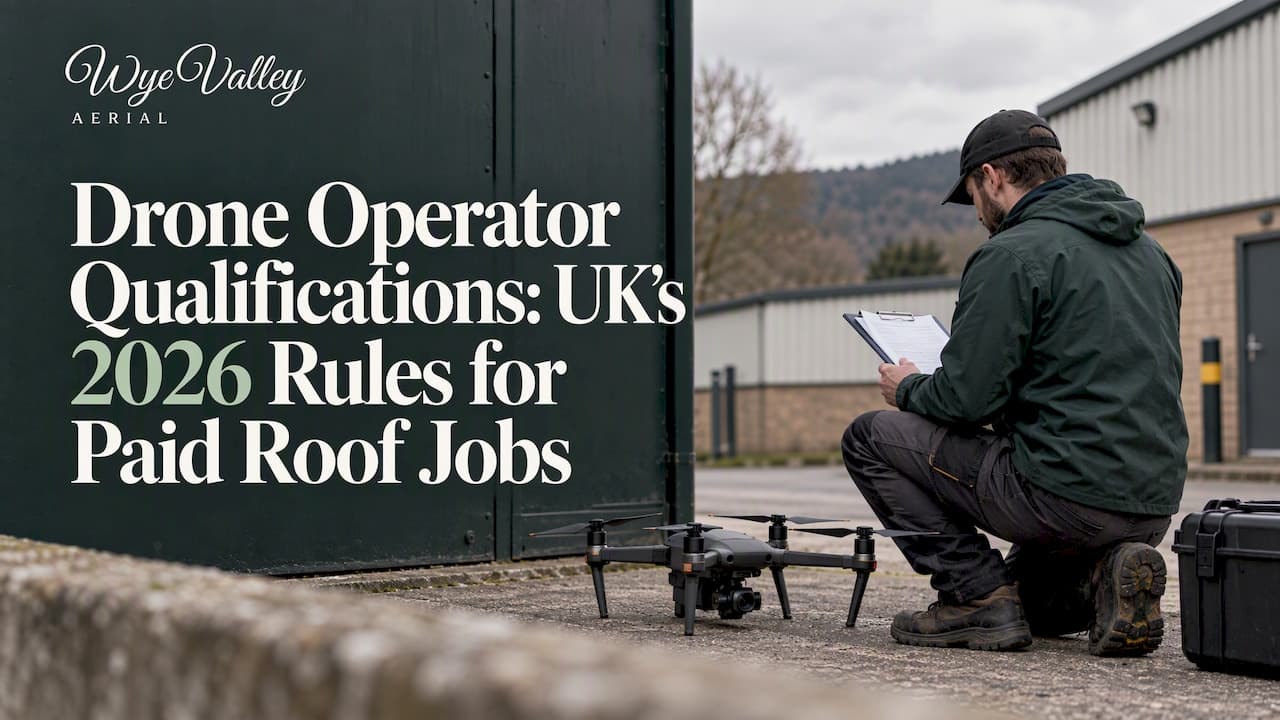
You may need a Flyer ID and an Operator ID to fly a camera drone commercially in the UK, depending on the drone and operation. Close-proximity work, such as roofs and property shoots, then also needs an A2 CofC or a Specific category authorisation backed by a GVC or Remote Pilot Certificate. Check Remote ID status before every paid shoot, as the 2026 rollout is under way.
TL;DR:
- Register the pilot and operator separately: Flyer ID applies from 100g, while Operator ID is required at 250g, or 100g with a camera.
- An A2 CofC covers Near People work, but roof inspections and jobs near buildings often require a Specific category authorisation such as PDRA01.
- PDRA01 pilots need a valid RPC Level 1 or GVC, recent experience on similar aircraft, and an operator contract; operators need manuals and flight records.
- Class determines Remote ID deadlines: some drones must broadcast by January 1, 2026; all operations are covered by January 1, 2028, unless exempt.
Table of Contents
- Who needs a Flyer ID and Operator ID, and what do they involve?
- What do A2 CofC, GVC and RPCs let you do?
- When must you apply for an Operational Authorisation?
- Which drones must broadcast Remote ID, and when?
- How do you get trained, take the tests and evidence competence?
- What should you do before your first commercial job?
- What proof should clients expect from an operator?
- Want a CAA-compliant aerial service without managing the paperwork?
- FAQ
- Sources
Who needs a Flyer ID and Operator ID, and what do they involve?
Two registrations sit under everything else. The Flyer ID is for the person at the controls. The Operator ID is for the person or organisation responsible for the drone. If you hire a pilot, or you are the pilot and the business owner, you need both.

The thresholds are weight and camera based. You need an Operator ID for a drone that weighs 250g or more, or 100g or more with a camera, and the Flyer ID applies from 100g. Almost every professional camera drone clears that bar. Check the CAA guidance for the requirements to register as an Operator.
Here is what each registration involves:
- Flyer ID: you pass the CAA online theory test, and the Flyer ID must be renewed when it expires. Read the Drone and Model Aircraft Code first, then sit practice questions before the real test.
- Operator ID: you register with the CAA, pay £12.34 per year and display the ID on the aircraft.
- Operator duties: the Operator ID sets out your responsibilities, including making sure pilots have the right competence, labelling drones and maintaining them.
- Overseas registrations: a registration from another country does not carry over, because overseas registrations are not accepted for UK operations.
The old Permission for Commercial Operations has gone. Commercial compliance now depends on choosing the right operational category and proving competence with a recognised qualification, not on one commercial licence.
What do A2 CofC, GVC and RPCs let you do?
Match the certificate to the job, not the other way round. A Flyer ID alone lets you fly in the Over People (A1) and Far from People (A3) sub-categories, and the A2 Certificate of Competency is needed for Near People (A2) flying.
- A2 CofC: from 1 January 2026 it enables Near People (A2) operations. Assessment includes a theory test of at least 30 multiple choice questions plus self-directed practical training. It suits property shoots where you need to work closer to people than a basic Flyer ID allows.
- GVC: widely used to support Specific category authorisations. The GVC will stop being issued, though existing certificates stay valid until expiry where an authorisation accepts them.
- RPC-L1, L2 and L3: delivered through CAA-approved training and assessment providers. The levels step up from visual line of sight work towards more complex operations, and the authorisation itself states which competency it requires.
To decide, ask three questions. How close will you fly to people and buildings? Does the job need an authorisation? Which qualification does that authorisation name? Simple daylight stills away from people may need only the IDs. Roofs and busy streets point to the A2 CofC, or to the Specific category route in the next section.
When must you apply for an Operational Authorisation?
Many paid property jobs outgrow the Open category. For work like roof inspections, flying in the Open category is often insufficient because of the 150m distance restriction from residential and commercial areas. To work closer to buildings and people, you generally need a Specific category Operational Authorisation, typically via PDRA01. Retailers make the same point: roof inspections and property videography often need PDRA01 rather than the A2 CofC alone.
Here is what the route asks of you:
- Remote pilot prerequisites: pilots under a PDRA01 must hold a Flyer ID and a valid RPC-L1 or GVC.
- Employment or contract: the pilot must be employed by or contracted to the UAS operator.
- Recent experience: pilots need recent flying experience on similar or equivalent aircraft. Check the applicable authorisation for the requirements.
- Operator paperwork: an operations manual and flight records, with documents available to the CAA on request.
Organisations flying for work must also obtain insurance and any applicable authorisations. Our guide to drone roof inspections shows how this plays out on a real job.
Which drones must broadcast Remote ID, and when?
Remote ID is becoming mandatory in stages. Some classes must have it enabled by 1 January 2026 and others by 1 January 2028, and from 2028 it applies to all drone and model operations unless exempted. Before a commercial shoot:
- Check your drone's class mark against the CAA schedule, as class and Remote ID status decide your obligations.
- Look in the "My registration" area of your CAA account, where your Remote ID number appears.
- For legacy or privately built drones, consider an aftermarket Remote ID module and confirm it works.
- Update firmware and test the broadcast on the ground before you travel to site.
How do you get trained, take the tests and evidence competence?
Book through a CAA-approved RAE(PC) provider for the A2 CofC, an RPC or a GVC, and confirm the accreditation on the CAA pages. Training firms such as Coptrz advertise GVC and A2 CofC courses; prefer providers with verifiable approval.
- Expect a multiple choice theory test (30 questions or more for the A2) and, for some certificates, a practical flight assessment.
- Keep a logbook from day one, because PDRA01 requires evidence of recent flying experience. Check the applicable authorisation for its requirements.
- Draft your operations manual early, since the authorisation depends on it.
- Budget for training plus CAA application fees. Fees and timelines vary by provider, so ask each for a written schedule and total cost.
Pro Tip: Book your flight practice sessions and log them promptly after passing theory, so your recent experience is documented before your first paid job.
What should you do before your first commercial job?
Work through this order before accepting paid work:
- Register for your Flyer ID and Operator ID, label the aircraft and carry proof.
- Confirm the operation category and whether you need a Specific category authorisation.
- Hold the right certificate (A2 CofC, RPC or GVC), keep recent flight hours and log every flight.
- Check Remote ID readiness, arrange insurance and have your operations manual in place.
What proof should clients expect from an operator?
Our flights are run by a qualified pilot with an A2 CofC, we follow CAA rules and we hold insurance. Clients can reasonably ask any operator for their Operator ID, insurance certificate and operations manual. A compliant operator handles the authorisations and delivers work you can use without legal worry. Our write-up on commercial drone photography shows how rules shape deliverables.
— Rhys
Want a CAA-compliant aerial service without managing the paperwork?
We cover property stills, stills with a short film, roof and building checks, and half-day or full-day bookings. Every job is flown with certification, insurance and CAA rules as standard, and we give you a free quote. If you would rather not handle the photography or inspection work yourself, we can help with that. See our services, then get a free quote.

This article is general information, not a substitute for advice from a qualified lawyer. Consult a qualified legal professional about your own circumstances before acting on anything here.
FAQ
Do you need a licence to fly a drone in the UK?
There is no single licence. You must pass the theory test for a Flyer ID and register with the CAA before flying most drones outdoors. An Operator ID applies if the drone weighs 250g or more, or 100g or more with a camera.
What qualifications do you need to be a drone operator?
At minimum, a Flyer ID and an Operator ID. Near People flying needs the A2 CofC, and Specific category work needs an RPC-L1 or GVC plus an authorisation such as PDRA01.
Where can you find drone operator training?
Use a CAA-approved RAE(PC) provider, and check its accreditation on the CAA pages before paying. Providers such as Coptrz list A2 CofC and GVC courses.
How much does it cost to stay registered?
The Operator ID costs £12.34 per year, and the Flyer ID needs renewing every five years. Training and application fees depend on your provider and certificate.
Sources
- Fpvuk
- PDRA01 overview | UK Civil Aviation Authority
- Level 1, 2 and 3 Remote Pilot Certificates and GVC | UK Civil Aviation Authority
- A2 Certificate of Competency (A2 CofC) | UK Civil Aviation Authority