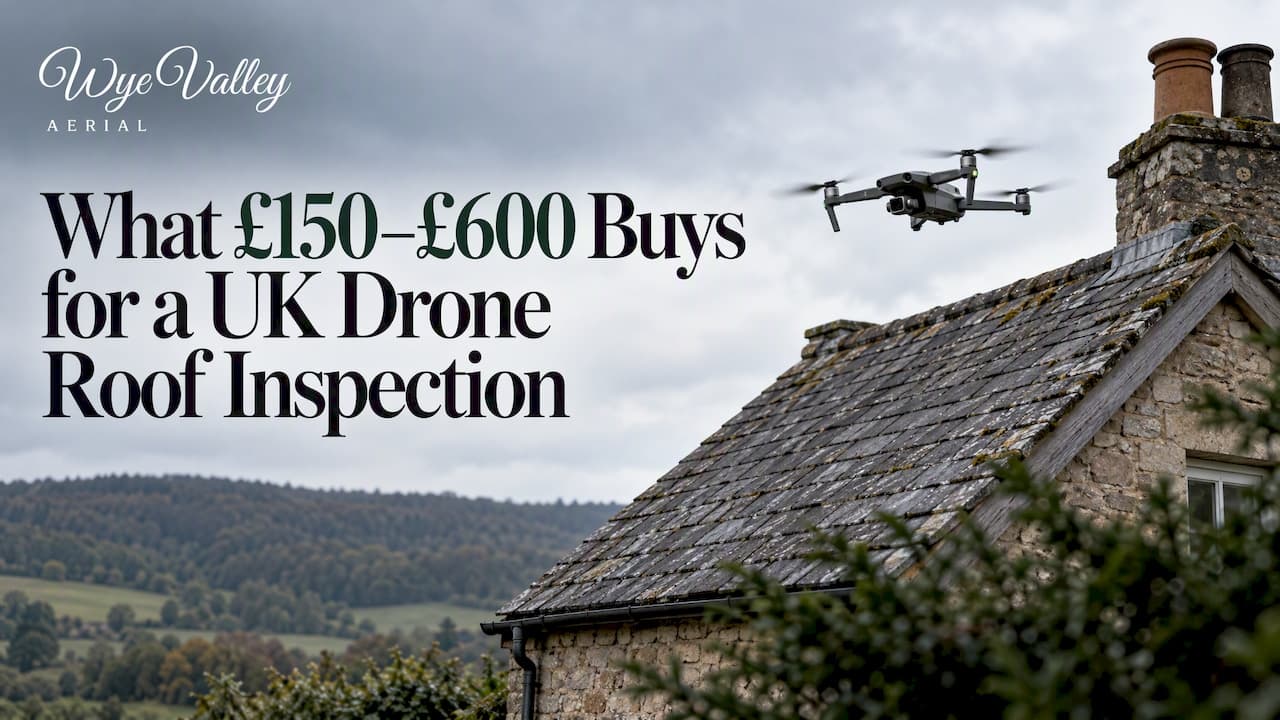
A typical UK drone roof inspection costs between £150 and £600, depending on whether you need visual photos only, a written report, or thermal imaging. A visual-only check on a standard home sits at the lower end, while UK operators commonly quote from roughly £150–£600 once a report and thermal add-ons are included. Legitimate quotes should reference CAA compliance and insurance, with capture and a basic report usually turned around within a few days.
TL;DR:
- Radiometric thermal imaging can add 40% to 80% to a visual quote, while 3D modeling or orthomosaic processing typically adds £20 to £50 per property.
- For moisture or insulation checks, require radiometric thermal data with usable temperature readings, not a visual infrared clip that only resembles a heat map.
- Before booking, verify CAA credentials and commercial insurance, and request an Operator ID plus an A2 certificate when a flight near people requires one.
- Compare itemized quotes for report inclusion, image resolution, thermal or 3D surcharges, travel, and rush fees, then confirm weather rescheduling terms before booking.
- A typical residential capture takes 15 to 30 minutes on site, while processing and report delivery usually follow within a few working days.
Table of Contents
- Typical package tiers and practical UK price ranges
- Factors that make a survey more expensive
- What each deliverable actually means
- Checklist: how to compare quotes and choose a supplier
- Payment terms and contract structures for drone inspections
- Our approach to quotes and safe, compliant inspections
- Get a free, itemised quote from Wye Valley Aerial Imaging
- FAQ
- Sources
Typical package tiers and practical UK price ranges
Most suppliers structure drone roof inspections into tiers, and understanding what each one buys helps you avoid paying for more than you need or settling for less.
- Visual-only or basic photo package: a set of high-resolution images with pinned close-ups of visible damage, no written analysis.
- Visual plus annotated written report: the same imagery with a short summary document flagging specific defects, useful for roofers or insurers.
- Thermal or radiometric package: infrared imaging layered over visual captures to show moisture ingress or insulation gaps, priced higher because of specialist sensors.
- 3D modelling or orthomosaic package: photogrammetry processed into a measurable model, useful for larger or more complex roofs.
For a single residential property, a typical drone roof inspection commonly costs in the low hundreds of pounds for visual-only work, with the written report tier adding to that baseline. Thermal surveys carry a noticeable premium: market guidance suggests radiometric payloads can add 40 to 80% to the base visual price because of the specialised equipment and the narrower weather and timing windows needed to capture reliable heat data.
Processing 3D models or orthomosaics typically adds £20 to £50 per property on top of a standard visual or report package, reflecting the extra software and labour time photogrammetry requires.

Commercial jobs, such as multi-unit blocks or larger commercial roofs, are generally quoted per building rather than per hour, and suppliers covering several structures on one site or for one managing agent often offer a lower per-property rate once travel and setup are spread across the job, benefiting from temporary staffing for construction arrangements.
Factors that make a survey more expensive
Not every quote is comparing the same job. Several concrete factors explain why one inspection costs more than another.
- Roof size and number of structures: larger roofs or multiple buildings on one site mean more flight time and often more battery swaps.
- Roof complexity: steep pitches, dormers, chimneys and restricted access points all require more deliberate flight patterns and more time in the air.
- Specialist sensors and deliverables: radiometric thermal cameras, 3D photogrammetry and orthomosaic mapping all add processing time and equipment cost.
- Airspace and permissions: sites near airports, built-up areas or with third-party access restrictions may need extra planning before a flight is lawful.
- Insurance and compliance requirements: a client asking for a certificate of insurance adds an administrative step that some operators price into the quote.
- Travel time and weather reschedules: longer journeys or a weather-delayed reshoot both affect the final price, as can a rushed turnaround request.
Pro Tip: Ask whether your quote already includes a weather reschedule at no extra cost. It is one of the quickest ways to spot a fair, well-structured price.
Roofs with multiple pitches or dense dormers need a more careful flight path to get usable close-up angles on every face, which takes longer on site than a simple single-pitch bungalow. Thermal work adds a further constraint: it usually has to happen within a specific window around dawn or dusk to capture a clear temperature differential, which limits scheduling flexibility and tends to push the price up.
What each deliverable actually means
Quotes often use terms that sound similar but buy very different things.
- Raw imagery: unedited photos or video straight off the drone, with no analysis attached.
- Annotated photo report: close-up shots with damage callouts and a short written summary, the format most useful for roofers and insurance claims.
- Measurable 3D model: a processed photogrammetry output that lets you or a contractor take real measurements off the roof surface.
- Radiometric thermal map: a true temperature-data image, distinct from a visual thermal video that only looks like heat mapping without the underlying data.
A reliable thermal survey depends on the operator supplying radiometric data rather than a visual-only infrared clip, since only the radiometric version carries usable temperature values for spotting moisture or insulation faults. Turnaround for most residential jobs follows a predictable pattern: capture on site typically takes 15 to 30 minutes for a competent pilot working to UK norms, with processing and report delivery usually following within a few working days depending on the package.
Checklist: how to compare quotes and choose a supplier
A few checks before booking will tell you whether a quote reflects a properly run operation or a shortcut.
- Confirm CAA compliance: ask for the operator's Operator ID and, for flights near people, confirmation of an A2 Certificate of Competency.
- Ask about insurance: UK operators flying commercially must hold third-party insurance, and many will provide a £1m certificate of insurance on request.
- Request a line-item quote: a clear breakdown of base capture price, thermal or 3D surcharges, travel and any rush fee makes it easy to compare suppliers fairly.
- Check deliverable formats: confirm image resolution, whether a written report is included, and whether measurements or a 3D model form part of the package.
- Prefer fixed-price quotes: a supplier who states terms for weather reschedules up front avoids surprise charges later.
Pro Tip: If a quote looks unusually cheap, check whether it includes a written report at all. A photo dump without analysis is a different product from a proper inspection package, even if both get called "drone roof inspection".
For property managers juggling several sites, our guidance on questions to ask before a building inspection covers this in more depth.
Payment terms and contract structures for drone inspections
Most UK drone inspection work runs on a simple fee-for-service model rather than a subscription or retainer. A supplier provides a fixed quote after reviewing the property, and payment is typically due on completion or shortly after the report is delivered, often by bank transfer or card.
For larger commercial jobs, such as blocks of flats or multiple buildings for one managing agent, suppliers may ask for a deposit to secure a booking date, with the balance due once the final deliverables are handed over. Repeat clients, such as roofing contractors or estate agents who commission inspections regularly, sometimes agree a standing rate for a set scope of work, which simplifies invoicing on each job.
Weather is the most common reason a job shifts, so it is worth confirming in writing whether a reschedule due to poor flying conditions carries any extra charge. A well-structured quote states this upfront rather than leaving it as a point of negotiation after a delay. Cancellation terms vary too: some operators ask for notice of a few working days to avoid a cancellation fee, particularly where travel has already been arranged. Asking these questions before signing off on a quote avoids disputes later, and a supplier confident in their process will usually have clear answers ready rather than vague reassurances.
Our approach to quotes and safe, compliant inspections
We run every roof and building check to CAA rules, with flight plans checked in advance and a qualified pilot holding an A2 Certificate of Competency at the controls. Quotes are built around the actual site: travel distance, roof complexity, weather risk and whether a certificate of insurance is needed all feed into a fixed price before we fly.
A fair quote should reflect the actual job in front of you, not a flat rate copied from a different roof.
— Rhys
Get a free, itemised quote from Wye Valley Aerial Imaging
Whether you need a straightforward roof and building check, property stills for a sale, or a tailored package with stills and a short film, we quote each job individually once we know your roof size, access and the deliverables you need.

| What you tell us | What we use it for |
|---|---|
| Roof size and number of structures | Estimating flight time and battery needs |
| Access and site restrictions | Planning a compliant, safe flight path |
| Deliverables wanted (photos, report, thermal) | Building your line-item price |
We follow applicable aviation rules and can provide insurance certification on request. Get in touch through our services page or main site for a free, no-obligation quote.
FAQ
How much for a drone survey?
A drone roof survey in the UK typically costs between £150 and £600, depending on whether you need visual photos only, an annotated report, or thermal imaging. Larger or more complex roofs, and jobs requiring a certificate of insurance, tend to sit at the higher end of that range.
Are drone roof inspections accurate?
Drone roof inspections give a close, high-resolution view of surfaces that are otherwise hard or unsafe to reach, which makes them a reliable way to spot visible damage such as missing tiles or cracked flashing. Thermal or radiometric packages add genuine temperature data for spotting moisture or insulation issues, provided the operator supplies true radiometric imaging rather than a visual-only infrared clip.
How much does it cost to get your roof checked?
Costs vary by package and roof complexity, with visual-only checks commonly priced in the low hundreds of pounds and written-report or thermal packages costing more. Larger properties, multiple buildings on one site, or rushed turnaround requests usually push the price toward the upper end of typical UK ranges.
How does a surveyor check a roof?
A traditional roof check usually involves a surveyor accessing the roof by ladder or scaffold tower to inspect tiles, flashing and guttering at close range. A drone inspection achieves a similar close-up view from the air, without the access equipment or the time needed to set it up, and can cover a full roof face in a single pass.
Sources
- A2 Certificate of Competency (A2 CofC) | UK Civil Aviation Authority
- Flying drones for work | UK Civil Aviation Authority
- Drone Roof Inspection Cost: $150-$400 vs $300-$600 Manual