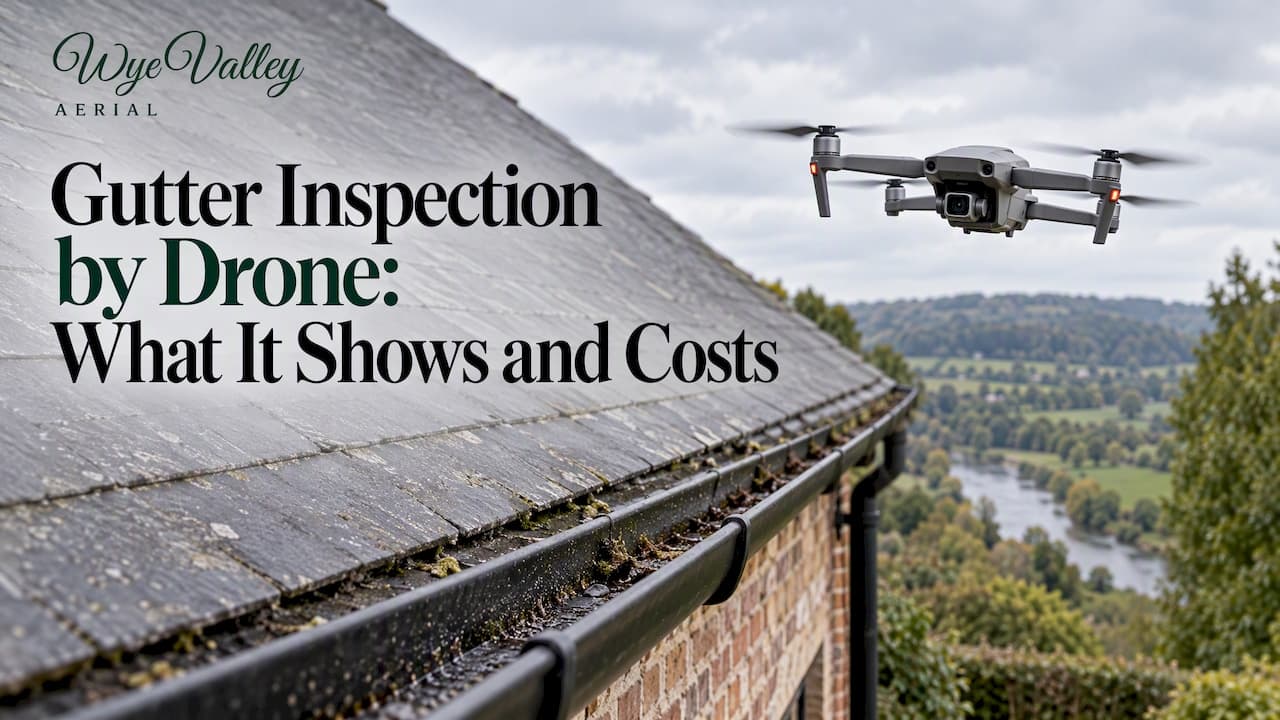
A drone gutter inspection is a flight along your roof edge that captures close, sharp photos and video of every gutter run, so you can see blockages, sagging joints, slipped brackets and plant growth from the ground. Nobody climbs a ladder. You get the images, and a cleaner or roofer gets a clear scope of work. It does not clean anything, and that distinction decides whether it is worth booking.
We are Wye Valley Aerial Imaging, and we fly roof and building checks around Monmouth, Ross-on-Wye, Chepstow, Coleford and Lydney. This guide explains what you can expect, what the rules say, and how to judge a quote.
TL;DR
- A drone inspection shows the condition of gutters, fascias and roof edges without ladders. It diagnoses; it does not clear debris.
- The HSE advises inspecting from the ground with cameras or drones where possible, because falls from height remain a serious risk.
- In the UK, the pilot needs the right CAA qualifications. Flying close to people or buildings you do not control brings extra conditions.
- Pair the inspection with a cleaner or roofer: the images tell them what to fix, so you pay for the right job only.
- Our roof and building check is quoted for free and fixed in advance, depending on the site.
Table of Contents
- What a drone sees that you cannot from the ground
- Why use a drone instead of a ladder
- A drone diagnoses, someone else clears
- What does a gutter drone inspection cost in the UK?
- The UK rules your pilot has to follow
- Our view: inspect first, then clean once
- When a gutter inspection is worth booking
- What to expect on the day
- Book a roof and building check in the Wye Valley
- FAQ
- Sources
What a drone sees that you cannot from the ground
From the garden, a gutter on a two-storey house is a thin line against the sky. You can see water streaming over the edge in a downpour, or a stain on the wall, but not the cause. A drone changes the angle. Flying at the height of the eaves, it looks along the run and into the channel.
Typical findings from a good gutter flight:
- Blockages. Leaf mulch, moss, seeds and silt, often worst near downpipe outlets and valleys.
- Plants. Sycamore saplings and grass growing in the channel are common on older properties near trees, which is most of the Wye Valley.
- Sagging runs. Water pooling in the middle of a section usually means brackets have shifted or the fall has been lost.
- Open or leaking joints. Staining below a union bracket is often the clue; the close-up confirms it.
- Damaged or missing brackets and clips.
- Nearby roof defects. Slipped tiles, cracked mortar on verges, and failing flashing show up in the same pass, which is why gutter checks and roof checks tend to merge into one visit.
- Wildlife and nests. Birds and wasps use gutters and eaves, and a camera lets you see them without disturbing them.
What it cannot do is feel for corrosion on the underside, test water flow with a hose, or tell you what is inside a closed downpipe. A drone gives you visual evidence. Where a roofer needs to touch something, the images tell them where to go.
Why use a drone instead of a ladder
The case is mostly about safety. The Health and Safety Executive's guidance for building owners and managing agents on fragile roofs says nine people die each year falling through a fragile roof or roof light, with many more seriously injured. The same document points owners toward inspecting from the ground using cameras or drones where possible, and warns that ladders are for short-duration work and must not be leaned against fragile surfaces such as fibre cement gutters.
That last point matters in this area. Outbuildings, barns and older garages across Herefordshire, Monmouthshire and the Forest of Dean often have fibre cement or old plastic guttering that will not take the load of a ladder.
For landlords and managing agents there is a second benefit: a dated set of photos. If a tenant reports damp or a contractor disputes a finding, you have evidence. Our guide to what a useful inspection report looks like lists the photo checks worth asking for.
A drone diagnoses, someone else clears
Practitioners elsewhere make the same point we do: a drone inspection confirms the need for repair, not the repair itself. Drones are strong on diagnostic precision and safety, but they do not remove debris, so the efficient route is a drone-led diagnostic that gives the cleaning contractor a precise scope.
In practice that means three steps:
- Inspect first. Fly the whole property, including the roof edges and chimney if you wish.
- Send the images to the right trade. A gutter cleaner for blockages, a roofer for slipped tiles or failed flashing, a gutter fitter for sagging runs.
- Re-fly if you need proof. A quick follow-up confirms the work was done, which is useful for landlords, insurers and buyers.
If you are weighing up whether to hire out or do jobs yourself, this piece on DIY versus professional cleaning costs is a helpful look at where hiring a specialist pays off. It covers windows rather than gutters, but the reasoning about time, equipment and safety carries over.
What does a gutter drone inspection cost in the UK?
There is no standard rate, and anyone quoting a single national figure is guessing. The price depends on the size and height of the building, how many buildings are involved, access and takeoff space, airspace or people nearby, and whether you want a written report or just the files.
For context, a typical gutter clean without any drone is a separate cost. One 2026 UK price guide puts most gutter cleaning at £60 to £180, depending on property size and height. An inspection does not replace that cost; it helps make sure it is spent in the right place.
For an Australian comparison, one New South Wales provider lists drone-assisted gutter inspections at $250 to $500, and notes that bundling inspection with cleaning can cut the total. Prices there are in Australian dollars and a different market, so treat it as a sign of how the work is structured, not as a UK benchmark.
Our own approach: we do not publish a price list because every site differs. We give a free, fixed quote before you commit, so the number you agree is the number you pay. For a deeper breakdown of how roof inspection pricing is built, see our drone roof inspection cost guide, and for the flying side, what sits behind a drone photography quote.
What pushes a quote up or down
| Factor | Effect on quote |
|---|---|
| Single small house, open garden | Usually the simplest job |
| Large detached house, outbuildings or a barn | More flight time and more images |
| Tight terraces, close neighbours, roads | More planning, sometimes extra safety measures |
| Written report with annotated images | More editing time than raw files |
| Combined with chimney or full roof check | Often better value than separate visits |
| Weather rescheduling | We reschedule flexibly for weather |
If you are comparing quotes, ask each provider the same four questions: what is delivered, how is it delivered, is the pilot qualified and insured, and is the price fixed?
The UK rules your pilot has to follow
It is reasonable to ask whether the person flying over your roof is legal. The rules are set by the Civil Aviation Authority (CAA), and they are specific.
For work near homes, the key qualification is the A2 Certificate of Competency. The CAA says that from 1 January 2026 the rules changed and its page sets out what now applies. The certificate allows flying closer to uninvolved people than the basic open category, and involves a theory test. Pilots also need an Operator ID and Flyer ID for drones over the weight thresholds; the CAA sets out the Flyer ID requirement for drones weighing 100g or more on its where-you-can-fly page.
The CAA's guidance for the Near People A2 subcategory sets a minimum horizontal distance of 30 m from uninvolved people, with the possibility of reducing it in low-speed mode for suitable drones. Pilots working near neighbours plan their flight paths with this in mind. A gutter job on a terraced street therefore takes planning: where the drone takes off, where people are likely to be, and which side of the house is flown when.
We plan every job this way. Our pilot holds the A2 CofC, flights are fully insured, and we follow CAA rules and flight plans. If you want to understand the detail, our explainer on the A2 CofC and the 30 m and 5 m distances goes through it.

Can I just buy a drone and do it myself?
You can, within the rules. Small drones are capable cameras, and for your own house in your own garden it is a reasonable thing to try. Be realistic though. You will need to register as required, keep clear of people and other properties, and learn to position the camera so the gutter interior is visible rather than just the roof tiles. Many first-time attempts produce pretty images that miss the channel entirely. Flying near neighbours or a road is where DIY becomes a legal and safety question rather than a camera one.
If you own several properties, run a holiday let, or need images for an insurer or contractor, paying a qualified operator is usually the better trade.
Our view: inspect first, then clean once
The way we see it, the best money you can spend on gutters is the money you do not waste. Too often a cleaner arrives, clears the front run, and leaves the sagging section at the back that was really causing the damp patch. Or a roofer is called out for a leak that turns out to be a blocked outlet.

We built our roof and building check around that problem. A drone flight gives a clear record of every run, outlet and edge in one visit, and the images go to whoever does the work. You do not need ladders, and nobody has to step onto a fragile roof. That matters particularly for older properties, farm buildings and holiday lets across the Wye Valley, where roofs and gutters are often awkward to reach.
We also say plainly what we can't do. We do not clean gutters, and a camera cannot replace a hands-on repair quote. What we can do is make that conversation shorter and cheaper, because the contractor arrives knowing the job. If the images show something that needs a specialist, we say so.
— Rhys
When a gutter inspection is worth booking
Book one when:
- You are selling or buying and want to know the condition of the roof edge before a survey.
- Water is overflowing, staining walls or showing damp, and you want to find the cause.
- After storms or autumn leaf fall, especially if you have overhanging trees.
- You manage rental properties, a hotel or an estate and need records for several buildings.
- The gutters are above a conservatory, porch, or fragile outbuilding where a ladder is a risk.
- You are a roofer who wants to quote accurately without climbing the roof first. See also our guide for roofers and owners on drone roof inspection.
Skip it when the gutters are plainly low, reachable from a stable ladder or a pole camera, and obviously just need clearing. In that case a cleaner will do.
What to expect on the day
- Quote. You describe the property, we agree a fixed price in advance.
- Site check. We look at takeoff space, neighbours, nearby roads and airspace, and set a flight plan.
- Weather. Rain, strong wind and poor light make for poor images and unsafe flying, so we move the date if needed.
- Flight. A short flight along each gutter run and roof edge, with close stills and video of problem areas.
- Delivery. You receive the images by download link, ready to forward to a roofer, cleaner, insurer or agent.
If you also want to look at the chimney while we are there, see our guide to chimney drone inspections. For larger sites, our questions for property teams before a building inspection are worth reading first.
Book a roof and building check in the Wye Valley
Our roof and building check covers gutters, roof edges and the surrounding structure, flown by a qualified A2 CofC pilot with full insurance. We cover Monmouth, Ross-on-Wye, Chepstow, Coleford and Lydney and the surrounding area; check the area we cover if you are unsure. Look at the services we offer and ask for a free fixed quote.
FAQ
How do I check my gutters without a ladder?
Start from the ground in rain: watch for overflow at joints and outlets, and look for stains or green marks on the wall below. For a closer look, use a drone inspection or a camera on a pole. The HSE advises ground-level methods where possible, as ladders should be limited to short tasks.
Is a drone gutter inspection worth it?
It is worth it when you do not know what is wrong, when access is awkward, or when you manage several buildings. It is less useful for a single low roof that simply needs clearing. The inspection finds the problem; the cleaner or roofer fixes it.
Can a drone clean gutters?
The inspection drones we use do not remove debris. Specialist cleaning systems exist, but our service is aerial imaging, so we pair the images with whoever does the clearing or repair.
How much does a drone gutter inspection cost?
It depends on the size and height of the building, access and what you want delivered. We give a free fixed quote before any work, so you know the price in advance.
Do drone pilots need qualifications to fly over my house?
Yes. Flying close to people and buildings requires the right CAA permissions, such as the A2 Certificate of Competency, plus registration IDs. Ask any provider to show their qualification and insurance.
Sources
- HSE: Fragile roofs guidance for building owners and managing agents
- CAA: A2 Certificate of Competency
- CAA: Where you can fly
- CAA: GM1 UAS.OPEN.030(1) Near People A2
- BG Pro: drone gutter inspection
- Fantastic Services: gutter cleaning cost guide 2026
- The Quote Yard: gutter inspection and reports NSW