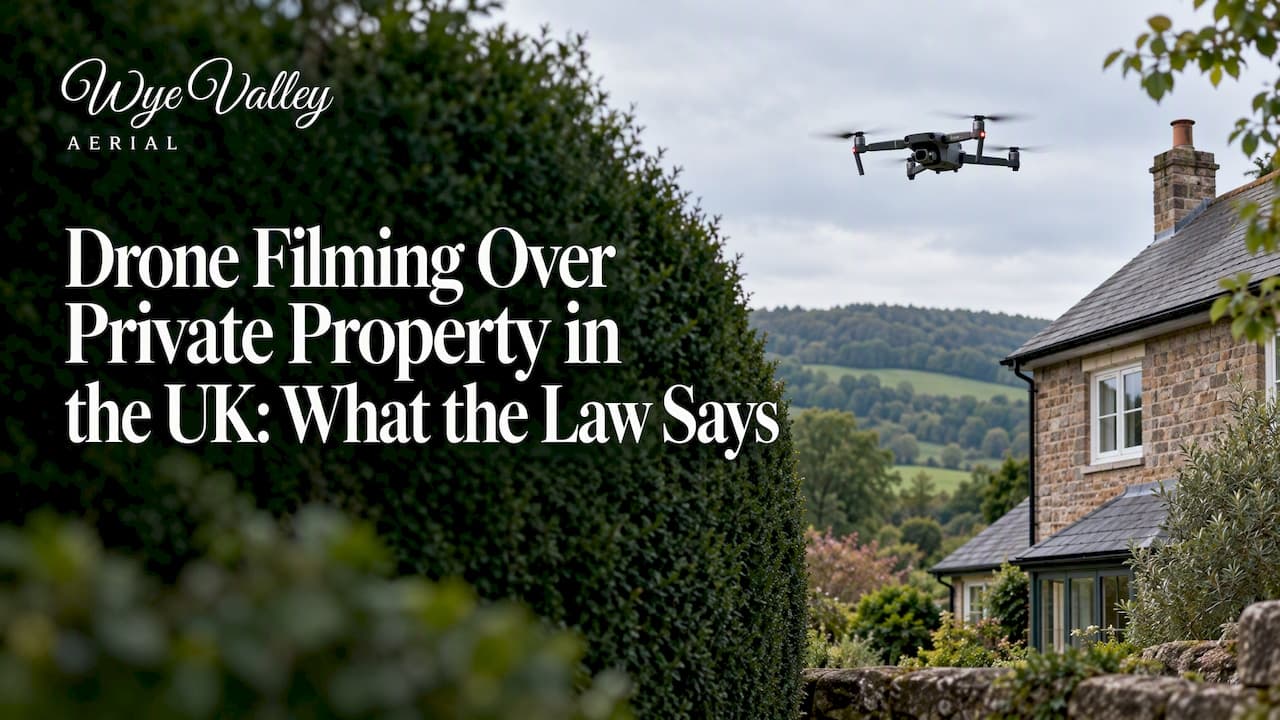
In the UK, a drone can often fly over your house or garden without breaking any law, but filming people where they expect privacy is a different matter. No single rule bans overflight of private land. Several rules apply at once: CAA flying rules, data protection law, and the landowner's say over take-off and landing. This guide is for homeowners worried about a drone overhead. It is also for anyone planning to commission aerial filming of a house, estate, hotel or wedding venue.
TL;DR
- Flying over private property is not automatically illegal in the UK. Courts have not set a firm rule on when overflight becomes trespass or nuisance, so each case turns on its facts.
- Filming is where the risk sits. Recording people in gardens or private grounds can breach UK GDPR and the Data Protection Act 2018.
- Anyone paid to take pictures or video with a drone needs third party insurance as a minimum, and must register as an operator with the CAA.
- The pilot must have the landowner's permission to take off and land, even if the flight itself is lawful.
- Worried about a drone? Call 101 for non-emergencies, 999 if there is immediate danger, and take privacy complaints to the ICO.
Table of Contents
- Can a drone fly over your house?
- Where privacy law bites
- Take-off and landing: the permission people forget
- If you are the one commissioning the footage
- What to do if a drone is bothering you
- Our view: how we keep a shoot respectful
- Commissioning aerial work in the Wye Valley
- FAQ
- Sources
Can a drone fly over your house?
Often, yes. Airspace above your roof is not yours to close off in the way your front door is. A pilot flying within the CAA's rules, at a safe height and distance, is not committing an offence simply by passing over your property.
The rules that do apply are about safety and behaviour. The CAA's Drone and Model Aircraft Code sets out what pilots may fly and where, depending on drone class and weight. The maximum height is 120 metres, a ceiling that shapes how aerial work differs from a helicopter shot. Pilots must also keep the aircraft in clear sight at all times.
The CAA's own guidance notes that people are allowed to fly small drones under 250g in most places, including towns and cities, but not over crowds. Heavier drones face more restrictions. A professional drone is usually heavier than that, so a commercial pilot works under tighter conditions than a hobbyist with a mini drone.

Trespass and nuisance: no clean answer
People often ask whether a drone overhead counts as trespass. The honest answer is that it depends. UK courts have not established a definitive rule for when overflight becomes trespass or nuisance. Cases are weighed on how often the drone came, how low it flew, and whether it hovered or captured targeted footage.
In practice, a single pass at height is very unlikely to be actionable. A drone that hovers at fence height beside your bedroom window, day after day, is a different story.
Where privacy law bites
Privacy, not airspace, is the real issue. The CAA tells pilots that if a drone has a camera, they must respect other people's privacy whenever they use it. That matters most in gardens and private grounds, where people reasonably expect not to be recorded.
Operators also have to comply with UK GDPR and the Data Protection Act 2018 when filming. Capturing identifiable people without a strong justification can breach those laws.
The Information Commissioner's Office goes further. Its guidance on unmanned aircraft systems points out that individuals are often unlikely to realise they are being recorded, and that footage may capture people who were never the focus of the shoot. Organisations flying drones are treated as controllers of any personal data they collect. For commercial pilots, that means:
- thinking through the risks before the flight, usually in a written Data Protection Impact Assessment (DPIA);
- being able to show the flight was necessary and proportionate;
- keeping a privacy notice available to the public;
- avoiding recording until the drone is high enough to limit collateral intrusion.
The BBC's own drone guidance takes a similar line: privacy infringement is context-dependent, and steps such as using zoom selectively and not recording over private gardens reduce the risk.
A quick test of whether a flight looks reasonable
| Situation | Likely to be a concern? |
|---|---|
| A drone passes over your roof at height, camera pointing ahead, not hovering | Unlikely to be a problem |
| A drone shoots a neighbouring house for a sale listing and your garden is in the background | Depends on what is visible and whether the pilot limited it |
| A drone hovers near your windows or follows you around the garden | Possible privacy and data protection issue, and possibly nuisance |
| A drone is launched from your land without your permission | The pilot needs the landowner's permission to take off and land |
This is a guide to how the rules are framed, not legal advice. If a specific situation is affecting you, speak to a solicitor or to the ICO.
Take-off and landing: the permission people forget
Even where the flight itself is lawful, the pilot must have permission from the land owner to take off and land. On public land, local bylaws or Public Space Protection Orders may ban launching and recovery. National parks and similar bodies publish their own drone rules, so a pilot working around the Wye Valley's scenic spots has to check each site.
The pilot's behaviour on the ground matters too. Launching from a busy spot can cause a nuisance, and that sort of nuisance is a common reason authorities bring in restrictions.
If you are the one commissioning the footage
Homeowners selling a property, wedding planners and hotel managers all ask for aerial footage. Your risk is not only the pilot's: you want the work done properly so it does not cause trouble with neighbours or guests.
Insurance and registration
The CAA is clear: if you fly for any commercial reason, you must have third party insurance as a minimum. Being paid to take pictures or record video counts. Any organisation responsible for a drone must also register as an operator, with a few exceptions for the lightest drones without cameras.
Ask to see the insurance certificate and the pilot's qualification before you book. Our guide to drone operator qualifications for paid jobs explains what a legitimate commercial pilot should hold, and what an A2 CofC allows in practice.
Questions worth asking any pilot
- Are you registered with the CAA, and what is your qualification?
- Can I see your insurance?
- Which neighbouring properties and gardens will appear in the frame, and how will you avoid them?
- Who owns the take-off and landing spot, and has permission been given?
- How will the footage be stored and delivered, and what happens to the unused material?
- What happens if the weather is wrong on the day?
For property sales, you can also read our note on what commercial drone photography should deliver. For hotels and estates, see the three checks before approving a flight. For weddings, the 50 metre rule is worth reading before you book.
What to do if a drone is bothering you
Start with calm facts. Note the date, time, height as best you can judge, how long it stayed and what you think it was filming. Photograph or film the drone if that is safe and easy.
Then choose the right route, following the CAA's guidance on reporting concerns:
- Dangerous or illegal flying: call the police on 101, or 999 if there is immediate danger to life, safety or property.
- Privacy and surveillance worries: raise them with the Information Commissioner's Office.
- A neighbour you know: a friendly word often settles it. Pilots flying for pleasure may simply not have thought about your garden.
Do not try to bring a drone down. It is dangerous, and you could be liable for the damage or for injuring someone.
If your concern is about your own home's security, a drone is only one of the ways you can be watched or protect yourself. A guide to choosing between NVR and DVR CCTV systems helps if you are weighing up cameras on your own property, though your own cameras then carry data protection duties of their own.
Our view: how we keep a shoot respectful
We run aerial photography in the Wye Valley, so we think about this every time we plan a job. Our pilot holds an A2 CofC, the flights are fully insured, and we follow the CAA rules and flight plans strictly. Those are the basics, not a selling point.
The harder part is the judgement. A house sale shot should show the house, its plot and the setting. It should not show the neighbours' patio. So we agree the shot list with you in advance, choose the take-off point with the landowner's say-so, and start recording once the drone is where it needs to be. If the weather or the light is wrong, we reschedule rather than push on.
Our advice to homeowners is simple. Tell your neighbours before a shoot. A quick note costs nothing and removes most of the suspicion. Our advice to anyone hiring a pilot is to expect them to talk about privacy without being asked. If they cannot explain what the camera will and will not capture, keep looking.
— Rhys
Commissioning aerial work in the Wye Valley
We cover Monmouth, Ross-on-Wye, Chepstow, Coleford and Lydney. Our work includes property stills, stills with a short film, half-day and full-day shoots, and roof and building checks, all quoted individually and free of charge. You get a fixed quote in advance and fully edited stills or films by download link. See the services page for what each option includes, or get in touch through our site to talk through a property or venue.
If you are comparing costs first, our note on what sits behind a drone photography quote is a fair guide. Roof work has its own considerations, covered in what property teams should ask before a drone building inspection.
FAQ
Is it legal for my neighbour to fly a drone over my house in the UK?
Often it is, provided they follow CAA rules on height, distance and keeping the drone in sight. The law gets stricter if the drone has a camera and captures people or private areas. Privacy and data protection law, and potentially nuisance, can then apply.
Can a drone film me in my own garden?
It can be a breach of privacy and data protection law if it records identifiable people where they expect privacy, without justification. The CAA expects pilots to respect privacy whenever a camera is in use. If it keeps happening, report it to the ICO, and to the police on 101 if you suspect harassment or illegal flying.
Do commercial drone pilots need permission to film my property?
They need the landowner's permission to take off and land. Filming your house for someone else is a data protection and privacy question rather than a simple yes or no. A responsible pilot limits what is captured and avoids recording your garden where possible.
Does a drone pilot need insurance in the UK?
If they fly for any commercial reason, including being paid to take pictures or video, yes. The CAA requires third party insurance as a minimum. Ask to see the certificate before you book.
Sources
- CAA: Protecting people's privacy (points 21 to 26)
- CAA: Concerns about privacy and illegal use of drones
- CAA: Insurance requirements
- CAA: Flying drones for work
- CAA: The Drone and Model Aircraft Code
- ICO: Unmanned Aerial Systems (UAS) / Drones
- Peak District National Park: Drones FAQs
- BBC Editorial Guidelines: Drones