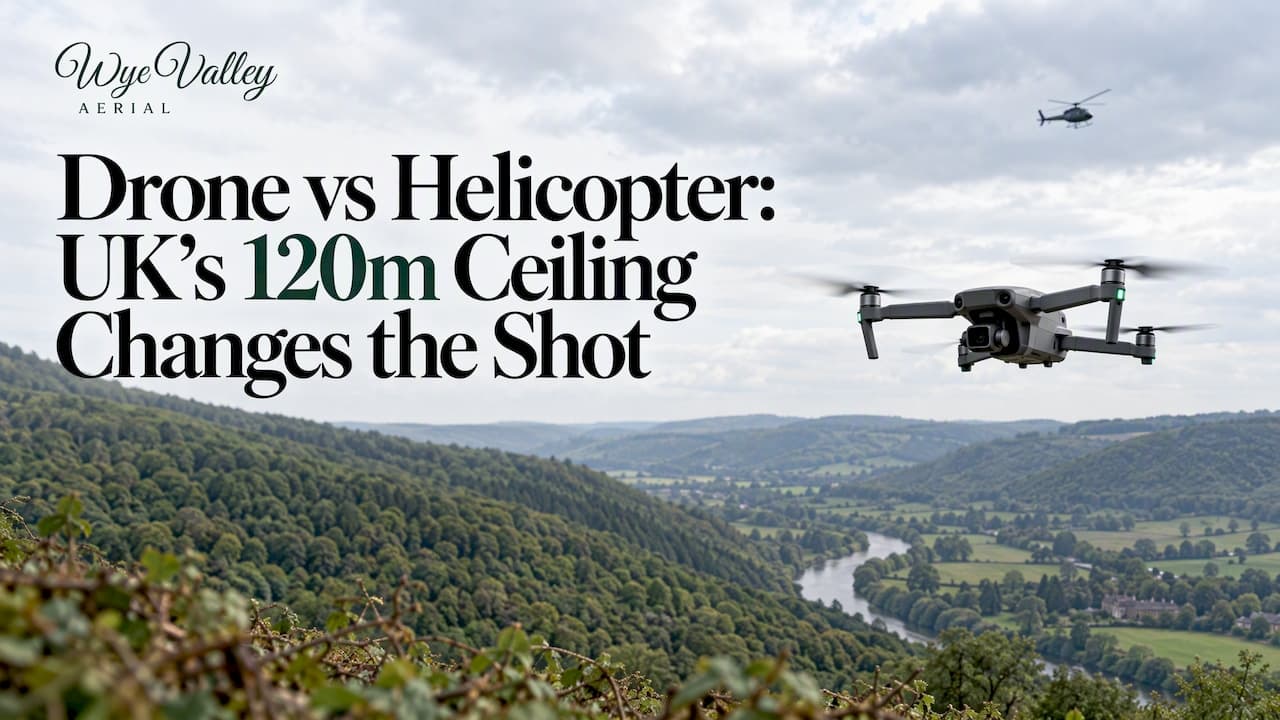
For short property shoots and building inspections, a drone is usually the practical, lower cost choice; for long range or high altitude cinematic sweeps, a helicopter remains the better tool. The decision turns on three things: project scale, the image quality and perspective you need, and the regulatory limits that govern where and how a drone can fly. Operating under an A2 Certificate of Competency shapes much of this advice.
TL;DR:
- Drones fly 20 to 40 minutes per battery; helicopters can stay airborne for two hours or more, while Open category flights stay below 120 meters.
- For roof checks and property details, a drone’s gimbal and small takeoff footprint suit close work; helicopters carry heavier cameras and cover distant terrain.
- With an A2 Certificate of Competency, pilots may fly closer than 50 meters from uninvolved people in low speed mode, subject to airspace rules.
- Before requesting a quote, prepare the shot list and site access details, and ask for pilot time, site survey, and editing to be itemized.
Table of Contents
- Design and flight mechanics: rotor vs multirotor control
- Performance: endurance, speed, altitude and payload trade-offs
- Cost and operating economics: buy, hire and project pricing
- Suitability for aerial photography and cinematography
- UK safety rules that shape what a drone can actually do
- Practical flying experience: licensing, crew and logistics
- Can drones replace helicopters? Use-case verdicts
- What years of drone bookings teach you about choosing the right platform
- Book a drone shoot or inspection with us
- FAQ
- Sources
Design and flight mechanics: rotor vs multirotor control
A helicopter generates lift from a single large rotor disc, with a tail rotor countering torque and a pilot managing pitch, cyclic and collective controls by hand. A drone instead uses multiple fixed-pitch rotors, with a flight controller reading data from an inertial measurement unit (IMU) and gyros dozens of times a second to keep the airframe level. That difference in architecture explains why one platform feels like flying and the other feels like programming a stable camera position.
The practical implications show up in how each platform fails and how precisely it can be placed:
- A multirotor drone has built-in redundancy across several motors, so losing one rotor is often survivable; a helicopter losing its single main rotor has far fewer options.
- Flight controllers let a drone hold a GPS position automatically, which suits slow, repeatable inspection passes.
- A helicopter pilot's manual control allows continuous, flowing camera moves over long distances that autonomous hover modes cannot easily replicate.
For a static property shot or a roof survey, the drone's autonomous stability wins. For a sweeping cinematic reveal across a valley, a helicopter's manual control still has the edge.
Performance: endurance, speed, altitude and payload trade-offs
Consumer and professional drones typically fly for 20 to 40 minutes per battery before needing a swap, while a helicopter can stay airborne for two hours or more on a single tank. That endurance gap is the single biggest practical constraint on drone jobs: longer shoots mean more battery changes, more landings and more planning around downtime.
- Cruise speed for most photography drones sits well below helicopter cruise speeds, which matters for covering large estates or long stretches of coastline in one pass.
- Wind affects a lightweight drone far more than a helicopter, often grounding smaller aircraft in conditions a helicopter handles without issue.
- Payload capacity on a photography drone is built around a gimbal and a single camera body, whereas a helicopter can carry heavier cinema rigs, multiple crew and backup equipment.
In the UK, drone flights in the Open category are generally expected to stay below 120 metres (400 feet), a limit set out in the Drone Code, which caps the altitude a drone can offer compared with a helicopter operating well above that ceiling. For most property and inspection work that ceiling is plenty; for wide landscape or skyline shots it becomes a real constraint.
Cost and operating economics: buy, hire and project pricing

A capable photography drone typically costs somewhere between a few hundred pounds for a consumer model and several thousand for a professional platform with a broadcast-grade camera and gimbal. Helicopter day rates work on a different scale entirely, built around pilot licensing, fuel, insurance and aircraft maintenance that a drone operation simply does not carry.
Costs that commonly appear on an aerial photography quote include:
- Pilot time and flight planning, including any site survey needed before the shoot.
- Insurance and, where relevant, CAA authorisation for the airspace involved.
- Equipment maintenance, travel to site and post-production editing time.
Our guide to drone photography prices breaks these components down further, and a roof inspection typically costs between £200 and £500 depending on the property's size and access. Deciding between a single helicopter charter and several drone sorties usually comes down to whether the brief needs one continuous long-range pass or a series of close, detailed shots gathered over a morning.
Suitability for aerial photography and cinematography
The platform you choose should follow from the shot list, not the other way round. A drone's gimbal keeps a camera stable during slow, precise manoeuvres close to a building or roofline, which is exactly what property and inspection photography needs. A helicopter's strength is covering ground: altitude, speed and the ability to carry a heavier camera package over long distances.
- Stability and payload: drone gimbals suit lightweight mirrorless or action cameras; helicopters carry cinema cameras and lenses a drone cannot lift.
- Perspective: drones excel at low, close, intimate angles; helicopters deliver the wide, elevated establishing shots used in landscape and tourism films.
- Access: drones need only a small clear take-off area and must stay within visual line of sight (VLOS), making them practical on tight residential sites where a helicopter has nowhere to land.
- Shot variety: a drone can reposition quickly between close detail shots and a wider hover, while a helicopter is better suited to one continuous move planned in advance.
For weddings and venue marketing, our note on the wedding drone video 50 metre rule covers the practical distance limits that shape how close a drone can get to guests during a ceremony.
UK safety rules that shape what a drone can actually do
Drone flights in the UK Open category fall into three sub-categories, A1, A2 and A3, each with its own separation rules from people and property. Standard separation from uninvolved people is 50 metres, but the Drone Code overview explains that pilots holding an A2 Certificate of Competency can fly at reduced distances in low-speed mode under the Near People (A2) sub-category. That certificate remains valid for several years before it needs renewing.
- The Drone Code's Open category also guides the 120 metre height limit referenced earlier, which applies across A1, A2 and A3 flights.
- CAP 722 guidance sets out detect-and-avoid responsibilities, which matter most near helipads and low-level manned traffic such as air ambulances.
- Flying above 120 metres, or in certain controlled airspace, can require a NOTAM or specific CAA authorisation, a step helicopters do not need because they already operate under a different licensing regime entirely.
These rules are the main reason a drone cannot simply substitute for a helicopter on every job: the law, not the hardware, often sets the ceiling.
Practical flying experience: licensing, crew and logistics
Every UK drone pilot needs a Flyer ID, and anyone operating close to people commercially will usually hold an A2 CofC, a qualification earned through theory training and an online test rather than years of flight hours. Helicopter pilots, by contrast, hold a full civil aviation licence requiring extensive flight training, medical checks and recurrent testing.
- A drone inspection or property shoot is often run by a single qualified pilot.
- Cinematic helicopter work typically needs a pilot plus a separate aerial camera operator, and sometimes a ground spotter.
- A site survey before the flight date is standard practice, checking access, obstacles and airspace restrictions.
Pro Tip: Ask any quote to break out pilot time, site survey and editing separately, so you can see exactly what you are paying for.
Can drones replace helicopters? Use-case verdicts
- Property inspection and roof checks: drones suit this well, close-range detail and low cost outweigh any need for altitude or speed.
- Wedding and venue marketing shoots: drones handle most briefs, though very large estates may still benefit from a helicopter's reach.
- Offshore or long-range survey: helicopters generally remain necessary, given drone endurance and VLOS limits.
- Emergency services work: helicopters retain the advantage, needing speed, altitude and payload a drone cannot match.
The deciding factors are always the same: range, endurance, payload and how close the airspace rules let you fly.
What years of drone bookings teach you about choosing the right platform
Running jobs under an A2 CofC across inspections, weddings and marketing shoots shows the same pattern repeatedly: a drone covers the vast majority of residential and commercial briefs cleanly and affordably. One roof inspection avoided the need for scaffolding entirely; one wedding shoot needed careful planning around the 50 metre guest distance rather than a bigger aircraft. Clients get the best results by having their shot list and site access details ready before requesting a quote.
— Rhys
Book a drone shoot or inspection with us
We run property stills, stills with a short film, half day and full day shoots, and roof and building checks, all flown under A2 CofC with full insurance and a CAA-compliant flight plan for every job. Getting a free quote just means telling us the site, the shots you need and your preferred dates, and we will confirm availability and reschedule around weather.

Have a look at our full service list to see which package fits your brief, or get in touch through our Wye Valley Aerial page to start a quote.
FAQ
Which is better, a drone or a helicopter?
Neither is better outright, it depends on the job. Drones suit close, detailed, lower-cost work such as property stills and roof inspections, while helicopters suit long-range, high-altitude or high-speed missions a drone's endurance and height limits cannot reach.
Can a drone damage a helicopter?
A collision between a drone and a helicopter could cause serious damage to both aircraft, which is why CAP 722 requires drone operators to consider detect-and-avoid risk near helipads and low-level manned traffic. Staying well clear of helicopter routes and following the published height guidance is the main safeguard.
Can drones replace helicopters?
Drones can replace helicopters for many shorter, close-range jobs such as inspections and property or event photography. They generally cannot replace helicopters for long-range, high-altitude or high-speed missions where endurance, payload or airspace access matter more than cost.
Are drones technically helicopters?
No, drones are multirotor aircraft controlled by a flight controller and multiple rotors, while a helicopter relies on a single main rotor and a pilot's manual control inputs. The two share the ability to hover but differ completely in design, licensing and regulation.