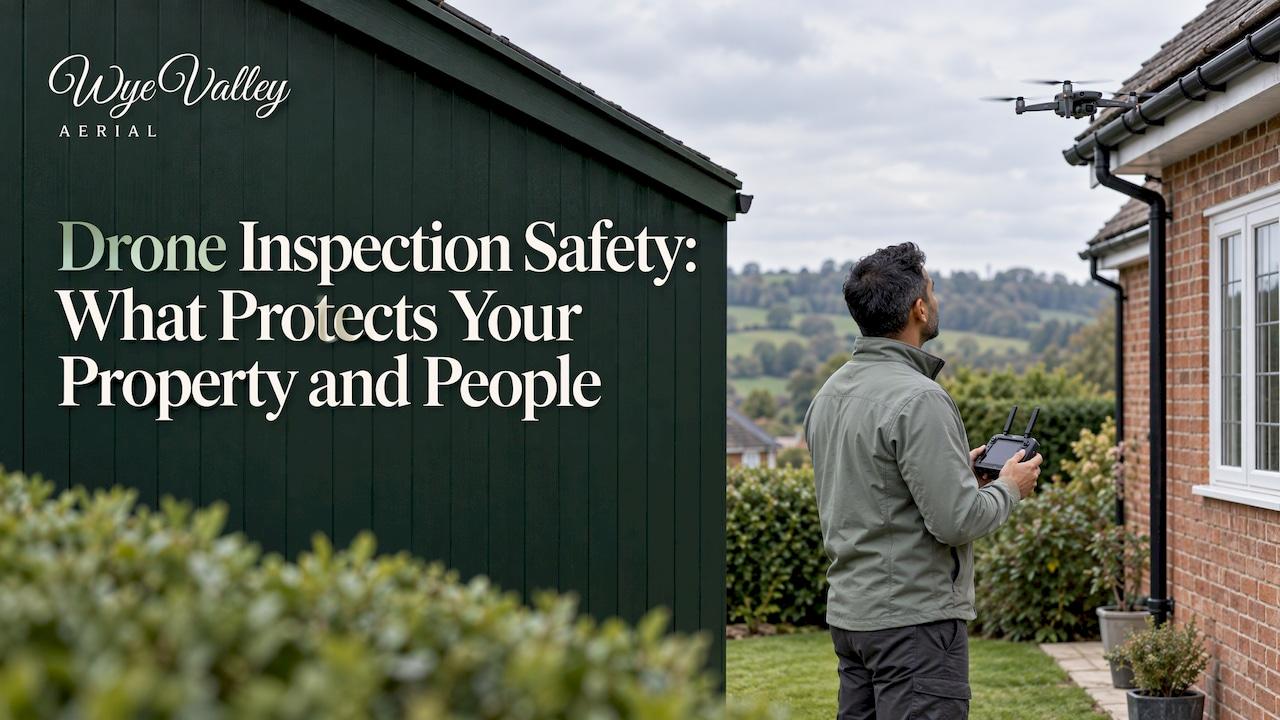
A drone inspection is safer than a ladder or a roof walk because nobody has to climb, and the risk that remains sits with the pilot's qualifications, insurance, pre-flight checks and respect for people nearby. Get those right and you have a roof, chimney or building checked from the air with no one working at height. Get them wrong and the risk simply moves from your roof to the air around it. This guide shows you what a safe flight looks like in the UK, so you can judge it whether you are selling a house, running an estate, planning a wedding or quoting a roof.
TL;DR
- A drone takes the person off the ladder or roof, which removes the main fall risk from a visual check.
- UK paid work needs a pilot who follows CAA rules and carries third-party liability insurance.
- A safe flight depends on pre-flight checks, weather limits, distance from people and a plan for when things go wrong.
- Privacy is part of safety: tell people before recording and store footage securely.
- Ask for a quote that names the pilot's qualification, insurance and what you will receive.
Table of Contents
- Why a drone makes inspection safer
- Who is protected, and from what
- What the law asks of a paid drone pilot
- The pre-flight checks that keep a flight safe
- Weather: the reason for flexible dates
- Airspace and where not to fly
- When something goes wrong in the air
- Privacy is part of safe inspection
- Safety checklist before you book
- How the risk looks for each reader
- What you should get after the flight
- Our view on drone inspection safety
- Book a safe aerial survey in the Wye Valley
- FAQ
- Sources
Why a drone makes inspection safer
The traditional way to look at a roof is to put a ladder against the wall, erect scaffolding or send someone up on the slates. Each of those puts a person at height. A drone replaces that climb with a camera in the air, flown from the ground, so the person who would have been on the roof stays on the grass.
There is a second benefit that homeowners and managers notice quickly. A drone visit can be done with little disruption to occupants, with no scaffolding standing around the building for weeks and no one needing to get into awkward spots. That matters for a hotel with guests, an estate with events booked, or a house with a sale under way.
Safety bodies in the UK recognise the shift. IOSH Magazine's 2024 piece on drone data reports that drones can reduce work-at-height exposure, which is the heart of the case for using one on a roof, chimney or gutter line.
What a drone looks at is the visible condition of the surface: slipped or missing tiles, cracked pointing, flashing that has lifted, moss, blocked gutters, a chimney stack that looks tired. If you want to see what that looks like on a typical job, our guide to drone roof inspections for property owners walks through it.

Who is protected, and from what
Safety on a drone job has four parts. It helps to think of them as four groups of people.
The person who would have climbed. This is the roofer, surveyor or handyman. With a drone, they look at stills and video from the ground and plan the repair before anyone goes up. For roofers, that means arriving at the job knowing which section needs attention, with photographs to quote from.
You and the occupants. Guests, family, staff or wedding guests should not be put at risk by a drone overhead. This is why distance rules and flight planning exist.
Neighbours and passers-by. A drone over a Monmouth terrace or a Chepstow cul-de-sac passes close to people who never agreed to be filmed or flown over. Their safety and privacy both count.
Your property and the aircraft. A drone that loses control can damage a roof, a car or a window. The pilot's checks exist to stop that.
What the law asks of a paid drone pilot
If someone is paid to photograph, film or survey, the job is commercial. The CAA's Drone Code is plain that paid photography, video, surveys or other work use requires third-party liability insurance. Third-party liability insurance pays out if the drone damages someone else's property or injures someone. If you are the client, it is your protection too, because an accident on your land is far easier to resolve when the pilot is insured.
The rules on distance also apply. In the Open Category rules the Drone Code describes, pilots must keep a 50-metre horizontal separation from people, including people inside buildings and vehicles, and must stay at least 150 metres from residential, recreational, commercial and industrial areas, with a separate 50-metre rule for an isolated building at least 50 metres from other buildings.
Roof inspection and building photography in built-up areas often need a different permission. The CAA's PDRA01 overview lists roof inspections and building photography among the activities that may use that Specific Category authorisation in residential, commercial, industrial and recreational areas. Under PDRA01 the pilot must stay at least 50 metres from uninvolved people, with take-off and landing allowed to come down to 30 metres, and any overflight minimised.
You do not need to memorise any of this. You do need to know that these rules exist, and that a pilot who talks about them comfortably is one who has read them. Our guide to UK drone operator qualifications for paid roof jobs explains the qualification side in more detail.

The pre-flight checks that keep a flight safe
Most drone accidents are decided before take-off. The CAA's guidance on making every flight safe lists what a responsible pilot does first, and it reads like a pilot's checklist you can ask about:
- Read the manufacturer's instructions for the aircraft.
- Check battery levels, including the battery in the controller.
- Keep the firmware up to date.
- Know how to set return-to-home, the function that brings the drone back if the signal drops.
- Allow extra power for emergencies or difficult weather.
These points come from the CAA's flight-safety guidance. A pilot who does them every time is protecting your roof as much as the aircraft.
The CAA's airspace guidance adds a wider habit: anticipate loss of control, fly cautiously, check the aircraft's condition, consider environmental hazards, use risk-reducing safety features and, where practicable, use a lighter aircraft. You will find that in the CAA's UK airspace operations guidance. Lighter aircraft matter on a domestic job, because a lighter drone carries less energy if something goes wrong.
Weather: the reason for flexible dates
The Wye Valley gets wind funnelled along the river, low cloud on the Forest of Dean side and rain that arrives quickly. The CAA says not to fly when wind, rain, snow, cold, fog or sun glare could compromise control, the operation of the aircraft or visual contact with it.
That has a practical meaning for you. A pilot who will fly in any conditions to keep a booking is a pilot you should worry about. A pilot who reschedules is looking after the aircraft, your property and the people nearby. Our own approach includes flexible rescheduling for weather, so a wedding date, a listing deadline or a roof survey is never flown in conditions that make it unsafe.
For a wedding planner the lesson is to build a little slack into the day. Agree with the pilot which parts of the day need aerial shots and in which order, so that if the wind is up at the ceremony, a calmer window later can still produce the venue shots.
Airspace and where not to fly
One check that applies to every flight is whether the site is near an airport or airfield. The Drone Code says pilots must not fly in a Flight Restriction Zone around an airport, airfield or spaceport without permission, and must avoid endangering aircraft even where no such zone applies. The pilot checks this before travelling to the job, not on arrival.
The Drone and Model Aircraft Code, updated in March 2026, sets the current baseline and advises pilots to stay within visual line of sight and follow the distance and airspace restrictions that apply. If you are booking, it is reasonable to expect the pilot to tell you that this check has been done.
When something goes wrong in the air
A safe operator has a plan for the unexpected. The CAA advises that if people or animals enter the area, or a low-flying aircraft that may be affected appears, the pilot should land or reduce height and wait. If it looks as though a crewed aircraft is attempting to land, the drone comes down immediately.
On a property job that might mean a child wandering into the garden, a dog off the lead or a neighbour stepping out. The pilot pauses. You do not need to apologise for it or push for the shot.
The same guidance says serious incidents or near misses that did, or could have, endangered people, property, buildings or equipment must be reported to the CAA. A professional operator treats that as a normal part of the job.
Privacy is part of safe inspection
People forget that a drone captures more than the roof. A camera pointing at a chimney may also see a neighbour's garden or a bedroom window. The CAA's privacy guidance says a camera drone must respect privacy, and recording where people expect privacy, such as inside a home or garden, is likely to breach data-protection law. Where footage is used commercially there are further requirements on whoever controls the data.
The March 2026 Code also says to tell people before recording where practical, to avoid sharing footage that is harmful or unfair, and to store images securely and delete what is not needed. Identifiable photographs or recordings may be covered by GDPR, the UK's data-protection law.
For you that means three habits:
- Tell neighbours before the drone goes up, especially in terraces and close-built streets.
- Agree which images you will keep and which will be deleted once the job is done.
- Share the footage only with people who need it: your roofer, your insurer, your agent.
If you are wondering about the rights of a neighbour who flies over your house, the CAA's airspace guidance points to Article 241 of the Air Navigation Order 2016, which prohibits recklessly or negligently causing or permitting an aircraft to endanger any person or property. Our guide to drone filming over private property in the UK goes into this in plain terms.
Safety checklist before you book
Whatever the job, these questions give you a quick read on how safely a pilot works.
| Question | What a good answer looks like |
|---|---|
| Who is flying? | A named, qualified pilot, with their CAA qualification stated |
| Is the flight insured? | Yes, with third-party liability cover for paid work |
| What if the weather turns? | The flight is rescheduled, not forced |
| Is the site near an airfield? | The pilot has checked airspace before the visit |
| Who will be nearby? | A plan for guests, neighbours and passers-by |
| What happens to the footage? | Stored securely, shared with named people, deleted when not needed |
| What do I receive? | Edited stills or film, delivered by download link |
If a quote does not answer these, ask. You are entitled to a clear picture of how the flight will be run.
How the risk looks for each reader
Homeowners and sellers. Your priority is getting aerial photographs without a stranger on the roof and without upsetting neighbours. A single visit can give both listing images and a record of the roof's visible condition. See our guide on commercial drone photography deliverables and UK rules for what to put in the brief.
Wedding planners. The risk is people. Guests are close, and the drone must keep its distance from them. Plan shots of the venue, grounds and arrival before guests gather, and keep any flight over people out of the plan.
Hotel and estate managers. You have guests, staff and often public footpaths. Book flights for quiet hours, tell staff, and agree a clear area for take-off and landing.
Roofers. The drone saves the climb before the quote. Photographs of the roof, chimney and gutters let you see the fault, price the job and arrive with the right materials. Our pages on chimney drone inspections and gutter inspection by drone show what the images capture.
What you should get after the flight
Safe inspection ends with usable evidence. Good images are sharp, cover every slope and edge, show close detail of anything that looks wrong, and are labelled so the roofer or insurer knows where each one was taken. Our guide to five photo checks for drone inspection reports gives you a way to judge them. If you are planning the budget, the pages on drone inspection costs in the UK and what a drone roof inspection costs set out what typically goes into a quote.
Our view on drone inspection safety
Most people ask us first whether a drone is accurate. The better question is whether the flight was safe for everyone below it.
We fly as a qualified pilot with A2 CofC certification and full insurance, and we follow CAA rules and our flight plan on every job. When the weather is wrong we reschedule, because a good shot is never worth a risk to people or property.
The result is a roof, chimney or building seen in detail without a ladder, and a set of stills or a short film you can use for a sale, a repair quote or a promotion. We shape each shoot around the site and give a free fixed quote in advance, so you know the job before it begins.
Rhys
Book a safe aerial survey in the Wye Valley
We cover Monmouth, Ross-on-Wye, Chepstow, Coleford, Lydney and the surrounding Wye Valley. Our services include property stills, stills with a short film, a half day or full day on site, and a roof and building check, all flown by a qualified pilot with A2 CofC certification and full insurance. Shots are planned to your brief and delivered as fully edited stills or films through a download link. Free fixed quotes come in advance. See the services we offer or get in touch through our site.

If you are comparing providers on checks, our guide on what UK property teams must ask before a drone building inspection is a good companion.
FAQ
Is a drone roof inspection safer than using a ladder?
Yes, for a visual check. The pilot flies from the ground, so no one climbs onto the roof or leans a ladder against the eaves. The IOSH Magazine article on drone data reports that drones can reduce work-at-height exposure.
What should a drone pilot check before flying?
The CAA lists reading the manufacturer's instructions, checking the aircraft and controller batteries, keeping firmware updated and knowing how to set return-to-home. They also check weather and whether the site lies in an airport Flight Restriction Zone. A pilot should be able to tell you these checks have been done.
Does a drone inspector need insurance?
Yes, for paid work. The CAA's Drone Code says paid photography, video, surveys or other work use requires third-party liability insurance. Our flights are fully insured, and the quote states who is flying.
Can a drone film my garden or my neighbours?
A camera drone must respect privacy. The CAA says recording where people expect privacy, including inside a home or garden, is likely to breach data-protection law. Telling neighbours beforehand and deleting footage you do not need keeps a job on the right side of the guidance.
What happens if the weather is bad on the day?
The flight is rescheduled. The CAA's guidance says not to fly when wind, rain, snow, fog, cold or sun glare could compromise control or visibility, and we offer flexible rescheduling for weather.
Sources
- What to do with drone data, IOSH Magazine
- Making every flight safe (points 10 to 20), UK Civil Aviation Authority
- Where you can fly (points 3 to 9), UK Civil Aviation Authority
- PDRA01 overview, UK Civil Aviation Authority
- Protecting people's privacy (points 21 to 26), UK Civil Aviation Authority
- Unmanned Aircraft System Operations in UK Airspace, UK Civil Aviation Authority
- The Drone and Model Aircraft Code, March 2026, UK Civil Aviation Authority