
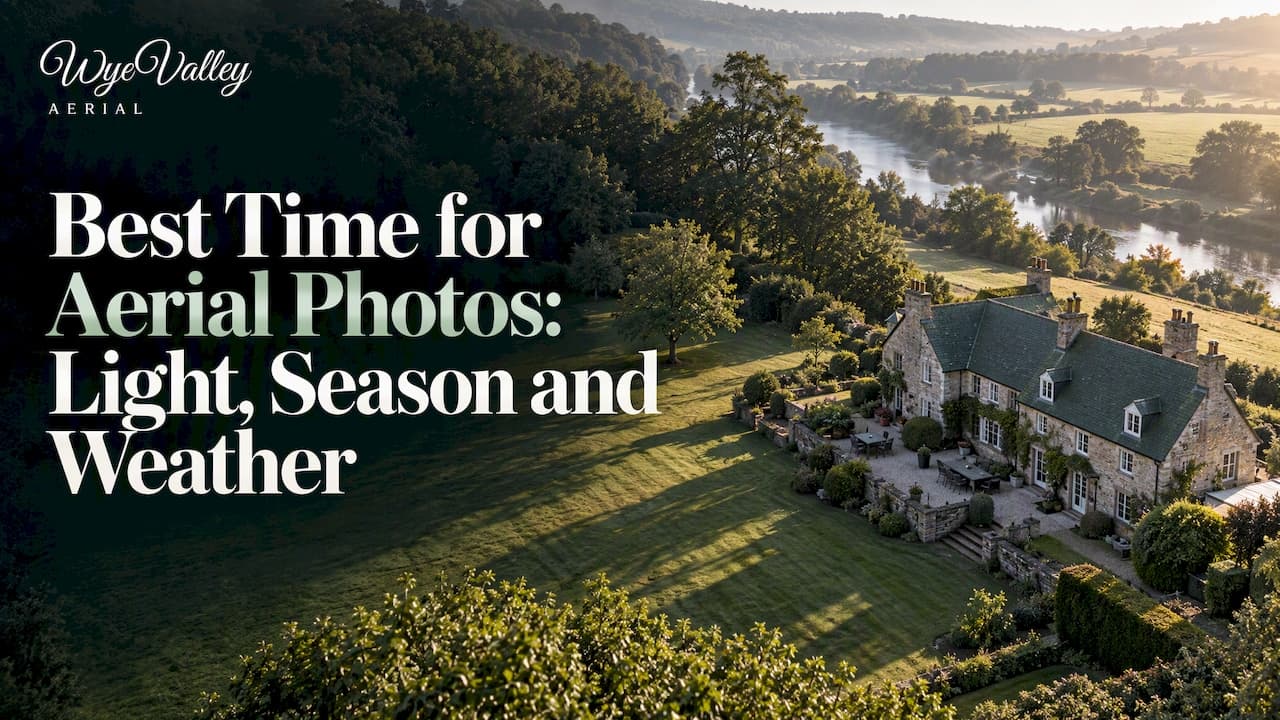
The best time for aerial photos is usually the first hour or two after sunrise, or the hour before sunset, on a day with light wind and clear air. Low sun gives soft, warm light and shadows that show depth. Calm morning air keeps the footage steady. Your property's orientation, the season and the forecast then decide which day is best.
This guide is for people who are paying for aerial work: sellers, estate and hotel managers, wedding planners and anyone commissioning a shoot in the Wye Valley and the Forest of Dean. It explains what to ask for and when, and why a good pilot will sometimes move your date.
TL;DR
- Book for the golden hour or the two hours after sunrise. Midday is rarely the best choice, but it suits some jobs, such as top-down shots of fields or patterns.
- Work out which way your house, venue or site faces. East-facing subjects suit the morning, west-facing ones suit the late afternoon.
- Winter is underrated. The sun stays low all day, so good light lasts far longer than in summer.
- Wind, haze and rain matter as much as the sun. Choose a pilot who will reschedule rather than fly in poor conditions.
- Roof and building checks are a different job: they need even light and dry roofs, not drama.
Table of Contents
- Time of day: why low sun wins
- Match the time to the way your property faces
- Best season for aerial photography and filming
- Weather: the part you cannot book
- Timing by job: homes, weddings, hotels and roofs
- Our view: wait for the right day
- Privacy and permission, whatever the time
- A simple checklist for booking
- Booking aerial work in the Wye Valley
- FAQ
- Sources
Time of day: why low sun wins
Aerial photography flattens the world. From above, a house, a field or a hotel garden loses the cues your eye normally uses to read depth. Shadows put them back.
Golden hour is the period when the sun sits less than about 6° above the horizon. Drone Companion describes the best light as arriving roughly 30 to 45 minutes after sunrise and before sunset, with warm, soft light and long shadows that define texture in a landscape. Aerotimelapse gives a slightly wider window of 20 to 60 minutes either side. In practice it varies with the day, so the exact minutes matter less than being on site with the sun low.

Local times in Monmouth
Sun times shift quickly in autumn. Metcheck's Monmouth table lists sunrise at 07:11 and sunset at 18:52 on 1 October 2026, with the morning golden hour around 07:56 and the evening one around 18:07. A month later the evening window is much earlier, once the clocks have gone back. Check the table for your own shoot date. A pilot planning a sunset shot for a late-autumn wedding or hotel launch needs to be on site well before the light you want.
The case for early morning
Golden hour is not the only reason to fly early. Drone Companion notes that the two hours after sunrise bring calmer air and less convective thermal activity. Thermals cause the shimmer and micro-jitter that can spoil footage. Cool, stable temperatures also make battery performance more predictable.
For you, that means sharper stills and smoother video. For a film that moves along a river bend or across an estate, early morning is often the safest bet.
When midday is the right call
High sun has a bad name, but it has uses. Sonuby points out that overhead sun suits top-down shots of patterns and fields, and shows clear detail in shallow water, because it cuts distracting shadows and lifts colour. If you want a plan-view image of a car park, a walled garden layout or a field boundary, midday can work well.
Match the time to the way your property faces
This is the point most people miss, and it is the one that most changes a result for a house sale or a venue brochure.
Photography Tips advises that east-facing subjects are generally best shot in the morning, so the front is not in dark shadow, while west-facing subjects benefit from late-afternoon light. Professionals use this to plan a flight before they arrive.
| What you are shooting | Best window | Why |
|---|---|---|
| House or hotel with a front facing east | Morning, after sunrise | The main elevation catches the light |
| House or venue facing west | Late afternoon, before sunset | Warm light falls on the front |
| Country house with gardens and a long drive | Early or late, low sun | Shadows show the layout and trees |
| Fields, plots, boundaries, patterns | Midday, high sun | Few shadows, clean plan view |
| River or coastline with shallow water | Midday | Clear view of the bed |
| Wedding venue | Whatever matches the ceremony and the guests' timetable | See the wedding section below |
| Roof or building check | Bright but even light, dry roof | Clear detail without glare or deep shadow |
Tell your pilot which way the front faces when you ask for a quote. If you do not know, a map and a compass app will tell you in a minute.
Best season for aerial photography and filming
There is no single best season. There is a best season for what you want to show.
Spring
Fresh green, blossom and long mornings. It suits a house with a mature garden or an orchard, and hotels about to open for the season. The valley woodland looks its best when the leaves are new.
Summer
Long days give the most flexibility, but the golden hour is short and the middle of the day is hard and hazy. Summer works well for gardens, hotel grounds and pools, and for tourism content where you want colour and people on site. Plan for early starts and late finishes.
Autumn
The Wye Valley is known for its woodland, and the colour in October and early November can make a striking aerial image. Mist in the valley can be beautiful, but mist and haze also reduce clarity, so we only fly when the air is clear enough to show the detail you are paying for. The sun is low for much of the day, which helps.

Winter
Often overlooked. Aerotimelapse notes that the UK sun peaks at only about 25 degrees in midwinter, so the long shadows that give aerial images depth last far longer than the short golden hours of summer. Bare trees also open up views: you can see the shape of a house, a hall or a ruin that summer leaves hide. The trade-offs are short days and cold. A property that is hidden in summer can look its best in January.
| Season | Strength | Watch out for |
|---|---|---|
| Spring | Fresh green, blossom, gardens | Showers, gusty days |
| Summer | Long days, colour, people on site | Hard midday light, haze |
| Autumn | Woodland colour, low sun | Mist, shorter days, wind |
| Winter | Low sun all day, clear structure | Short days, cold, rain |
Weather: the part you cannot book
The sun is predictable. The weather is not. Sonuby sums up good drone photography as needing light wind at flying height, low sun, a sky with some texture and dry air. Wind decides whether the drone can fly and whether the shot stays sharp. Light, cloud and haze decide how it looks.
Wind
The wind at 100 metres up can be very different from what you feel in the garden. Wye Valley hills channel and gust it. Strong or gusty wind shakes the image and can make a flight unsafe, so a good pilot will call it off.
Cold
The CAA's Drone and Model Aircraft Code expects operators to assess environmental conditions before every flight. Wind, temperature and low visibility can all affect safety and battery capacity. Cold weather can cut battery charge by 20 to 30 per cent, which shortens flight time on a winter morning. If conditions create a greater risk to people, pilots must also increase their separation distances.
Haze and cloud
A flat white sky makes a house look dull. Broken cloud gives the sky some character. Hazy air flattens distance, which matters for wide views over the valley. A clear forecast does not always mean clear air, so a pilot's judgement on the morning is worth more than an app.
Rain
Wet lenses and wet air are bad for the equipment and the pictures. For roof checks, wet slates and tiles also hide or exaggerate defects, so a dry day is better.
Timing by job: homes, weddings, hotels and roofs
Selling a house
Photos for a listing should show the property at its best from the first day it goes live. If you are selling in winter, do not wait for spring: a bright winter morning with low sun on the front elevation beats a dull, hazy April day. If the garden or the views are the selling points, consider a second flight in the season when they are at their best. For the rules on flying over homes and what ends up in frame, see our guide to commercial drone photography deliverables and UK rules.
Weddings
Weddings run to the clock of the day, not the sun. Ask the pilot to look at the venue's orientation, then pick the moments when light and the guests line up: the arrival, a group on the lawn, the evening sun on the house. Separation distances from people also affect where and when a drone can fly. Our wedding drone video guide covers the 50 metre rule to check before you book.
Hotels, estates and tourism
Promotional content has a longer shelf life when it shows more than one season. A single shoot in the best light of the year is good. A summer shoot and a winter shoot give you material for a whole year of marketing. Hotels should also agree on guest privacy and timing, and our hotel drone policy checklist sets out what to approve before a flight.
Roofs and buildings
Here drama is not the aim. You want even light, no deep shadow across the slopes, dry surfaces and low wind so the drone can hold close, steady views. Morning or early afternoon on a dry, bright day is usually ideal. Rather than climbing a ladder, you get clear images of tiles, ridges, flashings and chimneys, with no need to put anyone on the roof. See our guides to drone roof inspections and gutter inspection by drone for what the images show.
Our view: wait for the right day
This is how we think about timing at Wye Valley Aerial Imaging.
A completed flight and a good set of images are not the same thing. We would rather move your shoot by a few days than fly in poor conditions and deliver pictures you cannot use. That is why we offer flexible rescheduling for weather, and why the quote is fixed and free in advance: you are not paying more because the forecast slipped.
We plan from the map before we arrive. We look at which way the property faces, where the sun will be and what you need the pictures for. A house sale needs a different set of shots from a hotel's website or a roofer's report. Then we choose the time to suit.
All flights are made by a qualified pilot holding an A2 CofC and full insurance, and we follow CAA rules and plan each flight. That affects timing too. Separation from uninvolved people changes with the type of drone and operation, so a quiet early-morning flight is often the best for the picture and the safest on site. Our A2 CofC guide explains what the certificate allows.
If you are unsure when to book, ask. We would rather give you an honest answer on a forecast than take a booking for the wrong day.
— Rhys
Privacy and permission, whatever the time
Good light does not change the rules. The CAA's drone code asks operators to know what their camera can capture and to avoid invading people's privacy. When filming, data protection law applies, so tell people beforehand where it is practical and be careful with images of private homes and gardens.
For you as a client, that means two things. Tell neighbours before a shoot if you can, and ask your pilot how the footage is stored and shared. Early-morning flights often mean fewer people about, which helps. Our guide to drone operator qualifications explains what to check before you hire anyone.
A simple checklist for booking
- Decide the purpose: sale, promotion, wedding, record or inspection.
- Note which way the main front of the property faces.
- Pick a season that shows the subject at its best, or two seasons if you want a full year of content.
- Ask for a morning or golden-hour slot, with a backup date.
- Agree in advance how rescheduling for wind, rain or haze works.
- Ask for the shot list and how the finished files will reach you.
Booking aerial work in the Wye Valley
We cover Monmouth, Ross-on-Wye, Chepstow, Coleford and Lydney and the surrounding area, and you can check the area we cover. Our services include property stills, stills with a short film, a half day on site, a full day, and roof and building checks. Each job is quoted individually and the quote is free, with edited stills or films delivered by download link. If you tell us what you are shooting and which way it faces, we will suggest the best window. You can start from the Wye Valley Aerial homepage.
For how quotes are built, read our guide to drone photography prices in the UK.
FAQ
What is the best time of day for drone photography?
The best light is usually in the golden hour, around the first and last hour of sunlight. The two hours after sunrise are also the calmest for flying. Midday suits top-down shots of patterns, fields and shallow water.
What is the best season for drone filming in the UK?
It depends on the subject. Spring and summer suit gardens and green landscapes, autumn suits woodland colour, and winter gives low sun all day and clear views through bare trees. For a property that you want to show at its best, we often suggest two shoots in different seasons.
Can you fly in rain, strong wind or fog?
No. Operators must assess conditions before every flight, and wind, low visibility and cold can all affect safety. Rain and fog also spoil the pictures. We reschedule rather than fly in poor conditions.
Does the direction my house faces matter?
Yes. East-facing fronts are generally best in the morning and west-facing ones in the late afternoon. Telling your pilot the orientation lets them plan the flight before they arrive.
Can I find old aerial photos of my area?
Yes. Free public archives such as Coflein, for Wales, hold historic aerial photographs you can search online. They show how sites looked decades ago, which is a different job from commissioning new images.
Sources
- What Is the Best Time of Day to Fly a Drone? | Drone Companion
- Best Time to Fly a Drone for Photography | Aerotimelapse
- Drone Photography: How Wind, Light, Clouds and Rain Shape the Shot | Sonuby
- Lighting & Time of Day | Photography Tips
- The Drone and Model Aircraft Code | CAA
- Sunrise and sunset times for Monmouth | Metcheck
- Coflein archive