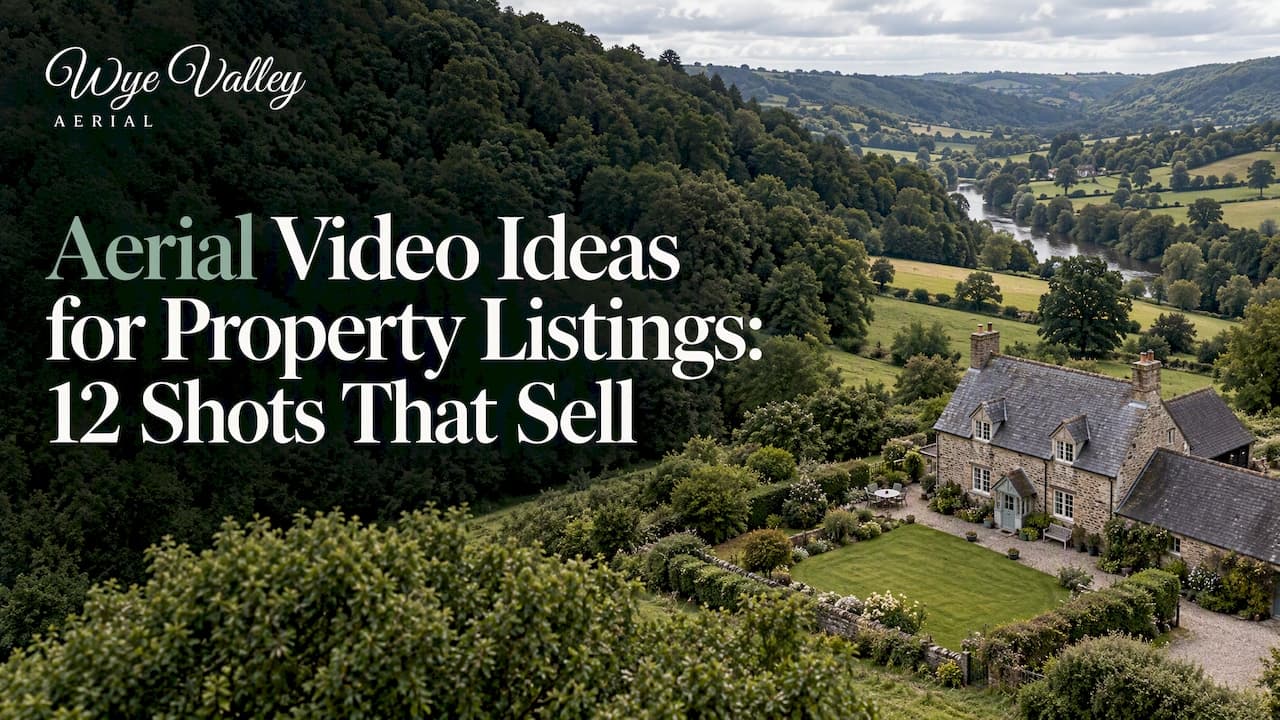
The best aerial video for a property is short, built around two or three things that make the place special, and flown by a pilot who is legally allowed to be there. Think of a rising reveal of the house, a slow pass along the garden, a pull-back that shows the village or river behind it. This guide gives you twelve shot ideas, a running order, the preparation that makes the footage look better, and the UK rules that decide what can be filmed.
It is written for homeowners selling privately, estate agents, landlords and managing agents, with examples drawn from the kind of rural and edge-of-town homes we film in the Wye Valley.
TL;DR
- Aim for a film of 30 to 60 seconds that features the property's best two or three selling points, not every corner of it. Stills carry the detail.
- Pick shots that show what a floor plan and ground-level photos cannot: plot size, boundaries, views, access and the setting.
- Tidy the drive, bins and garden before the pilot arrives. Small clutter is magnified from above.
- In the UK, a paid drone job needs a registered operator and a qualified pilot. Ask for the A2 CofC, insurance and a flight plan before you book.
- Brief the pilot with a shot list. It saves time on the day and avoids reshoots.
Table of Contents
- Why aerial video earns its place in a listing
- Twelve aerial video ideas for a property
- Building the film: length, order and pace
- Get the property ready before the drone arrives
- UK rules that shape the shots
- Our view: plan the story before the flight
- What a booking looks like with us
- How to brief your pilot
- Mistakes that make property drone films worse
- FAQ
- Sources
Why aerial video earns its place in a listing
Buyers look online first. Industry figures compiled by PropertyBox claim that listings with aerial imagery sell up to 68% faster than those using conventional pictures alone, and that most homeowners prefer agents who use drone services. Treat those as marketing-industry figures rather than guarantees: every house, price and market is different. The point that holds up in practice is simpler. A drone answers the questions buyers ask before they book a viewing: how big is the plot, what is next door, how far is the road, where is the view.
That matters most for the homes around Monmouth, Ross-on-Wye, Chepstow, Coleford and Lydney. A farmhouse with paddocks, a cottage above the Wye, or a barn conversion with woodland behind it is hard to explain from the ground. From 60 metres up it explains itself.
Twelve aerial video ideas for a property
You will not use all twelve. Choose the ones that match the property, then follow the running order in the next section.
1. The rising reveal
Start low behind a hedge, wall or gate and climb slowly so the house appears over the top. It works as an opener because it creates a small moment of anticipation, and it suits any property with a decent frontage.
2. The slow approach along the drive
Fly forward at a gentle pace along the access road towards the front door. Buyers of rural homes often want to know what the approach is like: surface, length, gates, passing places. This answers it in ten seconds.
3. The orbit
A smooth circle around the house shows every elevation, the roof and how the building sits on its plot. It suits detached homes, converted barns and period houses with interesting rooflines. Keep it slow. A fast orbit looks like a gimmick and makes the property look smaller.
4. Top-down plot view
A straight-down shot shows boundaries, outbuildings, parking, lawn and any orchard or pond. It is the most useful single frame for anyone selling more than a typical suburban garden, and it pairs well with a still annotated for the brochure.
5. The garden sweep
Fly low and sideways along the length of the garden, with the house in the background. It shows depth, planting and terraces far better than a wide-angle photo from the patio. This is also where the neighbours question comes up, so see the privacy section below.
6. The view the owner actually sees
Hover at first-floor or roof height and face outwards. If the bedroom window looks over the Wye, a hillside or the Forest of Dean, show that view from roughly the same height. Buyers pay for views, and a ground photo rarely captures them.
7. The pull-back to the setting
End on a slow reverse that rises until the house shrinks into its surroundings: the village, the river bend, the fields. It tells the buyer where they would be living, which is often the real sale.
8. Neighbourhood context
Short clips of the nearest pub, church, school, green or station, shown from above, help buyers who are relocating. Keep these brief and only include what is genuinely close. Use them in the film or as separate stills.
9. Roof and building condition
If the roof, chimney or gutters are in good order, show them. A drone can look closely at slates and stacks without anyone climbing a ladder. For older homes, a documented check can be a selling point: it tells a buyer you have nothing to hide. If you want to know more about what a check costs, see our guide to drone roof inspection costs in the UK.

10. Golden hour and dusk
The hour after sunrise or before sunset gives warm side light and long shadows. A lit-up house at dusk is a strong thumbnail for a listing. Because the light is brief, book flexibly: a reputable pilot will reschedule for weather rather than fly in flat grey cloud.
11. Seasonal proof
If the property is sold in winter, but the garden is lovely in June, ask the owner whether they have any existing summer footage. If you are filming in autumn, the colour in the valley is a feature. Do not mix seasons without saying so: buyers notice when the leaves are different between clips.
12. The short social cut
A 15-second vertical edit, using only the rising reveal, one garden pass and the pull-back, works for social media and the first screen of an online listing. Ask for it at the time of booking so the pilot frames the clips with cropping in mind.
Building the film: length, order and pace

A common rule of thumb in property video is to keep it to 30 to 60 seconds and highlight key features, not the whole property. We would not link to forum posts as evidence, so treat that as our own working guidance too: the longer the film, the fewer people watch it to the end.
A running order that works for most homes:
- Opening (3 to 5 seconds): the rising reveal or a high wide shot.
- The house (8 to 10 seconds): a slow orbit or a single sweeping pass along the front.
- The plot (8 to 10 seconds): top-down, then the garden sweep.
- The setting (8 to 10 seconds): the view, then neighbourhood context.
- Closing (3 to 5 seconds): the pull-back, ending on the wider landscape.
A few choices make the edit look professional:
- Move slowly and steadily. Smooth movement looks expensive. Jerky movement does not.
- Cut on movement. If one clip drifts left, start the next drifting left too.
- Keep music simple. Low, instrumental and non-distracting. Always use licensed music.
- Do not add text over every clip. One caption with the town and the price guide, if the agent wants it, is enough.
What stills should do
Use stills for the details the film cannot hold: a slate roof in sharp focus, a boundary line, a sunlit terrace. A good package covers both. Our own property stills and short film options are built around this split, with a bespoke shot list for each site.
Get the property ready before the drone arrives
The drone looks down, so everything on the ground is visible. Haus Properties, a lettings firm, advises sellers to clear cars from driveways, hide bins and arrange garden furniture beforehand because small details are magnified from above and hard to remove in editing. We agree. A quick checklist:
- Move cars off the drive, or park them out of sight.
- Put bins, recycling boxes and hoses away.
- Mow the lawn the day before if you can, and sweep paths and patios.
- Take down washing lines, remove toys and tidy sheds and outbuildings.
- Open gates and make sure the way in is clear.
- Check trampolines, skips and scaffolding: they may need to be moved or accepted as part of the scene.
- Tell the pilot about hazards: overhead cables, nearby livestock, bonfires, neighbours' trees.
On a second visit, walk the boundary with the pilot. They will want to know where you want the property to begin and end in the frame.
UK rules that shape the shots
A listing film is a commercial job, so UK drone law applies. Four points are worth knowing as a client, whether you are an owner or an agent.
The operator and pilot must be registered and qualified. The CAA says that anyone flying drones for work must be registered as an operator and make sure every remote pilot holds the right competency. The A2 Certificate of Competency is a qualification that allows flights closer to people than the basic open category. Our post on the A2 CofC and the 30m and 5m rules explains how this works around the Wye Valley.
Distances from people and buildings are limited. The CAA's Drone and Model Aircraft Code states that, at the basic level, you must not fly within 50m of uninvolved people or within 150m of residential, commercial or industrial areas. A qualified commercial pilot can operate within different limits, but the rules around towns still apply. The CAA publishes separate guidance on flying in towns and busy areas. This is why a village-centre terrace may be harder to film than a farmhouse in a field, and why you should ask for a flight plan.
Privacy is not optional. The same Code stresses privacy: tell neighbours or bystanders about planned filming where you can, and never use zoom to look into private spaces. A garden sweep that clips a neighbour's patio can cause real problems for a seller. A careful pilot frames the shot to avoid it, or asks you to speak to the neighbours first.
Insurance matters. Ask to see it. If a drone damages a roof, car or person, you want to know who pays.
For the commercial side in general, see our guide to commercial drone photography deliverables and UK rules.
Our view: plan the story before the flight
Most disappointing property films fail before the drone leaves the ground. The pilot arrives with no brief, flies a generic orbit and a few high shots, and the result could be any house in any county.
We start with a conversation about what the property has that others in the area do not. For a house outside Monmouth, it might be the view down the valley. For a Chepstow townhouse, it might be the garden that appears from nowhere behind a terrace. Then we write a shot list around those points, with a short film and a few stills, and fly it. Because our pilot holds the A2 CofC and flies with full insurance, we can plan flights close to houses and boundaries where the rules allow, and we explain clearly where they do not.
We also reschedule when the weather is dull. A property filmed in flat light looks smaller and colder than it is, and a second visit costs far less than a weak film that sits online for months.
If you take one thing from this guide: fewer, better shots, flown slowly, in good light.
— Rhys
What a booking looks like with us
We cover Monmouth, Ross-on-Wye, Chepstow, Coleford, Lydney and the surrounding Wye Valley, and you can check our area covered before you ask. Our property options range from stills only, through stills with a short film, to a half day or a full day on site for larger estates, hotels or multi-building sites. Every job is quoted individually: we give you a free fixed quote in advance, and the finished stills or film arrive as a download link. You can see the options on our services page and ask for a quote from there. For a sense of how quotes are built, our article on drone photography prices in the UK sets out the costs behind them.
How to brief your pilot
A good brief takes ten minutes and saves hours. Send the pilot:
- The full address and what3words or a pin for the access point.
- The sale price bracket and the type of buyer you expect (family, retiree, investor).
- Three things the property does best, in order.
- Any areas to avoid: a neighbour's garden, a school, livestock.
- Preferred times, plus flexibility on dates for weather.
- Your deliverables: horizontal film, vertical cut, a set of stills, file formats.
If you want a worksheet to start from, a free drone shot list for real estate video lists dozens of shots and checks in phases. Use it as an idea bank, then cut it down to the shots that suit your property.
Mistakes that make property drone films worse
- Flying too high. Past a certain height, the house is a dot. Buyers want to see the building, so stay close enough to show the stone, the windows and the roof.
- Showing the whole property. Pick the best bits.
- Ignoring the neighbours. A film that peers into someone else's garden can lead to complaints.
- Over-editing. Heavy colour, fast transitions and dramatic music make a film look dated.
- Wrong season or light. Book in good conditions, or accept the delay.
- Hiring an unregistered flyer. It is the client who is left with the awkward questions if a film is made unlawfully.
FAQ
How long should a property drone video be?
For a listing, 30 to 60 seconds is a sensible target. That is long enough for the reveal, the house, the plot and the setting. A separate 15-second vertical cut is useful for social media.
Do I need permission to film my own house with a drone?
You do not need the CAA's permission as the owner, but whoever flies the drone for payment must be registered as an operator and hold the right qualification. They must also respect the people and buildings around you, and the privacy of neighbours. Ask your pilot for their credentials and insurance before the day.
Is an aerial film worth it for a smaller house?
It depends on the plot and the setting. A terraced house with no garden gains little. A home with outbuildings, a large garden, a view or an interesting location gains a lot. Stills alone may be the better value for modest properties.
Can the same flight be used for a roof check?
Often, yes. Because the drone is already at the property, the pilot can capture close images of the roof and chimney. It is a separate deliverable with different shots, so say so when you request your quote. Our guide to drone roof inspections explains what is involved.
Sources
- PropertyBox: real estate statistics for agents
- Haus Properties: enhanced marketing and virtual tours
- CAA: flying drones for work
- CAA: A2 Certificate of Competency
- CAA: The Drone and Model Aircraft Code
- CAA: Drone rules, flying in towns or busy areas
- TrunkTransfer: drone shot list for real estate video