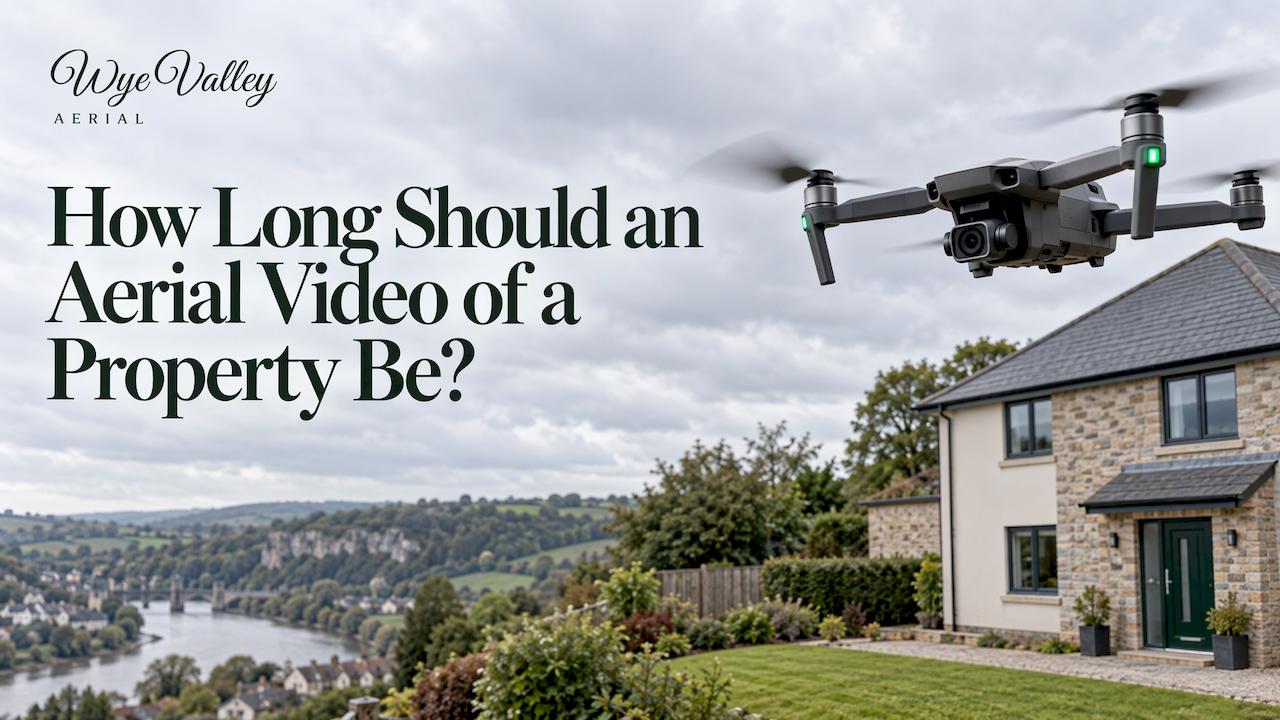
For most homes, an aerial property video should run between 45 and 90 seconds on a listing page, with a 15 to 45 second cut for social media. Estates, hotels and wedding venues can justify two to three minutes because there is more ground to show. The right length is the one that ends when the property has been shown. Plan it before the drone leaves the ground, because the length is decided by the shot list, not by the edit.
This guide is for homeowners selling a house, wedding planners, hotel and estate managers, and anyone briefing a drone pilot. It gives you the lengths that suit each use, the shots that fit inside them and how to brief a shoot so you get the cuts you need from one visit.
TL;DR
- A listing-page aerial video usually works at 45 to 90 seconds. A full filmed tour of a larger property runs 90 to 180 seconds.
- Social cuts are shorter: about 15 to 45 seconds, and 15 to 30 seconds for vertical Instagram Reels.
- Estates, hotels and venues can run to two or three minutes, because grounds and surroundings are the selling point.
- These ranges are practitioner opinion rather than measured watch-through data, so cut for content, not for a number.
- Ask for several lengths from one shoot, planned in a shot list before the flight.
Table of Contents
- The short answer: 45 to 90 seconds for most listings
- Length by where the video will be shown
- What fits inside the time
- When a longer film is worth it
- One shoot, several cuts
- How to brief the shoot so the length works
- What about roof and building inspections?
- Our shot lists and edits for Wye Valley properties
- Our view on length
- FAQ
- Sources
The short answer: 45 to 90 seconds for most listings
A UK guide to property video length reports that practitioners and vendors usually advise 45 to 90 seconds for a listing-page video and 90 to 180 seconds for a full filmed tour. The same guide is clear that these are opinions, not figures from watch-through data on property videos. That is worth knowing: nobody can promise that 62 seconds beats 71 seconds.
What the ranges do tell you is the shape of the decision. A listing-page video is there to hold someone who is already interested in the house. A full tour is for someone close to booking a viewing. Social is for people who were not looking at all.
For an aerial video specifically, the length also depends on how much there is to see from the air. A terraced house in a town has a front, a roof line and a garden, and shows everything it has in 30 to 45 seconds of drone footage. A farmhouse with outbuildings, paddocks and a view down the valley has more to say.
Length by where the video will be shown
The place where people watch matters more than the property. A video that suits a portal page is too long for a feed. Here are the ranges UK sources give, side by side.
| Where it is shown | Typical length | Format |
|---|---|---|
| Instagram Reels | 15 to 30 seconds | Vertical 9:16 |
| Other social feeds (Facebook, TikTok, Shorts) | 20 to 45 seconds | Vertical 9:16 |
| 45 to 90 seconds | 16:9 or square | |
| Listing page or property website | 45 to 90 seconds | Horizontal 16:9 |
| Full tour (portal or YouTube) | 90 to 180 seconds | Horizontal 16:9 |
| Estate or luxury cinematic film | 2 to 3 minutes | Horizontal 16:9 |
The social and portal figures come from a UK commercial property marketing firm, which says a 2 to 4 minute portal walkthrough suits active searchers, while a 30 to 60 second social cut builds awareness, with 45 to 90 seconds working well on LinkedIn and 15 to 30 second vertical clips on Instagram Reels. A separate UK guide to video marketing for estate agents puts short-form social at 15 to 45 seconds and full walkthroughs at 1 to 2 minutes, with vertical 9:16 for social and horizontal 16:9 for listing pages and YouTube.
The ranges overlap and the sources do not agree to the second. That is normal. Treat the table as a planning guide: pick the length that fits the property, then check it against the platform.
Portals and where the video goes
Online property portals often take a link to a video hosted elsewhere rather than an uploaded file, and each has its own limits on length, file size and format. A UK guide to making property videos notes that Rightmove, Zoopla and OnTheMarket often accept a YouTube or Vimeo link, with differing limits. Your agent can tell you which limits apply to your listing. Ask before the shoot, not after, so the main cut is made to fit.
Matching duration and format to each channel is a skill in its own right, and there is useful reading on video marketing for small businesses if you are planning to run the same footage across several channels.
What fits inside the time
Length is only a problem when a video has nothing new to show. One Australian production company puts it plainly: length is rarely the real problem, and what loses viewers is giving them nothing new for several seconds in a row, such as a long drive-up opener, repeated rooms, dead air at the end or a flat sequence with no build.
That is why the best way to plan an aerial video is by what each shot does. A 60 to 90 second aerial edit for a house with grounds might run like this:
- Reveal (about 8 seconds). A rising or pull-back shot that shows the house in its setting.
- Orbit (about 12 seconds). A slow curve round the building so viewers see every face of it.
- Boundary and context (about 15 seconds). The plot edge, the garden, the road, the village or the view.
- Push in (about 15 seconds). A move towards the front door, the terrace or the best feature.
- Close (last 5 seconds). A pull-back or a still hero shot, then stop.
That sequence follows a US shot-list guide that sequences a 60 to 90 second edit by job: reveal, orbit, boundary and context, push in, and a hero close, filming 10 to 12 clips and keeping five or six. It also advises that below 30 seconds you should drop the boundary and context shots rather than speed everything up. We think that is sound: a shorter video should show fewer things, not the same things faster.
For more on which shots earn their place, our guide to aerial video ideas for property listings goes through 12 of them.
When a longer film is worth it
A two to three minute film earns its length when the property has more to show than a house. Think of an estate with woodland and a river, a hotel with gardens and a spa, a wedding venue with a barn, a lawn and a view, or a farm with a holiday let.
One luxury-property guide says a full cinematic tour is generally ideal at 2 to 3 minutes, with 15 to 60 second social teasers, and that drone footage is essential for showing expansive grounds, architectural grandeur and surroundings. In the Wye Valley, where a property's setting is often the reason people want it, that logic applies to much more than the very top end.
A longer film is right when:
- the grounds, outbuildings or boundaries are part of what is being sold;
- the audience is deciding on a venue, such as a couple looking at wedding sites or a planner comparing hotels;
- the film will sit on your own website or YouTube channel, where people have come on purpose;
- you also want shorter cuts for social media from the same footage.
It is not right for a standard three-bedroom house just because there is a budget for a long one. Ending the video when the property has been shown is better than padding it to reach a number.
If you manage a hotel, our practical guide to hotel drone marketing covers what to show and where it goes. For visitor sites, there is a separate guide to drone photography for tourist attractions.
One shoot, several cuts
The cheapest way to get the right length for every platform is to film once and edit more than once. The same Australian guide advises cutting everything from one shoot: under 30 seconds for Instagram and TikTok, 60 to 90 seconds for portals, up to 2 minutes for YouTube and the property's own page, and a 10 to 15 second teaser for stories and pre-launch posts. Those are Australian figures, but the approach carries over.
A sensible set of cuts for a UK sale or venue launch:
- Hero film, 60 to 90 seconds. For the listing page or website.
- Social cut, 15 to 30 seconds. Vertical, strongest shot first, captions on.
- Teaser, 10 to 15 seconds. For the first post or a price change.
- Full tour, 2 to 3 minutes. Only where the property has the content to carry it.
On the first seconds: a UK video marketing guide advises leading with the strongest shot, because the first two seconds decide whether anyone watches the rest, and keeping captions on because most feeds autoplay muted. For aerial work, the strongest shot is often the rising reveal of the house in its landscape. Open with that, not a drive-up.
One UK template for price-reduction videos runs 15 to 30 seconds and is posted within 24 hours of a portal price reduction. That tells you a short refresh cut is worth planning for if a sale drags on. If your footage is already shot, a new short edit costs far less than a second flight.
How to brief the shoot so the length works
Most length problems are really briefing problems. A pilot who is told "get some aerial footage" comes back with lots of lovely, unfocused clips. A pilot given a shot list comes back with what the edit needs.
Decide the main use first
Tell the pilot where the main video will live. A listing page, a hotel website and a wedding venue enquiry each want a different balance of house, grounds and surroundings.
List the must-have shots
Write down the five or six shots you most want to see. For a home these are usually the front elevation, the garden from above, the roof, the plot boundary and the view. For a venue, they include the approach, the ceremony space, parking and the surrounding countryside. A UK script guide splits a 30-second video into a hook in the first 3 seconds, the setting, key features, a lifestyle close and a call to action, and says a 30-second social video needs roughly 75 to 90 words if narrated. Even if yours has no voice-over, the same five-part order gives a short film its shape.

Ask for the lengths you need
Say up front that you want a hero film and a short social cut, and whether you want vertical footage. If a film needs vertical and horizontal versions, say so before the flight, since framing is decided on the day.
Check the legal basics
Any aerial job needs a pilot with the right permissions and insurance, and in the UK that means following the Civil Aviation Authority (CAA) rules. If the property is overlooked by neighbours or close to other buildings, read our guide on drone filming over private property in the UK. For weddings, check the 50 metre rule for people before booking.
Leave room for the weather
Wind and rain stop flights, and a video made in grey light shows. A pilot who can reschedule for weather gives you a better film than one who has to fly on a fixed date.
What about roof and building inspections?
Inspection footage is a different job. A roofer, landlord or managing agent wants evidence, not a story, so length is set by what needs checking. Stills with clear detail and a short clip of each elevation usually matter more than a polished film. If this is your reader's need, see our guides on what to ask before a drone building inspection and five photo checks for a drone inspection report.
Our shot lists and edits for Wye Valley properties
We offer property stills, stills with a short film, a half day on site and a full day, plus roof and building checks. Each job starts with a free fixed quote, and the shoot follows a bespoke shot list built around your site and what you need it to do. You receive fully edited stills or film through a download link.
The flights are operated by a qualified pilot with A2 CofC certification, full insurance, flight plans and strict adherence to CAA rules. If the weather turns, we reschedule.
To describe your property and get a quote, see our services page or contact us through the Wye Valley Aerial website.

We cover Monmouth, Ross-on-Wye, Chepstow, Coleford, Lydney and the surrounding Wye Valley.
Our view on length
We get asked for a number of seconds nearly every time, and we understand why. A number feels safe. But the honest answer is that the property sets the length, and the brief sets the property.
A house with a tidy garden and a good roof line does not need three minutes from the air. An estate with a river frontage and a view down the valley might. The mistake we would like you to avoid is deciding the length first and filling it afterwards. That is how you end up with the same orbit shot three times.
So we start with a shot list. We ask what the film is for, where it will be shown and which five or six things you most want a viewer to see. Then we plan the flight around them, and the edit follows. Because everything comes from one visit, you can have a longer film for your website and shorter cuts for social media without paying for a second shoot.
It also means the quote is fixed before we fly. You know what the job covers, and you know what you will receive: edited stills or a finished film by download link.
Rhys
FAQ
What is the best length for a real estate video?
For a listing page, 45 to 90 seconds is the most common advice from UK practitioners. A full tour can run 90 to 180 seconds, and social cuts are shorter. These are professional opinion rather than measured data, so make the video as short as the property allows.
How long should an aerial video for social media be?
Aim for 15 to 45 seconds, and 15 to 30 seconds for vertical Instagram Reels. Lead with your strongest aerial shot and add captions, since many feeds play without sound. Ask for a vertical edit before the shoot so the framing works.
Can I have a long film and a short one from the same flight?
Yes, and it is usually the best value. One flight, planned with a shot list, gives enough footage for a hero film, a social cut and a short teaser. Tell the pilot which versions you want when you ask for the quote.
Is a longer aerial video better for an estate or hotel?
Often, yes. Grounds, buildings and surroundings give a two to three minute film enough to show. Keep the length only if each shot adds something new, and make a short cut as well for social media.
Sources
- How long should a property video be?
- How to make a property video from photos
- Property Video Social Media, Leeds Property Marketing
- Real Estate Video Marketing: Complete UK Guide 2026
- Listing Video Length: How Long Before Buyers Drop Off
- Real Estate Drone Videography: Shot List for 2026
- Luxury Real Estate Video Marketing: Strategies for Exclusive Properties
- Price Reduction Video Ad Template
- Property Video Script Writing
- Video Marketing for Small Businesses