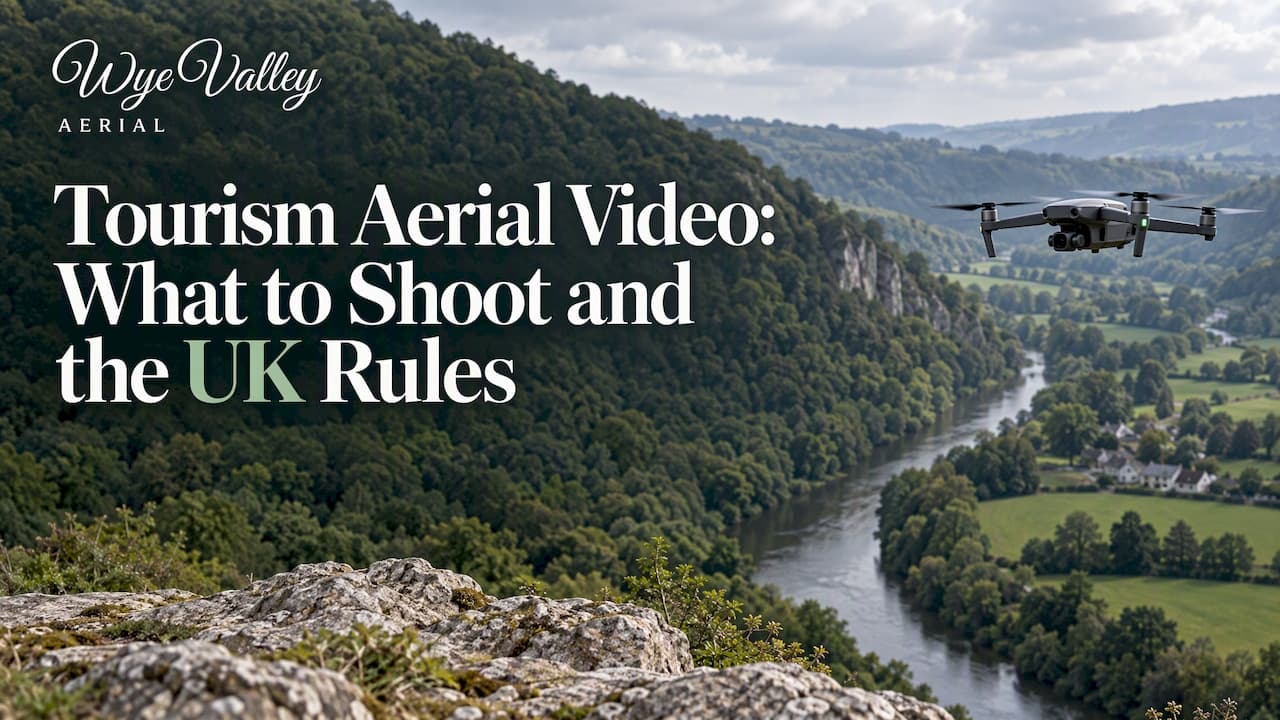
Tourism aerial video is drone footage that shows a destination, attraction or place to stay from above, so a viewer can see how it sits in its landscape before they ever arrive. Done well, it orients the viewer, then proves the experience on the ground. In the UK, doing it for a business means a qualified pilot, insurance and a plan for the site. This guide covers what to film, how to brief it and what the rules require, from a Wye Valley point of view.
TL;DR
- Tourism aerial video uses drone footage of landmarks, coast, countryside and buildings to give viewers a sense of place that ground-level footage cannot.
- The best films use aerials to orient the viewer, then cut to ground-level detail that shows what a visit is actually like.
- Paid UK drone work needs an Operator ID, a Flyer ID and, for flying closer to people, an A2 CofC, plus valid insurance.
- Heritage sites, busy venues and private land need permission and a risk assessment before the drone leaves the case.
- Agree in writing how you may use the finished footage, and ask for a fixed quote against a written shot list.
Table of Contents
- What tourism aerial video is and what it shows
- Why aerial footage works for promotion
- Shots that make a tourism film useful
- Quality, light and weather
- UK drone rules for commercial tourism filming
- Filming around visitors, residents and sensitive places
- Usage rights: who owns the footage?
- Our perspective: why local and bespoke beats stock
- What we offer for tourism and hospitality
- How to brief a tourism aerial shoot
- FAQ
- Sources
What tourism aerial video is and what it shows
It is the use of drone-captured footage to give viewers an overhead, immersive view of travel and leisure locations. Industry guidance on destination and tourism promotional video lists the typical subjects: historic landmarks, cultural attractions, coastal towns, forests, mountains and city skylines.
Search for the term and you will mostly find stock libraries and long scenic reels of beaches, resorts and cities. They are lovely to watch, but they are not made for a specific business. A hotel, a campsite, a heritage attraction or a wedding venue needs footage that shows its grounds, its approach road, its view, and what is nearby.
In the Wye Valley that tends to mean:
- river meanders, wooded gorges and viewpoints that explain why people visit;
- castles, abbeys and historic towns such as Monmouth, Chepstow and Ross-on-Wye in their setting;
- hotels, inns, holiday lets and estates, shown with their grounds and the surrounding countryside;
- activity venues, campsites and farm attractions where the layout matters to a family deciding where to go.
Why aerial footage works for promotion
There is research behind the instinct. A 2025 academic study on promoting Tuba Island in Malaysia found aerial drone images more appealing and emotionally impactful than eye-level photographs. It is a single study of one destination, so treat it as supporting evidence rather than a guarantee. But it matches what most tourism managers see: a view from above makes a place easy to understand quickly.
That clarity is the commercial point. A visitor choosing between two places to stay or visit wants to know how big the site is, where the parking sits, how close the river or the village is, and whether the view is as good as the brochure says. A well-planned aerial answers those questions in seconds.
Shots that make a tourism film useful
A scenic sweep is not a plan. The shots below are the ones that do a job.
The establishing shot
A high, wide view that places the site in its landscape. Use it at the start of a film or at the top of a web page. It tells the viewer where they are.
The approach
A low, slow flight along the lane, drive or path that a guest will take. It removes the worry of not knowing what to expect on arrival, and it suits hotels, venues and holiday properties well.
The reveal
A rise from behind a hedge, tree line or building that opens onto the view. It is the single most dramatic move in drone work, so keep it for the moment that earns it, such as the first sight of a river bend from a terrace.
The orbit and the pull-back
An orbit around a castle, church or main building shows its shape. A pull-back from a detail, such as a garden, a pool or a wedding marquee, to the whole estate shows scale.
Top-down layouts
Straight-down stills and clips are ideal for site maps, campsite pitches, car parks and event layouts. They give planners and managers something practical, not just pretty.

Context first, then proof
Filmmaker Nigel Camp argues that aerial moments should carry information: context first, followed by ground-level proof, with aerials used to orient or connect space rather than as filler. It is one practitioner's view, but it is sound advice for tourism. Open from above, then cut to the room, the food, the people, the path underfoot. A film made only of drone shots tells the viewer where a place is but not what it is like.
For hotels specifically, our guide to hotel drone marketing in the UK goes through how to use footage across a website and booking channels.
Quality, light and weather
Three practical points decide whether footage looks professional.
Light. Low sun, early or late in the day, gives depth to hills, water and stonework. Midday sun flattens a landscape. If a shoot can be timed around the light, it should be.
Weather. Wind, rain and low cloud all affect safe flying and picture quality. A pilot who offers flexible rescheduling for weather, as we do, will move the day rather than fly in poor conditions and hand you disappointing footage.
Season. Tourism footage is used for a year or more. Think about what the place looks like when guests actually visit: spring blossom, summer greenery, autumn colour on the valley sides. Many businesses shoot twice a year so their website is never out of step with the calendar.
Editing. Raw drone clips are not a film. Colour grading, trimming, stabilising and pacing turn them into something you can publish. Ask whether the price covers fully edited stills or film, and how it is delivered. For us, finished work comes by download link.
UK drone rules for commercial tourism filming
Filming for a business is not the same as flying for fun. The rules below come from the Civil Aviation Authority (CAA) and related guidance.
Categories, IDs and the A2 CofC
UK drone operations fall into Open, Specific and Certified categories. A camera drone needs an Operator ID, anyone flying a drone of 100g or more needs a Flyer ID, and flying in the Near People (A2) sub-category requires an A2 Certificate of Competency.
The A2 CofC is awarded by CAA-approved providers. In practice it lets a pilot fly closer to people than a basic Open category qualification allows, which matters at hotels, venues, weddings and attractions where people are never far away. Our pilot holds an A2 CofC. If you want the detail on how distances work, see our explainer on the A2 CofC and the 30m and 5m rules, and for the wider picture our guide to UK drone operator qualifications.
Insurance and authorisation
Guidance for film productions states that commercial drone flights in the UK require valid insurance compliant with EC 785/2004, and Specific Category flights need CAA operational authorisation. When you hire a pilot, ask to see the insurance certificate. A professional will send it without hesitation.
Risk assessment and flight plan
A proper job starts with a site-specific risk assessment: where people will be, where the take-off and landing area is, what is nearby, and what happens if something goes wrong. Our article on what a drone filming risk assessment must cover sets out the headings. If a pilot cannot explain their plan for your site, keep looking.
Filming around visitors, residents and sensitive places
Tourism sites are busy by nature, and that is where drone work needs the most care.
People. The Drone and Model Aircraft Code says not to fly over crowds or people who are not with you, and to think carefully before sharing photos and videos. For a tourism shoot, that usually means filming at quiet times, closing off a working area or briefing guests, rather than flying over a full car park or a busy terrace.
Privacy. The CAA's own code warns that using a camera where people can expect privacy, such as in their home or garden, is likely to break data protection laws, and that recordings may be covered by GDPR. Neighbouring gardens and windows should stay out of frame. Our guide to drone filming over private property explains how that works with land and permission.
Heritage and managed sites. Many attractions have their own rules. At English Heritage sites, for example, professional drone projects need approved paperwork, risk assessments and flight plans, and pilots are asked to fly outside opening hours. The same logic applies to other landowners: castles, National Trust properties, estates and farms usually want to know who is flying, when and how. Ask the landowner first, and give the pilot time to arrange it.
Hotels and venues. If you manage a place to stay, you will also be asked to approve other people's flights. Our UK hotel drone policy checklist covers three checks before you say yes.

Usage rights: who owns the footage?
Before a shoot, agree in writing what you may do with the result: website, social media, print, booking sites, partner tourism boards, paid advertising. Also agree for how long, and whether you may pass the files to a third party such as a marketing agency.
In the UK, copyright in a photographer's or filmmaker's work normally starts with the creator, so a clear licence matters more than assumptions. If you intend to use the footage in several places for several years, say so when you ask for a quote. A good pilot will write the licence to match. If you need legal certainty on a particular contract, a solicitor is the right person to check it.
Our perspective: why local and bespoke beats stock
We get asked why a hotel or attraction should pay for its own footage when stock libraries are full of gorgeous drone clips. Our answer is that stock shows a place that looks a bit like yours. It cannot show your gate, your terrace, your view down the valley, or the lane guests really drive along.
Tourism is a trust business. People book somewhere because they believe the picture, so the picture needs to be accurate and recognisably yours. That is why we build every job around a bespoke shot list for the site: we walk through what you want to say, agree the shots that say it, then fly them with the right light and the right permissions.
We work in the Wye Valley and around Monmouth, Ross-on-Wye, Chepstow, Coleford and Lydney, so we know the terrain, where the wind funnels along the gorge and which viewpoints work at which time of day. Every flight is run by a qualified pilot with an A2 CofC and full insurance, with flight plans and CAA rules followed. We give a free fixed quote in advance, so there are no surprises, and we reschedule for weather without fuss.
The result is footage you can use for years: a hero film for your homepage, stills for listings and brochures, and top-down layouts for planning.
— Rhys
What we offer for tourism and hospitality
Our services page sets out the options: property stills, stills with a short film, a half day on site and a full day. Hotels, estates and attractions usually choose a half or full day, because it gives time to film several areas and wait for the right light. Each job is individually quoted, and finished stills or films arrive by download link.

If you would like to talk through a hotel, venue, campsite or attraction, get in touch for a free quote and tell us what you want the footage to do.
How to brief a tourism aerial shoot
A clear brief saves time and money on the day. Cover these points.
- The purpose. Is it a homepage hero film, social clips, a brochure, a sales listing or a tourism board submission?
- The audience. Families, couples, walkers, wedding clients, corporate groups? That decides what to show.
- The must-have shots. List them, including the view you are proudest of and the approach road.
- The ground-level partners. Plan any interior, food, activity or people footage that will sit alongside the aerials.
- The constraints. Opening hours, guests in residence, neighbours, protected areas, landowner permissions.
- The deliverables. Stills, film length, formats, and the usage rights you need. Our guide to commercial drone photography deliverables is a good checklist.
- The timing. Season, time of day and flexibility for weather.
If you are comparing quotes, it helps to know what sits behind them. Our article on what drives drone photography prices in the UK explains the CAA-related costs, and the one on drone versus helicopter shows how the UK height ceiling affects the shot you can get.
FAQ
What is tourism aerial video used for?
It promotes destinations, attractions and places to stay by showing them from above in their surroundings. Businesses use it on websites, in social media, in booking-site galleries and in tourism board material. It works best alongside ground-level footage that shows the experience itself.
Do I need a qualified pilot to film my hotel or attraction from the air?
Yes, if the footage is for business use. A camera drone needs an Operator ID, the pilot needs a Flyer ID, and flying closer to people needs an A2 CofC. Ask for proof of qualification and insurance before you book.
Can a drone fly over guests or visitors?
The CAA's drone code says not to fly over crowds or people who are not with you. A tourism shoot is normally planned for quiet times or with the filming area cleared, and the pilot's risk assessment should say how.
Do I need permission to film a castle, abbey or heritage site?
Usually yes. Owners and managers set their own rules. English Heritage, for instance, asks for approved paperwork, a risk assessment and a flight plan, and prefers flights outside opening hours. Contact the site owner early and allow time.
How much does tourism aerial video cost?
It depends on the size of the site, the time on location and what you need edited. We quote each job individually and give a free fixed quote in advance, so you know the cost before you commit.
Sources
- Destination and tourism promotional videos drone guide, Association for Drones
- Reconceptualizing Tourism Promotion: The Impact of Drone Imagery, UiTM
- Drone footage for brand video, Nigel Camp
- Introduction to more advanced flying, UK Civil Aviation Authority
- A2 Certificate of Competency, UK Civil Aviation Authority
- Filming with drones in the UK, guidance for productions
- The Drone Code, January 2026
- The Drone and Model Aircraft Code, March 2026, UK Civil Aviation Authority
- Drone guidance, English Heritage