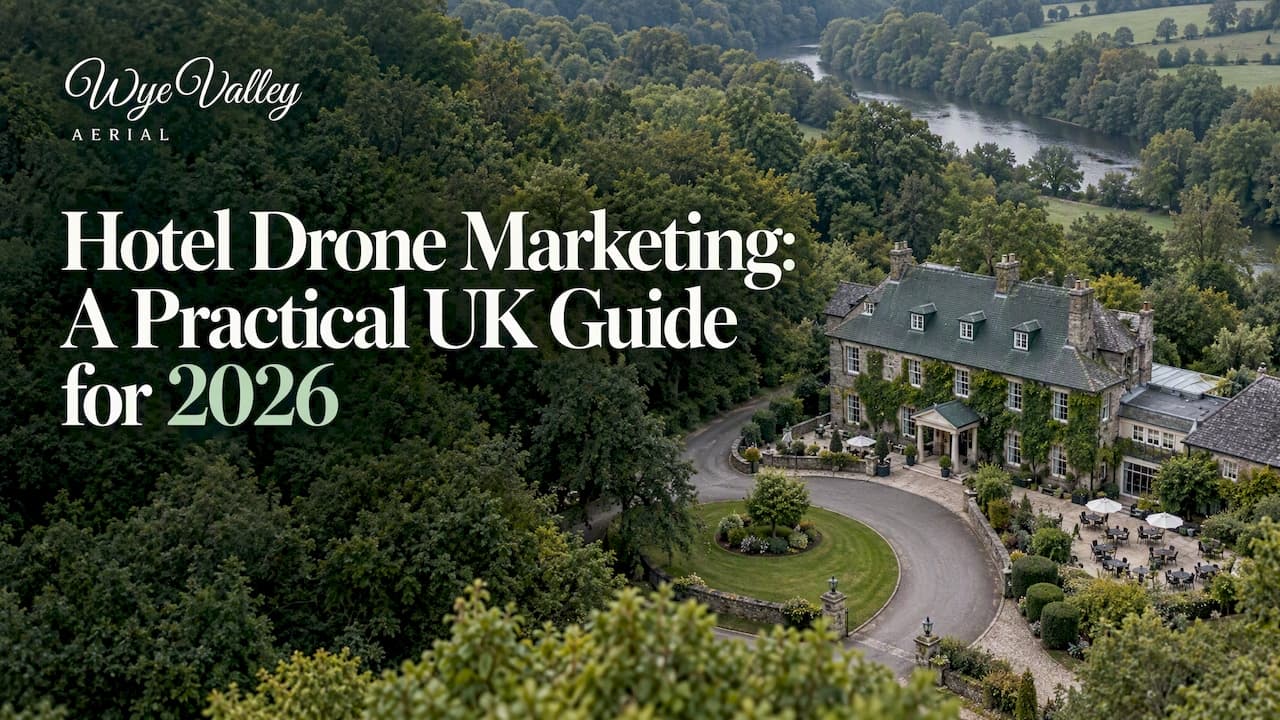
Hotel drone marketing works when aerial footage sells the setting, the arrival and the experience, not just a view of the roof. Done well, a short set of stills and clips shows guests where you sit, how they get there and what the grounds feel like. Done badly, it is a generic flyover that could belong to any hotel. This guide covers what to film, how to reuse it, and the UK rules your pilot has to work within.
TL;DR
- Build the shoot around your hotel's promise (arrival, setting, grounds, event space) before anyone talks about flight paths.
- Treat the footage as a reusable library for your website, social media, email, ads and event sales, not one hero film.
- A drone pilot's A2 CofC is not blanket permission. Ask what is feasible at your site, how guests will be kept clear and how privacy is handled.
- Plan guest-free windows and a weather fallback, because occupied hotels and British weather both move the schedule.
- Ask for a fixed quote with a shot list, so you know what you are paying for before the drone leaves the case.
Table of Contents
- Why aerial content suits hotels
- Start with the promise, not the flight path
- A shot list for a hotel or country house
- Build a library, not a single film
- Where the footage should live
- Is the drone overused?
- UK rules: what your pilot has to get right
- What a good quote should tell you
- Our perspective
- Hotel aerial work with Wye Valley Aerial Imaging
- FAQ
- Sources
Why aerial content suits hotels
Room photographs tell a guest what they will sleep in. Aerial images tell them where they will wake up. That matters most for hotels whose appeal is the place: a country house above a river, a coaching inn at the edge of a market town, a estate with woodland and a wedding lawn.
Practitioner coverage describes hotel drone work as location-and-experience storytelling: aerial images reveal setting, access, grounds, pool, event spaces and the surrounding destination, while short video gives a stronger emotional preview than rooms alone. The same piece cites a hotel test with a 47% rise in social engagement over two weeks after drone Reels and Stories. Treat that as one reported case, not a benchmark you can expect to repeat.
There is also a wider commercial logic. VisitBritain's 2025 campaign with Expedia Group linked screen-led inspiration to ads, microsites and bookings, and Expedia reported that 66% of travellers in its Unpack '25 research said travel choices had been influenced after seeing a destination on screen. Guests are choosing places as much as rooms, and a drone is the quickest way to show a place honestly.

Start with the promise, not the flight path
The most useful question comes from hospitality marketing specialist Olha Kotova: not whether you can film the building from above, but what mood and promise the guest should experience. Her suggestion is that every clip has a purpose, such as arrival, morning coffee, sunset by the pool or the layout of the property.
A separate hospitality feature draws the same line between a flyover and a story. Strong content sequences arrival, setting, amenities and atmosphere for a defined guest segment, while generic or over-edited spectacle can make a property feel less authentic.
In practice, write one sentence about who you are selling to and what they want, then derive the shots from it.
| If your guest is... | The promise | Shots that carry it |
|---|---|---|
| A couple on a weekend break | Quiet, privacy, a place to slow down | Slow approach along the drive, the building in its landscape, the river or hills beyond |
| A wedding party | A venue with room for everyone | Lawn and marquee area, ceremony space, car park and arrival route, the wider estate |
| A walker or cyclist | Right on the trail, easy to reach | Footpaths and lanes leading to the door, the village or valley context |
| A corporate booker | Space, access, a base for the team | Parking, entrance, meeting-room wing, grounds for breakouts |
A shot list for a hotel or country house
A good brief is short and specific. For most hotels, these are the frames worth asking for.
- The approach. The route a guest takes, from the road or lane to the front door. It answers the question "is it easy to find?" and sets the first impression.
- The setting. A higher, wider shot that places the hotel within river, town, hills or coast. This is the shot rival hotels cannot copy.
- The grounds. Gardens, terraces, pool, parking, outbuildings and any wedding or event space, shown in relation to each other so a planner can read the layout.
- The building itself. Facade and roofline from low and medium altitude, ideally in good light.
- Seasonal variants. One set in summer light and, if the budget allows, one in autumn or winter. A hotel that trades all year should look like it does.
- Atmosphere. Early light, evening glow, smoke from a chimney. These are small details that make a clip feel like a place, not a diagram.
A drone does not replace interior photography. The strongest hotel content combines both, with aerial work establishing the context and interiors closing the sale. Our guide to commercial drone photography deliverables and UK rules explains how to brief the outputs you actually need.
Build a library, not a single film
One hero video is a lovely thing to have and hard to reuse. A library is more valuable: a set of stills and short clips that your team can cut into different formats.
Aerial content is most useful when it can support the website, short-form social, paid campaigns, email, event sales and destination partnerships. The Hotel Dive report on the New York Marriott Marquis shows the scale at which this can go: a cinematic tour for the hotel's 40th anniversary covering arrival, lobby, rooms, kitchen, restaurants and meeting space, reported at nearly 650,000 YouTube views. That is a 1,971-key Manhattan hotel and not your benchmark, but the structure is transferable. Cover the whole guest journey, not only the facade.
For an independent hotel, a practical library might be:
- Six to ten edited stills for the website, booking pages and wedding brochure
- One 30 to 60 second film for the homepage and venue pages
- Several short vertical clips for Reels, Stories and TikTok-style placements
- A wider, slower cut for event enquiries and partnership decks
Turning raw drone clips into platform-ready content takes its own skill. Teams that do not have an in-house editor often look at video editing for social media so the footage keeps working after the shoot.
Where the footage should live
Footage that sits on a hard drive earns nothing. A sensible distribution plan for a hotel includes:
- Your own website: the homepage hero, the location page, the weddings and events page.
- Your Google Business Profile and listings: current exterior and aerial images that help someone understand the layout before they arrive.
- Social media: short clips matched to the season, with the setting leading.
- Email: a single strong still at the top of a seasonal offer or wedding enquiry follow-up.
- Paid campaigns: short cuts with a clear call to action.
One caution applies to all of it. Your imagery should match what a guest finds on arrival. If you want a model for what honest hotel visuals look like, this piece on spotting misleading hotel photos shows how guests read photographs for evidence. Aerial shots that flatter the setting but hide a car park, a road or a neighbouring building will cost you in reviews.
Is the drone overused?
Yes, sometimes. Drone footage is now so common that a flyover alone no longer stands out, and one widely ranked article asks whether drones are overused in hotel brand videos. The remedy is purpose. Research from Kotova argues that drone visuals can influence emotional perception, trust and brand image, but that the effect depends on scripting, technical execution, channel choice and audience fit, not on owning a high-resolution drone.
So keep each clip tied to a reason. If you cannot say what a shot tells the guest, cut it.
UK rules: what your pilot has to get right
This is where a hotel shoot differs most from photographing an empty house. You have guests, staff, cars and sometimes a wedding in progress.
Flying near people
The CAA's Drone and Model Aircraft Code separates open-category operating limits from more advanced operations that need authorisation. An A2 Certificate of Competence is a real qualification, and it allows closer flying than the basic A3 limits, but it is not blanket permission for every hotel flight. What can be flown depends on the drone, the site and who is nearby, and an A2 pilot cannot simply fly over guests.
For you, that means a good plan includes:
- Guest-free windows, such as early morning before breakfast or a quiet midweek period.
- Exclusion zones around the area being filmed, with staff briefed.
- A weather fallback date, agreed in advance.
- A frank list of what cannot be filmed, for example, a pool full of guests or an occupied terrace.
Our separate piece, three checks before you approve a hotel drone flight, goes through the questions a manager should ask before saying yes.
Privacy and data protection
The CAA states that pilots must respect people's privacy and avoid causing nuisance, and its privacy guidance for drone pilots sets out what that means in practice.
The ICO adds a data protection angle. Its guidance on drones warns that people can be identified through context or zoom, and that the elevated viewpoint can create collateral intrusion. It points organisations towards a documented justification, privacy information such as signage or a website notice, secure storage, limited retention and recording only when necessary.
A hotel is an occupied building, so agree these points before filming, not during editing:
- Who decides whether guests are visible in any frame?
- Where will the raw footage be stored, and for how long?
- Will there be a notice at reception or on your website about the filming?
- What happens if a clip catches an identifiable guest or a neighbour's garden?
If your hotel is considering a larger operation, such as repeated filming or filming that could be treated as surveillance, speak to your data protection lead or take advice from the ICO.
What a good quote should tell you
A quote for hotel work should be more than a price. Expect it to state:
- The pilot's qualification, Flyer ID and Operator ID, and proof of insurance
- The operating category and what is feasible at your site
- The shot list and deliverables (stills, edited film, formats)
- How guests and staff will be kept clear
- The weather policy and rescheduling terms
- How you will receive the files
If any of those are missing, ask. For the cost side, our explainer on drone photography prices in the UK covers the CAA-related costs behind a quote.
Our perspective
We work with hotels, estates and venues across the Wye Valley, from Ross-on-Wye to Chepstow, and the pattern is consistent: the best results come from a short, clear brief. Hoteliers tend to arrive asking for "a video". We would rather start by asking what a guest should feel in the first ten seconds.
The Wye Valley helps, because the river, woods and hills are the product. A hotel here does not need much spectacle. It needs the setting shown clearly and honestly, with the approach road and the layout of the grounds, so a couple or a wedding planner can picture the day.

We are one operator with one aircraft, which keeps the process simple. The pilot is A2 CofC qualified, insured for commercial flights and registered with the CAA, and flights follow CAA rules. We would rather tell you a shot is not possible on a busy Saturday than promise it and fly it badly. Weather also moves things, so we build rescheduling into every job rather than treat it as a problem.
One piece of advice we repeat: spend less on the dramatic move and more on planning. A well-chosen dawn window and a sensible shot list beat a clever flight path every time.
— Rhys
Hotel aerial work with Wye Valley Aerial Imaging
If you manage a hotel, inn or estate in the Wye Valley area, we provide aerial stills, stills with a short film, half-day and full-day options on site, all quoted individually and for free. You get a bespoke shot list and fully edited files delivered by download link. Take a look at the aerial photography and film services, or visit our home page to ask for a quote. We cover Monmouth, Ross-on-Wye, Chepstow, Coleford and Lydney.
If your venue also hosts celebrations, our guide to wedding drone video and the UK 50 metre rule is worth reading before you book.
FAQ
How much does hotel drone photography cost?
It depends on the site, the number of locations, the deliverables and whether you want stills, film or both. We quote each job individually and give free fixed quotes in advance, so you know the figure before you commit. Our guide to drone photography prices in the UK explains what sits behind a quote.
Can a drone fly over hotel guests?
Not as a matter of routine. The CAA's drone code limits flying near and over uninvolved people, and an A2 qualification does not remove those limits. A careful pilot will plan guest-free windows and exclusion zones, and will tell you in the quote what is feasible at your site.
Do we need guest consent for aerial filming?
The aim is to avoid capturing identifiable guests at all, by timing and framing. Where people might be identifiable, the ICO expects a documented justification, privacy information and limited retention. Agree this with your pilot beforehand and ask your data protection lead if you are unsure.
What should a hotel drone video include?
The approach, the setting, the grounds, the building and any event space, each with a reason. The aim is to show guests the place and its promise, with interiors added by conventional photography.
What happens if the weather is bad on the day?
We reschedule. Rain, low cloud and strong wind affect both safety and image quality, so we agree a fallback date at the start and fly when conditions suit the shot.
Sources
- How Drone Storytelling Is Transforming Hotel Marketing, Hotelspeak
- VisitBritain partners with Expedia Group
- The Shift in Hotel Visual Marketing, Hospitality Net
- Drone Storytelling: a Powerful Marketing Tool for Modern Hospitality, Hotel Executive
- The cinematic drone tour showcasing New York Marriott Marquis, Hotel Dive
- Kotova study on drone visuals and brand image
- The Drone and Model Aircraft Code, CAA
- Privacy rules when flying drones, CAA
- Unmanned Aerial Systems (UAS) / Drones, ICO