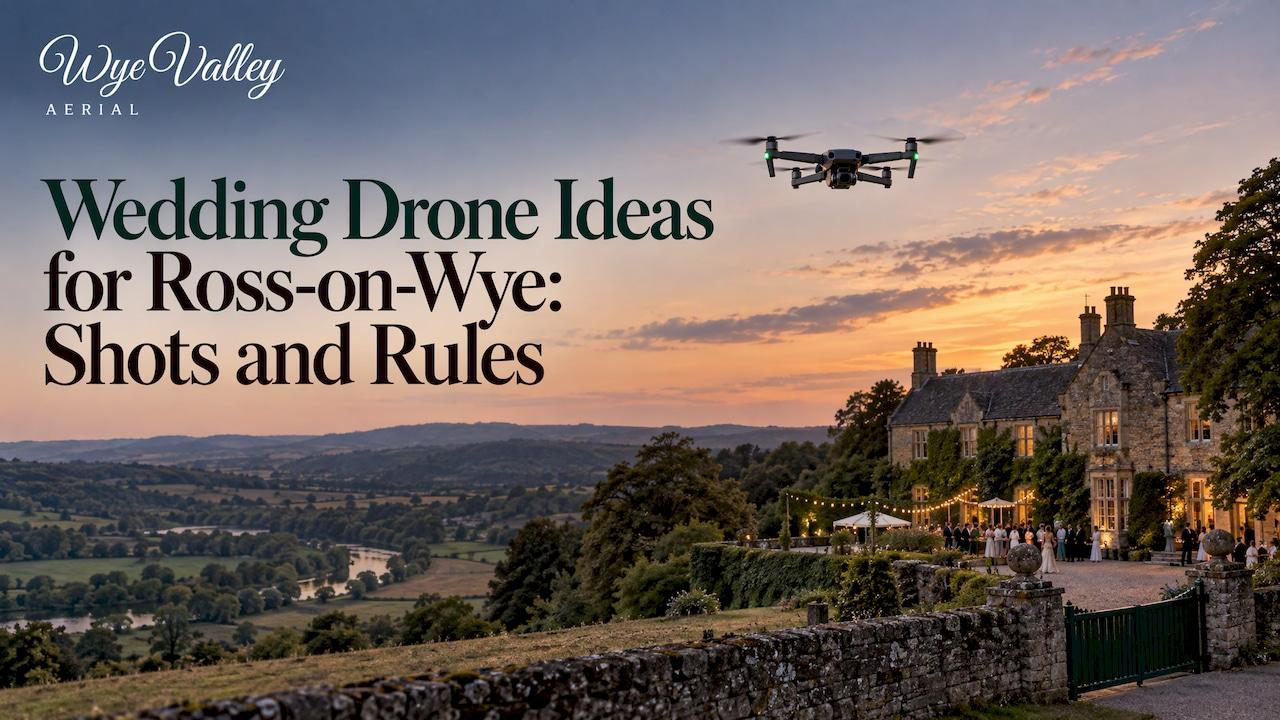
The best wedding drone shots in Ross-on-Wye use the landscape: a slow reveal of the venue, a tracking shot of the couple, and a high view of the river bend or hills. They work when a qualified pilot plans them around the ceremony, not over it. We fly weddings across the Wye Valley as a qualified pilot with an A2 CofC and full insurance, and we build a shot list around your venue, your timings and the people who need to stay undisturbed. This guide covers the ideas, the places, the rules and the planning.
TL;DR
- Pick three to five aerial moments, not twenty: an arrival or venue reveal, a couple tracking shot, an orbit and one wide landscape shot.
- Ross-on-Wye gives you the river, wooded hills, castle ruins and country-house grounds, so aerial context shots add real value.
- UK rules keep drones away from uninvolved people and crowds, so the flight plan has to be agreed with the venue before the day.
- Drone footage that shows identifiable people falls under data protection law, so a good pilot keeps flights respectful and tells guests what is happening.
- Ask for a free fixed quote early, so the aerial shots are planned into the day rather than squeezed in.
Table of Contents
- Why a drone suits a Herefordshire wedding
- Wedding drone shot ideas that work
- Ross-on-Wye and Wye Valley settings to consider
- Capturing the day without disrupting it
- UK drone rules for weddings
- Privacy and your guests
- Weather and light
- Planning checklist for couples and venues
- Our approach to wedding drone work
- Booking aerial wedding shots with us
- FAQ
- Sources
Why a drone suits a Herefordshire wedding
Ground-level wedding photos show the people. Aerial shots show where they are. In this part of Herefordshire the setting is often the reason couples chose the venue: a country house on a ridge above the Wye, an orchard marquee, a converted barn in open farmland, or a hotel with long grounds. A drone is the only way to show the scale of that setting in a film or an album.
It also changes the pace of the film. Footage shot from the ground cuts between close and medium views. A smooth aerial move gives the edit a breath, a way to open the day, change scene and close. That is why a short drone sequence tends to sit at the start and end of a wedding film.
What a drone does not do is replace the photographer or videographer. It adds a few carefully chosen shots to their work. If you are still deciding what to book, our guide to a wedding videographer versus a photographer explains where aerial footage fits.
Wedding drone shot ideas that work
These are the moves a pilot can plan in advance. Each one should be smooth and unhurried: jerky movement is what makes drone footage look amateur.
The reveal
The drone starts low behind something, such as a hedge, a tree line or a gatehouse, and rises to show the venue or the surrounding valley. It is the classic opening shot because it tells the viewer where they are before a single guest appears. It suits grand arrivals, country-house lawns and any venue with a good approach.
The tracking shot
The drone follows the couple as they walk, perhaps along a drive, across a field or down a lane after the ceremony. Keep the walk slow and the distance generous. This shot works best when the couple are the only people in frame, which is why it is usually planned for a quiet moment away from the main group.
The orbit
The drone circles the couple, or the venue, in a slow arc. For people it needs space and a calm moment, such as the couple standing alone at a viewpoint. For a building, an orbit shows a house, barn or castle ruin from every side and gives the editor a flexible clip.
The high wide
A single frame from well above showing the venue in its landscape: the river loop, the fields, the hill line. This works as a still for an album page or a framed print, and as a closing shot in a film. It is the shot most couples say they would not have thought of.
The grounds map
A straight-down shot of the lawn, marquee or ceremony layout before guests arrive. It records the day's set-up from above, the table plan, the aisle, the flowers, in a way no ground photo can. It takes a minute and does not involve any guests at all.

The golden hour send-off
If the timeline allows, an early-evening flight over the venue with low sun along the valley is often the most memorable footage of the day. Weather and light decide whether it happens, so ask your pilot how they handle rescheduling. Our own service is flexible on rescheduling for weather.
Ross-on-Wye and Wye Valley settings to consider
The area is unusually good for aerial work because the geography is varied within a few miles.
- The river and the Wye bends. Wide shots following the water give a sense of place that is unmistakably Wye Valley. Our Ross-on-Wye drone photo spots guide covers where flying and shooting works in the town and nearby.
- Castles and ruins. The English Heritage page for Goodrich Castle itself promotes the idea of flying over the castle through drone footage, which shows how well this sort of setting looks from above. Any flight at a heritage site needs the site owner's permission, so ask before you plan a shot there.
- Country houses and hotels. Long drives, parkland and walled gardens suit reveals and grounds maps. Venues usually have their own rules on flights, and for hotels our note on the checks before approving a flight sets out what a manager should look at.
- Barns and farm venues. Open farmland gives pilots room, and many rural weddings happen at converted farm buildings. If you or your family are thinking about turning land into a venue, this overview of farm or barn wedding venues covers the planning side.
- Hills and woodland. Autumn colour in the valley and spring blossom in the orchards make seasonal shots that suit a venue's own character.
A drone is also useful for the venue itself: hotel and estate managers can use the same footage for promotion, which is why we often agree the shot list with the venue as well as the couple.
Capturing the day without disrupting it
This is the question couples worry about most, and the answer is mainly planning. A drone is audible, and a pilot who flies at the wrong moment can ruin a ceremony. A well-run job follows a few principles.
- Fly before and after, not during. Most aerial footage is captured in the gaps: before guests arrive, between ceremony and reception, and at the golden hour. The vows stay a ground-level affair.
- Agree the timings with the venue and the other suppliers. The photographer, videographer and coordinator should all know when the drone will be up, so no one is surprised.
- Keep the pilot's position away from the guests. A take-off and landing point on a quiet edge of the grounds keeps the noise and attention low.
- Brief the guests. A quick word from the coordinator or a note on the order of service means nobody is startled. This also helps with privacy, covered below.
- Write the shot list in advance. We provide bespoke shot lists, so the flight is short, focused and the pilot is not wandering about hoping for something good.
Short, planned flights also protect batteries and daylight, and they give you a better edit: five great clips beat fifty average ones.
UK drone rules for weddings
Wedding drone flying is regulated by the Civil Aviation Authority (CAA), and the rules matter more at weddings than almost anywhere, because there are lots of people about.
Open category and distance from people
Most wedding flights fall in the CAA's Open category, which has three subcategories based on how close the drone flies to people who are not involved in the flight. According to the CAA, A1 allows flights over uninvolved people but not over crowds, and applies to lighter drones. A2 needs an A2 Certificate of Competency, a Flyer ID and an Operator ID, with a 30m separation from uninvolved people for UK2 drones, reducible to 5m in low-speed mode. A3 requires at least 50m from uninvolved people and at least 150m from residential, commercial, industrial or recreational areas.

The official regulation text says the same thing for A2: at least 30m horizontally, with a reduction under low speed only after the pilot has assessed the weather and other factors, and it also sets competence requirements for the remote pilot (UK Regulation 2020/639). For A1 flights, the pilot must not overfly assemblies of people, as that same regulation states.
In plain terms: a wedding crowd is an assembly of people, and the drone must not fly over it. That is why aerial shots are planned for moments when guests are indoors, seated elsewhere or not present. Our article on the 50 metre rule before booking goes through how this affects a booking, and our guide to A2 CofC 30m and 5m distances explains why the qualification gives a pilot more flexibility near people.
IDs and registration
The CAA's Drone and Model Aircraft Code says a Flyer ID is required to fly a drone of 100g or more, and an Operator ID is needed for the person responsible for a drone of 100g or more that has a camera. Any drone used for wedding filming has a camera, so the operator must have one. When you hire a pilot, you are not responsible for these, but you can expect your pilot to hold them. Ours is a qualified pilot with an A2 CofC, full insurance, and flight plans in line with CAA rules.
Permission to take off and land
Separate from aviation law, the pilot needs the landowner's permission to take off from and land on private land. Venues commonly set their own rules on drones, so tell your venue early. Our guide to drone filming over private property covers what the law says about this.
Risk assessment
A professional flight starts with a written assessment of the site, the people nearby, the weather and what could go wrong. Our guide to what a drone filming risk assessment must cover lists the points, and it is one reason a plan agreed in advance is calmer than an improvised flight.
Privacy and your guests
A wedding film with aerial footage still includes people, and in the UK people in footage are protected by data protection law. The Lake District National Park authority notes that drones can infringe privacy if used intrusively, and that the Data Protection Act 2018 and UK GDPR protect personal data, including photographs and film from which people can be identified.
The Information Commissioner's Office says that people may not realise they are being recorded by a drone, and that privacy information should be provided where appropriate, through signage, a website privacy notice or other means. It also flags the risk of collateral intrusion, because a drone's height gives it a wide view (ICO guidance on drones).
In practice for a wedding:
- Tell guests that a drone will be used and roughly when.
- Keep flights away from neighbouring gardens and properties.
- Let guests who prefer not to appear tell the coordinator, and plan shots around them.
- Share footage with the couple by a private link, not publicly, unless everyone agrees.
Weather and light
Drones are sensitive to wind and rain, and the Wye Valley's hills can channel the wind. Strong gusts, low cloud and heavy rain can ground a flight. A good plan includes a window of time rather than one fixed moment, and a pilot who is willing to move the flight to a better slot. Rescheduling for weather is built into how we work.
Light matters as much as wind. Flat midday sun gives flat footage; morning and early evening light brings out the river and woodland. If your timeline is tight, pick the one shot that matters most and place it in the best light available.
Planning checklist for couples and venues
Before you book anyone to fly at your wedding:
- Choose the venue and ask if drone flights are allowed, and where the pilot can take off.
- Confirm the pilot holds the right qualification, Flyer ID and Operator ID, and insurance. Our article on drone operator qualifications in the UK explains what to expect.
- Decide on three to five shots and when in the day they happen.
- Tell your photographer, videographer and coordinator.
- Let guests know.
- Ask for a fixed quote and the delivery format. Our guide to wedding drone costs in the UK explains what affects the price.
Our approach to wedding drone work
Weddings are the job where a drone pilot's planning shows most. The flight itself is short. What makes the footage good is what happens before it: walking the site, agreeing when the grounds will be empty, and knowing which three shots matter to you.
We work as a qualified pilot with an A2 CofC and full insurance, and we follow CAA rules and file a flight plan. We tailor the shot list to your venue and give you fully edited stills or a short film by download link. That means you do not have to chase files or work out how the footage fits your film.
If the weather turns, we can reschedule, so the aerial shots do not rest on one fixed hour. The result is footage that looks like your wedding, in your landscape, without a drone buzzing over the vows.
Rhys
Booking aerial wedding shots with us
We offer property stills, stills with a short film, a half day on site and a full day, all quoted individually and free of charge. You tell us your venue, your date and the moments you want, and we give you a fixed quote in advance. Details of each option are on our services page, and you can reach us from the Wye Valley Aerial Imaging home page.

We cover Ross-on-Wye, Monmouth, Chepstow, Coleford and Lydney, so most Wye Valley venues are within our area.
FAQ
Can a drone fly over wedding guests in the UK?
Not over a crowd. Under the CAA's Open category, flights over uninvolved people are only allowed for the lightest drones and never over assemblies of people. Larger drones must keep a distance of 30m, or 5m in low-speed mode with an A2 CofC, and 50m in the A3 subcategory. This is why aerial shots are planned for quiet moments.
Do I need permission from the venue to use a drone at my wedding?
Yes, ask the venue before you book. The pilot needs permission to take off and land on private land, and many venues have their own policies. Heritage sites and hotels in particular may have extra rules, so raise it at the first conversation.
How many drone shots do I need?
Three to five is plenty for most weddings: a reveal of the venue, a couple tracking shot, an orbit and a high wide shot, perhaps with a grounds map before guests arrive. Fewer, better planned shots make a stronger film than a long list.
Does the drone get in the way of the ceremony?
It should not. Flights are normally scheduled before the ceremony, after it, or at golden hour, with the take-off point away from guests. Agreeing timings with the venue, photographer and videographer keeps the vows quiet.
What if it rains or is too windy on the day?
The flight can move to a better time slot, or to another day if the aerial shots are a separate booking. Tell your pilot your timeline so they can pick the best weather window. We offer flexible rescheduling for weather.
Sources
- CAA: Introduction to more advanced flying
- CAA: The Drone and Model Aircraft Code
- UK Regulation 2020/639, Part A
- English Heritage: Goodrich Castle
- ICO: Unmanned Aerial Systems (drones)
- Lake District National Park: Flying drones