
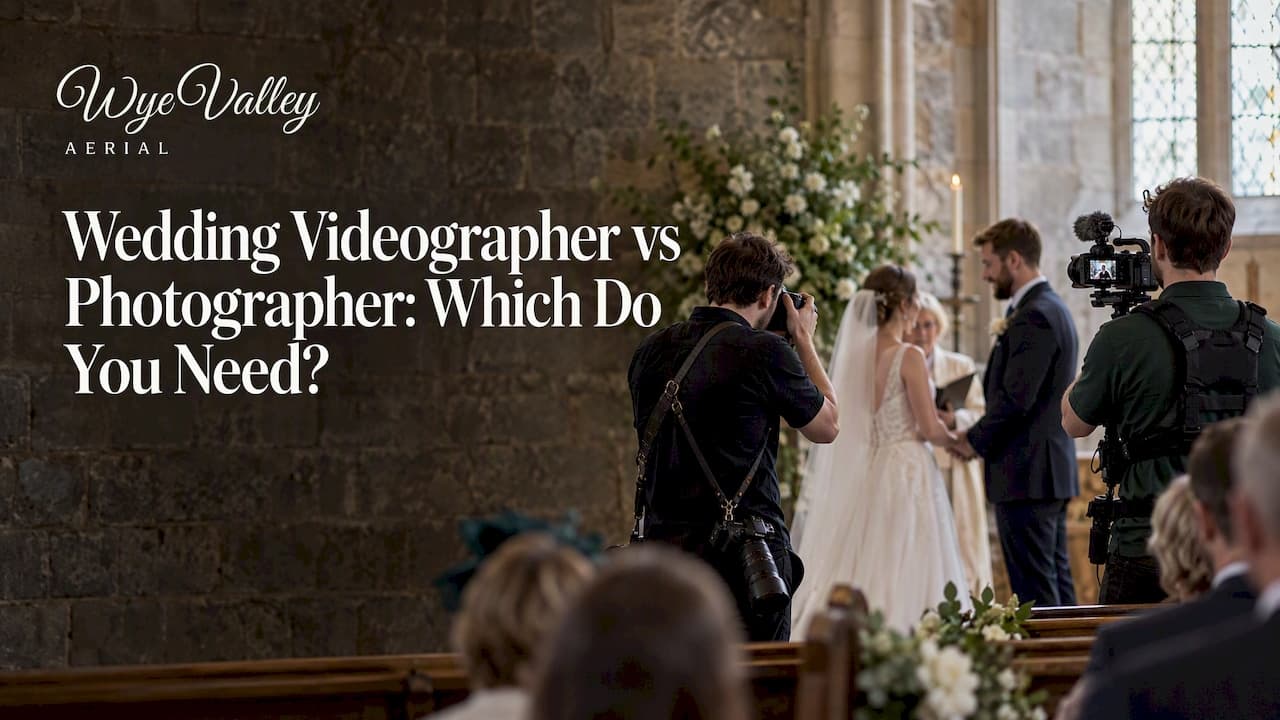
A photographer gives you images you can hang, print and put in an album. A videographer gives you a film with movement and sound: the vows, the speeches, the laughter. They are different mediums, not rival versions of the same job. If your budget stretches to only one, most couples are better served by a dedicated photographer first, then adding video if the money is there.
This guide sets out what each does, what they cost in the UK, how to decide, and where an aerial pilot fits in if your venue is worth showing from above.
TL;DR
- Photography captures still moments for display. Videography preserves movement, voices and atmosphere. One cannot properly replace the other.
- UK couples typically budget around £1,400–£2,000 for photography and £1,300–£1,500 for video, though quotes vary widely by region and package.
- If you can afford only one, book the photographer first, and make sure the photography coverage is adequate before expanding to video.
- Drone footage is a garnish, not a main course. Check your operator holds the right CAA permissions before you book.
- A photographer and videographer who have worked together before will share space far more smoothly, so ask each for recommendations.
Table of Contents
- What a photographer and a videographer each capture
- What each costs in the UK
- Do you really need both?
- Getting the two to work together
- Where drone footage fits
- Our view: aerial is a supporting act
- Aerial shots for your Wye Valley wedding
- A practical checklist before you book
- FAQ
- Sources
What a photographer and a videographer each capture
The simplest version: photography gives you images, videography gives you film. Each preserves something different about the day.
A photographer gives you high-resolution stills: the portraits, the details, the dress, the rings, the group shots you will want on the mantelpiece. Stills are made for display, so albums, framed prints and wall art are their natural home. A frame pulled from video is not a substitute, because camera resolution, depth of field and editorial precision differ.
A videographer records what a still cannot: the crack in someone's voice during a reading, your grandfather's speech, the sound of the room when the first dance starts. Video also tends to feel more natural to be filmed for. Photography asks couples to pose and look at the camera, while video is more observational.

An American wedding studio makes the same point from its own side of the trade, arguing the two are complementary rather than interchangeable. The article is written for couples in Texas, so ignore its local details, but the reasoning on what each medium keeps is sound.
Side by side
| Photographer | Videographer | |
|---|---|---|
| Main output | Edited stills, gallery, album, prints | Highlights film, sometimes a full ceremony and speeches edit |
| Preserves | Faces, details, composed moments | Movement, audio, atmosphere |
| Feels like on the day | Some posing and direction | More observational, less interruption |
| Kit and setup | Lighter, quicker to move | More gear, longer to set up and plan |
| Best for | Display, sharing, family keepsakes | Rewatching, sharing with those who could not attend |
What each costs in the UK
Figures differ by source, region and package, so treat all of them as a range, not a promise.
One 2025 budget breakdown puts photography at £1,400–£1,600 and videography at £1,300–£1,500, which is roughly 6% of the typical wedding budget each. A 2026 UK pricing guide is higher for video, saying most couples pay between £1,400 and £2,500, with highlights-only films from newer videographers starting around £700 and premium cinematic packages going beyond £4,500.
What moves the price:
- Hours of coverage. Full-day coverage costs more than ceremony and reception only.
- Number of operators. A second shooter adds cost, and adds angles.
- What you receive. A three-minute highlights film is a different job from a full edit of ceremony and speeches.
- Location. London-based videographers frequently charge a 40–70% premium over regional providers. If you are marrying in the Wye Valley or the Forest of Dean, it is worth getting quotes from people who work in the area.
- Drone work. Aerial footage is a cost driver in its own right, as the Bookt guide notes.
Do you really need both?
The honest answer depends on what you will miss in ten years.
The numbers are mixed, which is useful. According to one compilation of wedding statistics, 37% of couples book a videographer, and roughly 19% name not booking one among their top regrets. Another source quotes a higher figure from a Zola survey, saying 35% of couples regret not hiring one. The surveys are largely American and use different samples, so do not read too much into the gap. The pattern is what matters: a meaningful minority wish they had booked video, and few wish they had spent less on it.
There is a twist. 42% of couples regret not having a second photographer, which makes thin photography coverage the most-regretted cut in that data. So before adding a video package, make sure the stills are properly covered.
A simple way to decide
- Start with the photographer. Stills are what you will display and share most.
- Ask what you would grieve losing. If the answer is voices (a parent who is frail, a toast you know will be special), video moves up the list.
- Check the numbers. Price a highlights film rather than a full edit if money is tight.
- Decide before you are too far along. Videographers tend to be booked later than photographers, with a median of around 10.4 months before the wedding, but good ones in popular seasons still go.
Hybrid packages: one person, both jobs
Some suppliers offer a single person shooting stills and video. Professionals commonly warn that hybrid services often compromise one or both mediums, and that two dedicated specialists working as a team usually deliver better results. A small number of highly skilled hybrid shooters do exist. If you consider one, ask to see full wedding galleries and full films from the same event, not a highlights reel of each.
Getting the two to work together
Two professionals in one ceremony can be a gift or a headache. The difference is usually whether they have met before.
The most common route to a videographer is a photographer's recommendation: 32% of couples cite it as the main trigger for their hire. The reason is practical. Teams that have worked together share the space, communicate during the ceremony and avoid blocking each other's shots.
A few things to do:
- Ask your photographer which videographers they enjoy working with.
- Share the timeline with both suppliers at the same time.
- Agree where each will stand during the ceremony, particularly in a small church or a barn with a single aisle.
- Do not over-research. Couples who compare seven or more videographers report lower satisfaction than those who compare just one or two. Shortlist two or three whose work moves you, and book.
Where drone footage fits
If your wedding is at an estate, a country house or a riverside venue, you may be offered aerial shots as an extra. Neither the photographer nor the videographer is replaced by a drone. It adds one angle: the scale of the place and its setting.
Film specialists suggest using it with intent. Sparingly, it gives an establishing sense of scale and venue grandeur that ground cameras cannot reach. Overused, it can feel more like a property showcase than an emotional film. A few well-placed shots, such as the arrival, the venue in its landscape and the grounds at golden hour, usually do more than a constant bird's-eye view.

The legal bit couples should check
Drone flying in the UK is regulated, and your guests are the reason it matters. A professional operator should hold a CAA Flyer ID and an Operator ID. For weddings with guests present, an A2 Certificate of Competency is what allows flying closer than the standard 50-metre separation from uninvolved people. The same source warns that using an operator without proper certifications can compromise the wedding and expose the couple to liability.
The A2 CofC is awarded by CAA-approved assessment providers, is valid for five years and requires a Flyer ID first. Ask any aerial supplier to show their certificate, their insurance and how they will plan the flights around your guests. Our guide to the UK 50 metre rule for wedding drone video goes through the questions in more detail.
Our view: aerial is a supporting act
We are an aerial imaging business, so you might expect us to push drones. We would rather be straight with you.
We do not replace your photographer or your videographer, and we would not suggest you try. Our job is the view they cannot get: your venue, its grounds and the surrounding Wye Valley countryside, shot from the air and delivered as edited stills or a short film via a download link. A couple who has the ground coverage right and then adds a short aerial sequence usually ends up with the better wedding film, because the drone shots have a purpose.
Three things we think matter most:
- Qualifications first. Our flights are run by a qualified pilot with A2 CofC certification and full insurance, following CAA rules and a flight plan. Ask every aerial supplier the same.
- A shot list, not a free-for-all. We build the shots around your venue and your timetable, so the drone is not buzzing over the ceremony.
- Weather flexibility. A windy or wet day is a reason to reschedule, not to fly regardless. We offer flexible rescheduling for weather.
If we are working alongside your photographer and videographer, we will agree timings with them, because a team that talks beforehand makes better pictures.
— Rhys
Aerial shots for your Wye Valley wedding
If you are marrying around Monmouth, Ross-on-Wye, Chepstow, Coleford or Lydney and want your venue shown from above, we offer bespoke aerial photography and film, with free fixed quotes in advance. See the services we offer, check the area we cover, or tell us about your day through our main site.
A practical checklist before you book
- Decide your priority: stills for display, film for sound and movement, or both.
- Ask each supplier for a full gallery or full film from a recent wedding at a similar venue.
- Confirm exactly what you receive, how it is delivered and when.
- Ask whether the photographer and videographer have worked together.
- Get written confirmation of hours of coverage and any second shooter.
- For aerial footage, ask for proof of Flyer ID, Operator ID, A2 CofC and insurance, and check the venue's permission.
- Keep a weather plan for anything outdoors.
FAQ
Is a videographer worth it at a wedding?
For many couples, yes, if the sound and movement matter to you. Video keeps vows, speeches and emotional moments in motion with audio, which photographs cannot. If photography coverage is still thin, spend there first.
Do you need a photographer and a videographer for a wedding?
No, but they do different jobs. A photographer covers stills for albums and prints, and a videographer preserves the day as a film. If you can only afford one, a dedicated photographer is the usual starting point.
Is a photographer the same as a videographer?
No. They use different equipment, different skills and different editing. Some people offer both, but professionals often find that dedicated specialists produce stronger results in each medium.
Will I regret not having a videographer at my wedding?
Some couples do. In one dataset, about 19% list it among their top regrets. If you doubt you would regret it, a short highlights film is a cheaper middle route than a full edit.
Do I need a drone at my wedding?
No, and used too much it can distract from the people. If your venue has a striking setting, a few aerial shots can add scale. Make sure the pilot holds the right CAA qualifications for flying near guests.
Sources
- Photography vs videography, Flower and Oak
- Should we have a videographer, Hitched
- How wedding videographers and photographers should work together, Sambaly Films
- Average wedding cost UK 2025, Charlotte Burn Photography
- How much does a wedding videographer cost in the UK, Bookt
- Wedding photography statistics 2026, Pix
- Is wedding video worth it, Anatole
- Wedding photography statistics 2026, Snapeen
- How couples choose a wedding videographer, OurStoria
- Hybrid wedding photography, The Societies
- Drone wedding videography, Wedding Film Studio
- Wedding drone footage, Wedding Video Essex
- A2 CofC drone licence, Hire Drone Pilot