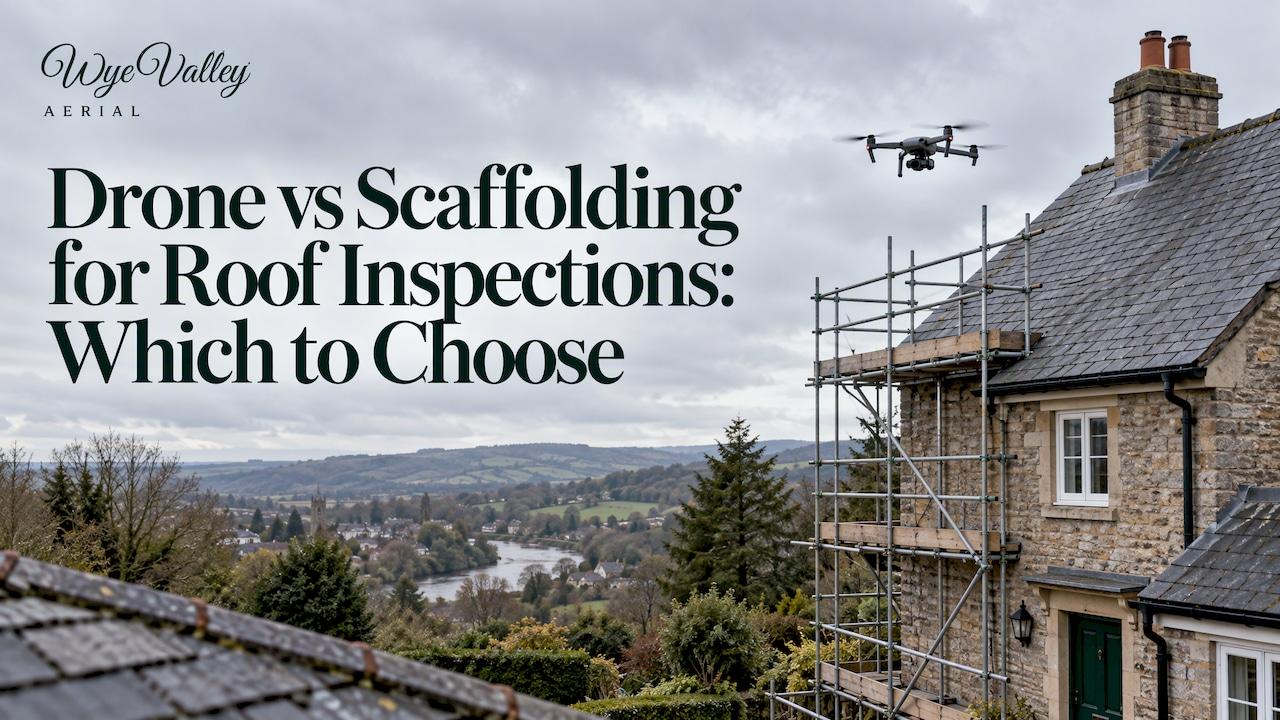
If you need to know what condition a roof is in, a drone survey is the sensible first step: it is quicker, it needs no one on the roof, and it costs a fraction of erecting scaffolding. Scaffolding earns its place later, when a roofer has found a fault that needs repair and needs a safe platform to fix it. Used in that order, you pay for access only where the work needs it.
This guide is for homeowners, landlords, estate and hotel managers and roofers who want to see what is on a roof, chimney or façade before spending money. It sets out what each method does, what it costs in time and disruption, the safety and legal points, and how to commission a survey.
TL;DR
- A drone survey photographs the roof from above and around it, with no ladders and no one on the roof. Scaffolding gives people physical access, which is a different job.
- One UK council reports its drones survey rooftops in as little as 20 minutes, with scaffolding put up only where repairs are needed.
- Scaffolding costs thousands of pounds in the council's own words; a drone survey costs a few hundred.
- The pilot should hold an A2 Certificate of Competency, carry insurance and follow CAA rules, especially near houses and people.
- Survey first, scaffold only for the repair: that order avoids paying for access you may not need.
Table of Contents
- What each method actually does
- Drone vs scaffolding at a glance
- Cost: a few hundred pounds against thousands
- Time and disruption
- Safety: the case for keeping people off the roof
- The rules for flying near homes
- What a drone survey shows
- When scaffolding is still the right call
- How to commission a drone roof survey
- Our view
- Book a roof and building check
- FAQ
- Sources
What each method actually does
The two are often compared as if they were rivals, but they answer different questions.
A drone roof survey is a visual inspection. A qualified pilot flies a camera drone around and above the roof, chimney, gutters and walls, capturing high-resolution stills and video. You get a set of images showing the condition of the surface: slipped or cracked tiles, lifted ridge tiles, damaged flashing, blocked gutters, moss build-up, chimney pots and mortar. The images go to you, your roofer or your insurer.
Scaffolding is temporary structure that lets people stand at height. It lets someone touch the roof, lift a tile, check the underside of a joint and carry out repairs. It is there to give workers a safe place to stand and work, so it is essential for repair and heavy work but expensive and slow as a way to simply look.

So the real choice is not drone or scaffold. It is whether you need to look or to work. If you need to look, a drone gets you there first. If you need to work, scaffolding or another form of access follows once you know what the job involves.
Drone vs scaffolding at a glance
| Drone roof survey | Scaffolding | |
|---|---|---|
| Main purpose | See and record condition | Provide access to work at height |
| Time on site | Typically a short visit | Erection and removal take days, plus the hire period |
| People at height | None | Scaffolders, then the inspector or roofer |
| Disruption | Minimal; usually no access needed inside the property | Blocks paths, drives and windows, may need permissions |
| Cost | A few hundred pounds, according to one council | Thousands of pounds, according to the same council |
| Output | Photos and video you can share and keep | A platform; the inspection record is separate |
| Best for | Condition checks, quotes, sale and insurance evidence | Repairs, rebuilds and hands-on work |
Cost: a few hundred pounds against thousands
Hackney Council described its drone programme in June 2026. It says its drones can examine council rooftops in as little as 20 minutes without scaffolding, and its councillor notes that scaffolding can cost thousands of pounds, whereas a drone costs a few hundred pounds. Scaffolding is then installed only where repairs are actually required.
That is a public landlord with a large estate, but the logic carries to a single house. Scaffolding to inspect a roof means paying for erection, hire and removal before you know whether anything is wrong. If the roof turns out to be sound, that money has bought you nothing. A drone survey puts the cost where the information is.
The price of a drone survey depends on the size and height of the building, how many elevations you need, and the travel. If you want the figures in more detail, we have written separately about what a drone roof inspection costs and what drone inspections cost in the UK in 2026. Our own jobs are individually quoted, and the quote is free.
Time and disruption
Scaffolding has to be ordered, delivered, erected, checked, used and taken down. Even for a modest house that is days of lead time, and the structure sits on your drive or garden for as long as it is hired. Neighbours notice. Access to doors and windows can be affected. For a hotel or an estate with guests and events, that is a real cost in itself.
A drone survey is mostly a morning or an afternoon. The pilot arrives, checks the site and the weather, flies the building and leaves. Nothing is left standing. For a hotel manager, a landlord with a block of flats or an estate manager with outbuildings, that means the property keeps operating while it is inspected.
Weather matters to drones more than to scaffolding. Wind and rain stop flights. We build that into the job and reschedule for weather, so you are not paying for a flight that could not safely go ahead.
Safety: the case for keeping people off the roof
Work at height is a leading cause of serious injury in UK workplaces, and the Health and Safety Executive's own guidance on roofs starts from caution. Its fragile-roofs guidance says to do work without going onto the roof where possible, noting that inspections can be done from ground level or from a mobile elevating work platform, and short-duration work from a secured ladder. It also advises assuming that any roof is fragile unless you are certain it is not.
A drone fits that approach neatly. It produces a close, detailed view of the roof without anyone standing on it or climbing to it. For a roofer, that means arriving to a job already scoped, with photographs of the problem areas and a clearer idea of what equipment is needed. For a homeowner, it means nobody has to balance on a ladder to look at a chimney.
If you manage a site where people work at height, it is worth understanding your duties; this overview of the regulations for working at heights is a helpful starting point on the safety side.
Our drone flights are operated by a qualified pilot who holds an A2 CofC and full insurance, with flight plans prepared and CAA rules followed. That is the standard to expect from anyone you hire, and it brings us to the legal side.
The rules for flying near homes
Many readers ask whether it is even legal to fly a drone over or near a residential property in the UK. It is, if the pilot works within the rules for the category of flight. The details changed recently, so it is worth knowing the outline.
The Civil Aviation Authority records on its Drone Code updates page that from 1 January 2026 new registration requirements, a UK class-marking framework and Remote ID obligations took effect for UK1, UK2 and UK3 class drones. The same page notes that the A3 subcategory, for flying far from people, requires keeping at least 150 metres from residential, recreational, commercial and industrial areas and at least 50 metres from individual buildings. The regulatory text for subcategory A3 says the same and adds that the pilot must have completed online training and passed an online theory exam.
That is why a roof survey on a house in a village or town cannot be done under the A3 limits: you are by definition close to buildings and people. The route for this work is the A2 subcategory. UAS Feed's explanation of the framework says A2 "Near People" needs a UK2 or C2 class-marked drone, or a legacy drone under 2kg, plus an A2 Certificate of Competency. Standard separation from uninvolved people is 30 metres, which can be reduced to 5 metres in low-speed mode.
What this means for you: ask whoever you hire whether the pilot holds an A2 CofC and is insured. We explain the certificate and the 30 m and 5 m distances for Wye Valley work in our A2 CofC guide, and the wider requirements for paid roof jobs in our piece on drone operator qualifications.

What a drone survey shows
A good survey gives you a clear visual record of the parts of the building a drone can see. In practice that covers:
- Roof coverings: slipped, cracked or missing tiles and slates, lifted ridge or hip tiles.
- Chimneys: pots, flaunching, mortar joints, flashing and stack condition. See our note on chimney drone inspections.
- Gutters and downpipes: blockages, vegetation, misaligned or sagging runs. See gutter inspection by drone.
- Flat roofs and valleys: ponding, debris, visible membrane damage.
- Façades and high walls: cracking, staining and areas that need a closer look.
The result is photographs you can zoom into, which makes them useful for three groups in particular. Roofers can quote from images rather than guessing. Landlords and managing agents get a dated record of condition. Homeowners get evidence to show an insurer or a buyer. Our guide to drone inspection reports covers five checks to run on the photos you receive.
A photograph shows the surface. If it reveals something worrying, such as a patch of damaged slates or a chimney with crumbling mortar, the next step is for a roofer to look at that specific spot. That is the point where access equipment earns its cost, and it is a far smaller job than scaffolding the whole building to find out.
When scaffolding is still the right call
Scaffolding is the right tool in several situations, and a survey makes them easier to plan.
- Repairs and rebuilds. Re-roofing, chimney rebuilds, extensive re-pointing and similar work need a safe platform to stand on. A survey tells the scaffolder which elevations are involved and how much is needed.
- Hands-on checks. If a roofer needs to lift tiles, test fixings or look at the underside of a detail, someone has to get there. The HSE's fragile-roof guidance notes that a mobile elevating work platform or a secured ladder may do for short jobs, so full scaffolding is not always the only option.
- Long jobs. Where work takes days or weeks, a scaffold gives a stable, edge-protected working platform.
The pattern is consistent. Survey first, then provide access for the work the survey shows is needed. Hackney's approach follows exactly this order, with scaffolding installed only where repairs are required.
How to commission a drone roof survey
Here is the routine, with the points where jobs most often go wrong.
- Decide what you need to see. Roof only, chimney, gutters, all elevations, or a mix? Say whether the survey is for a sale, an insurance matter, a roofer's quote or a routine check. Vague briefs produce vague images.
- Check the pilot. Ask for the A2 CofC and the insurance. This is where cheap or casual operators fall short, and the risk is yours if something goes wrong. Our pilot holds the A2 CofC and full insurance, and we follow CAA rules on every flight.
- Get a fixed quote in writing. We provide free fixed quotes in advance, so you know the cost before you commit. Compare on what is included, not just the headline price.
- Agree access and timing. The pilot needs a safe take-off point and permission to fly from the site. We plan the flight around the building and reschedule for weather.
- Receive the files. Our stills and films are fully edited and delivered by download link, so you can pass them straight to your roofer or file them for your records.
- Act on the findings. Send the images to a roofer with the problem areas marked. Arrange scaffolding or a platform only for the repair that follows.
If you are managing a larger building, our guide on what UK property teams must ask before a drone building inspection goes through the questions in more depth.
Our view
We fly roofs in the Wye Valley, and the question we hear most is whether you really need scaffolding just to find out what is wrong. Usually you do not.
The sensible order is to look first and build second. A survey from the air tells you where the damage is, and a roofer can quote from the images instead of putting up a platform and hoping. Scaffolding then goes where the work is, not everywhere.
That is why we offer a roof and building check as one of our services. It is flown by a qualified pilot with an A2 CofC, fully insured, following CAA rules, and quoted free and fixed before we start. The same approach works for a chimney, a block of flats or a hotel roof.
If you are weighing up a survey against a scaffold, send us the address and what you need to know. We will tell you what we can capture and what it will cost.
Rhys
Book a roof and building check
We cover Monmouth, Ross-on-Wye, Chepstow, Coleford, Lydney and the surrounding Wye Valley. Our roof and building check puts a camera where it needs to be, without a ladder or a scaffold, and sends you edited stills or film by download link. The same pilot can also shoot property listings, hotels, estates and weddings from the air, as a half day or a full day on site if you need more.

See our services for the options, or get in touch for a free fixed quote.
FAQ
Can a drone replace scaffolding?
For looking at a roof, yes: a drone gives a close visual record without anyone climbing. It does not replace scaffolding for repair work, where people need a safe platform. The usual approach is to survey by drone first and arrange access only for what the survey shows needs fixing.
Is a drone roof survey cheaper than scaffolding?
Generally, by a wide margin. Hackney Council says scaffolding can cost thousands of pounds where a drone costs a few hundred. Exact prices depend on the building, so ask for a fixed quote based on your property.
Is it legal to fly a drone near houses in the UK?
Yes, with the right pilot qualification and drone class. Work close to homes and people falls under the A2 subcategory, which needs an A2 Certificate of Competency. Normal separation from uninvolved people is 30 metres, reducible to 5 metres in low-speed mode, according to the CAA framework.
What alternatives are there to scaffolding for reaching a roof?
The HSE says inspections can be done from the ground or from a mobile elevating work platform, and short jobs can sometimes be done from a secured ladder. For a pure condition check, a drone avoids the need for any of them.
Do I need to be at home during a drone survey?
Usually not for the flight itself, as long as the pilot can reach a safe take-off point and has permission to fly from the site. Tell us at the quote stage what access is available and we will plan around it.
Sources
- Hackney Council: the drones saving money and speeding up repairs
- UK Civil Aviation Authority: Drone Code updates
- CAA regulatory library: UAS.OPEN.040 UAS operations in subcategory A3
- UAS Feed: UK drone law explained
- HSE: Fragile roofs, CIS 68
- Regulations for working at heights: a 2026 guide