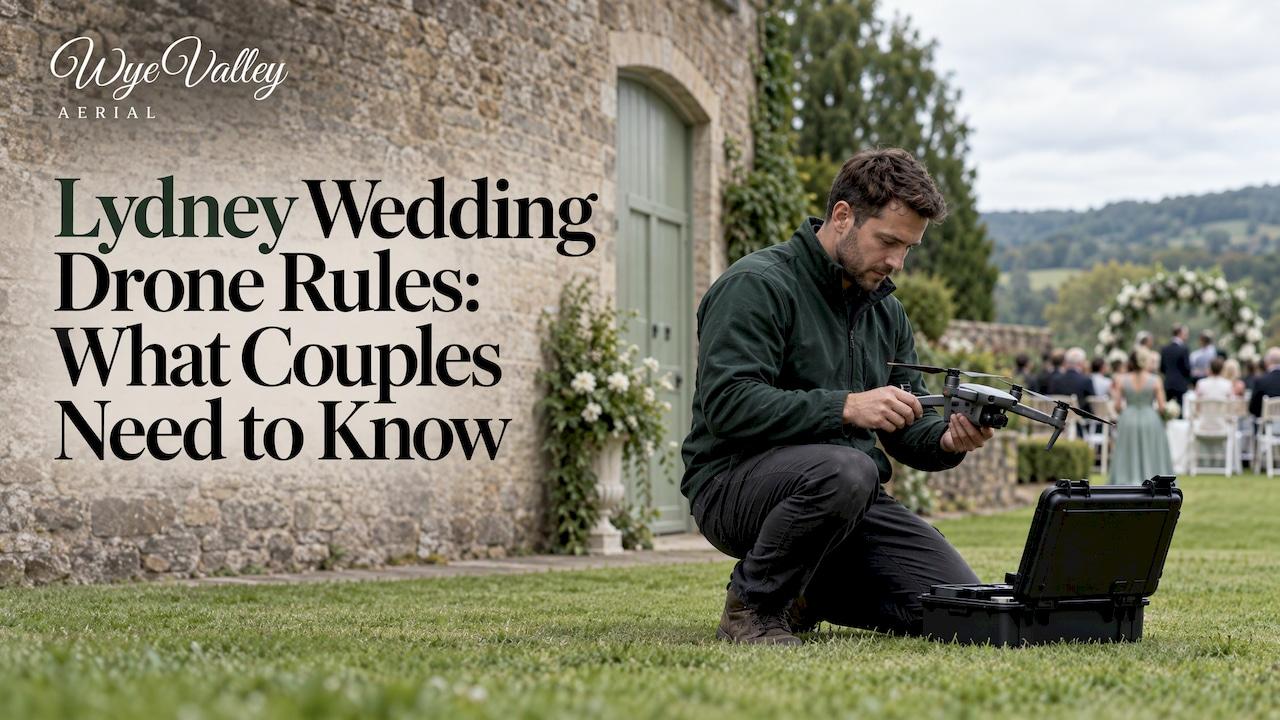
A drone can film your Lydney wedding legally, but only if four things are in place: the pilot holds the right CAA registrations and qualification, the airspace is checked on the day, the landowner or venue has said yes in advance, and the flight keeps clear of your guests. No airport restriction zone covers Lydney, so the rules that matter most are the ones about people and permission. Our pilot holds an A2 CofC (the CAA's Certificate of Competence for flying closer to people), is fully insured, and follows CAA rules and flight plans on every job, so you do not have to work any of this out yourself.
TL;DR
- Any camera drone of 100g or more needs both a Flyer ID and an Operator ID, and the pilot must stay below 120m (400ft) and keep the drone in sight.
- Drones must never fly over crowds, so a wedding pilot films the ceremony and guests from the side, at a distance, and saves the overhead shots for empty ground.
- Permission to take off and land comes from the landowner or venue, and churches, estates and forest land often have their own policies. Ask before you book.
- Airspace must be checked before every flight with an up-to-date source, not just the drone's own app.
- Ask your pilot for their qualification and insurance in writing. A qualified, insured pilot who follows CAA rules makes the permissions much easier to get.
Table of Contents
- Does Lydney have special drone restrictions?
- The national rules that apply at every wedding
- Your guests are not an uninvolved crowd, but they are not nothing
- Permission: who has to say yes?
- Privacy and flying over private property
- Safety on the day
- A short checklist for couples and planners
- What about roofers, estate managers and sellers?
- Booking drone footage for a Lydney wedding
- FAQ
- Sources
Does Lydney have special drone restrictions?
Lydney sits outside any airport flight restriction zone. One airspace mapping service lists no airport restriction zone within 30km of Lydney, and the same page reminds pilots to check live notices and protected sites. That is a useful starting point, but a map is not a clearance. The CAA tells pilots to check permanent and temporary airspace restrictions before every flight using the official NATS source, and warns that smaller airfields may not show up in apps.
What does change from place to place is who owns the ground and what they allow. Around Lydney that can mean a church, a private estate, a hotel garden, the harbour area or woodland in the Forest of Dean. Each owner can set its own terms for taking off and landing, and some set byelaws. The national drone rules are the floor. Local permission sits on top.
The national rules that apply at every wedding
Registration: Flyer ID and Operator ID
The CAA's guidance says a Flyer ID is required for any drone or model aircraft weighing 100g or more, and an Operator ID is required if that drone also has a camera. Almost every wedding drone weighs more than 100g and carries a camera, so the pilot needs both. The CAA's registration table shows that drones from 250g to 25kg need both IDs, and so do camera drones between 100g and 250g.
The rules changed at the start of 2026. The CAA's news and updates page confirms that from 1 January 2026 anyone flying a drone over 100g must hold a Flyer ID, and that Remote ID functionality is being introduced. The regulations themselves replace the old "C" class labels with "UK" class marks, with further requirements phasing in from 2028. For a couple, the practical point is simple: a pilot who is flying commercially in 2026 should be able to show current registration without hesitation.

Height and sight
The CAA sets the universal limits: no higher than 120m (400ft), no flying over crowds, no flying in restricted airspace, and the drone kept in direct visual sight at all times. That last rule matters at a wedding. A pilot who is also busy chatting to the photographer, or who is flying a long way over the trees, is not keeping the drone in view.
Distance from people
This is the rule that shapes what footage you actually get. The CAA's Drone Code says that drones under 250g or UK0 and UK1 class may fly closer than 50m to and over uninvolved people, but never over crowds. Larger drones in the A3 subcategory must stay 50m from uninvolved people and 150m from residential, recreational, commercial or industrial areas. Flying over crowds, or closer to residential areas than the code allows, needs CAA authorisation.

A qualified pilot with an A2 CofC can work closer to people with the right class of drone, which is why our pilot's qualification matters for close-range wedding and venue work. But "near" never means "over". If you want the detail on how the 50 metre figure plays out for a wedding party, our guide to the 50 metre rule before booking walks through it.
Your guests are not an uninvolved crowd, but they are not nothing
Couples often assume that guests who have said yes to being at the wedding are "involved" and therefore fair game for low passes. Production guidance from Filming in England takes a more careful line. It defines assemblies of people as situations where people cannot quickly move away, and states that overflying an assembly is illegal in the majority of Open category cases. The same guidance says buildings and vehicles should be treated as containing people unless known to be empty.
For a Lydney wedding, that shapes the shot list in a few predictable ways:
- Arrival and exterior. The venue building, the approach drive and the grounds are filmed from a distance, with the pilot treating parked cars and the venue itself as occupied.
- Ceremony. An outdoor ceremony with seated guests is a gathering where people cannot quickly step aside. The drone stays out of the airspace above them, and the pilot usually shoots wide establishing frames before guests gather or after they have moved on.
- Group photos. Overhead group shots are generally taken once the group is set and the pilot has agreed the position, with the drone kept clear of the people themselves.
- Golden hour and landscape. The best drone footage at most weddings is the setting: the estate, the river, the woods and the light. Nobody is underneath, so there is nothing to restrict.
That last point is why a drone is worth having. As the Forest of Dean and Severn estuary give Lydney some striking backdrops, we have a longer look at Lydney drone photo spots for ideas that carry no crowd issue at all.
Permission: who has to say yes?
The CAA says that you may need landowner permission to take off and land, and should check local byelaws. Production guidance adds that taking off or landing without permission could be civil trespass. Airspace itself is a separate matter: the CAA notes that owning the land beneath does not mean permission to launch lifts airspace restrictions, so both checks are needed.
In practice, there are three groups to ask.
The venue or estate
Hotels, barns and estates often have written drone policies, and some ban drones outright. Ask the venue for their position before you pay a deposit on the footage, not after. If you manage a hotel or estate yourself, our guide on three checks before approving a flight sets out what to ask a pilot for.
The church or ceremony site
Church rules vary. Churches have warned that permission is not automatic and that couples should get confirmation in advance. Some cathedrals go further: Norwich Cathedral, for example, requires prior written consent and proof of £10m indemnity insurance for any drone use. Lydney's own churches will have their own position, so ask the incumbent or parish office early and keep their reply in writing.
Public and shared land
Byelaws may restrict when and where you can fly. The CAA's Drone Code says to check local signs and that byelaws are unlikely to show on drone apps. Flying may also be temporarily banned around events such as airshows or festivals. Woodland and harbour areas near Lydney can have their own landowner rules, and the owner decides whether the take-off point is acceptable.
Our separate guide to wedding drone permissions in the UK lists the questions to ask each of these in order.
Privacy and flying over private property
There is no blanket law saying that flying above a house is illegal in itself. But the CAA says drone users must respect privacy and not cause a nuisance, must follow the same privacy rules as anyone using a camera, and need the owner's permission to fly from private property. The Drone Code adds that recording where people expect privacy, such as inside a home or garden, is likely to breach data protection law.
At a wedding this means the pilot should frame neighbouring gardens and windows out of the shot, and should know the camera's zoom and recording abilities. If your venue sits close to houses, mention it when you book. Our article on drone filming over private property goes into the legal detail.
Safety on the day
The Drone Code also requires that pilots be clearly identifiable when flying, that they stop immediately if an emergency incident happens nearby unless the emergency services give permission, and that they get the property owner's permission before retrieving a drone that has come down on private land. These are the sorts of things you want a pilot to have already thought about, not something to work out in the middle of your reception.
A sensible pilot also plans around the weather. Wind and rain shorten flights and can stop them, so flexibility on timing matters. We offer flexible rescheduling for weather on our shoots, which is helpful for roof and property work and for the edges of a wedding weekend.
A short checklist for couples and planners
- Ask the pilot for their Flyer ID, Operator ID and qualification. A2 CofC is the qualification for closer work. Ask for insurance details too.
- Get written venue permission. Ask both for taking off and landing, and for filming on the grounds.
- Confirm the ceremony site's rule. Church or chapel policy can differ from the reception venue.
- Agree a shot list that avoids overflying guests. Landscape, venue and arrival shots do most of the work.
- Plan a weather fallback. Agree in advance what happens if the wind is too strong on the day.
- Tell the venue if neighbours are close. It helps the pilot to frame out private gardens.
What about roofers, estate managers and sellers?
The same rules apply beyond weddings. For a hotel or estate manager the permission questions are the same: who owns the take-off point, are guests on site, what is the airspace like? For a homeowner selling a property, the pilot needs the owner's consent and should keep neighbouring gardens out of frame. For a roofer or landlord needing a roof check, flights are close to a building, so the pilot's qualification and sensible separation from people matter a lot; our guide to drone operator qualifications for paid roof jobs explains what to look for, and the commercial drone photography page covers what a client should receive at the end.
Our view on wedding drones
We think the rules are less of a barrier than couples fear, as long as the planning is done early. Most of the problems we hear about come from a missing permission, not from a drone being refused outright: the venue was never asked, the church was assumed to be fine, or the pilot turned up with no paperwork.
Our pilot holds an A2 CofC and flies with full insurance, following CAA rules and a flight plan for every job. That is the foundation. On top of it, we build a shot list around the site rather than around a template, because the best drone footage at a Lydney wedding is usually the setting: the grounds, the approach, the river and the light.
We keep the drone away from your guests, we plan around the weather, and we quote a fixed price in advance so there are no surprises. That is how a drone adds to the day without taking anything from it.
Rhys
Booking drone footage for a Lydney wedding
We provide aerial photography and film across the Wye Valley, including Lydney, Chepstow, Coleford, Monmouth and Ross-on-Wye. For weddings and venues we offer stills, stills with a short film, a half day on site or a full day, each built around a bespoke shot list and delivered as fully edited files through a download link. Quotes are free and fixed in advance.

Send us your venue, your date and the shots you have in mind, and we will tell you what is possible there. See the services we offer, or start from the Wye Valley Aerial home page. If budget is your first question, our guides to wedding drone cost in the UK and wedding drone video cost set out what affects it. Planning a wedding near the Herefordshire border? Read our Ross-on-Wye wedding drone ideas.
FAQ
Do I need a licence to fly a drone at a wedding in Lydney?
There is no single licence, but there are registrations. A camera drone of 100g or more needs an Operator ID, and the pilot needs a Flyer ID. For closer work near people, the pilot would normally hold an A2 CofC. Ask your pilot to show their details.
Can a drone fly over wedding guests?
No. The CAA says drones must not fly over crowds, and production guidance treats gatherings where people cannot quickly move away as assemblies that must not be overflown. A good pilot shoots the ceremony from a distance and uses overhead views only of empty ground.
Who gives permission for a drone at a church or venue?
The landowner or venue decides, because they control take-off and landing, and some set their own written policies. Ask the church office or venue manager early and keep their reply in writing. Airspace checks are a separate duty for the pilot.
Is it illegal to fly a drone over private property?
Not automatically. The CAA expects drone users to respect privacy, to avoid recording where people expect privacy such as gardens or inside homes, and to have the owner's permission to take off from private land. Airspace restrictions apply wherever you fly outdoors.
Did the drone rules change in 2026?
Yes. From 1 January 2026 anyone flying a drone over 100g needs a Flyer ID, and Remote ID and new UK class marks are being phased in. Check the CAA's news page for the latest position.
Sources
- Lydney drone no-fly zones and airspace map
- Where you can fly, UK Civil Aviation Authority
- Getting what you need to fly legally, UK Civil Aviation Authority
- Where you can fly (points 3 to 9), UK Civil Aviation Authority
- Airspace restrictions, UK Civil Aviation Authority
- Concerns about privacy and illegal use of drones, UK Civil Aviation Authority
- The Drone and Model Aircraft Code, March 2026
- News and updates, UK Civil Aviation Authority
- The Unmanned Aircraft (Amendment) Regulations 2025
- Filming with drones in the UK: Guidance for Productions
- Photography Policy, Norwich Cathedral