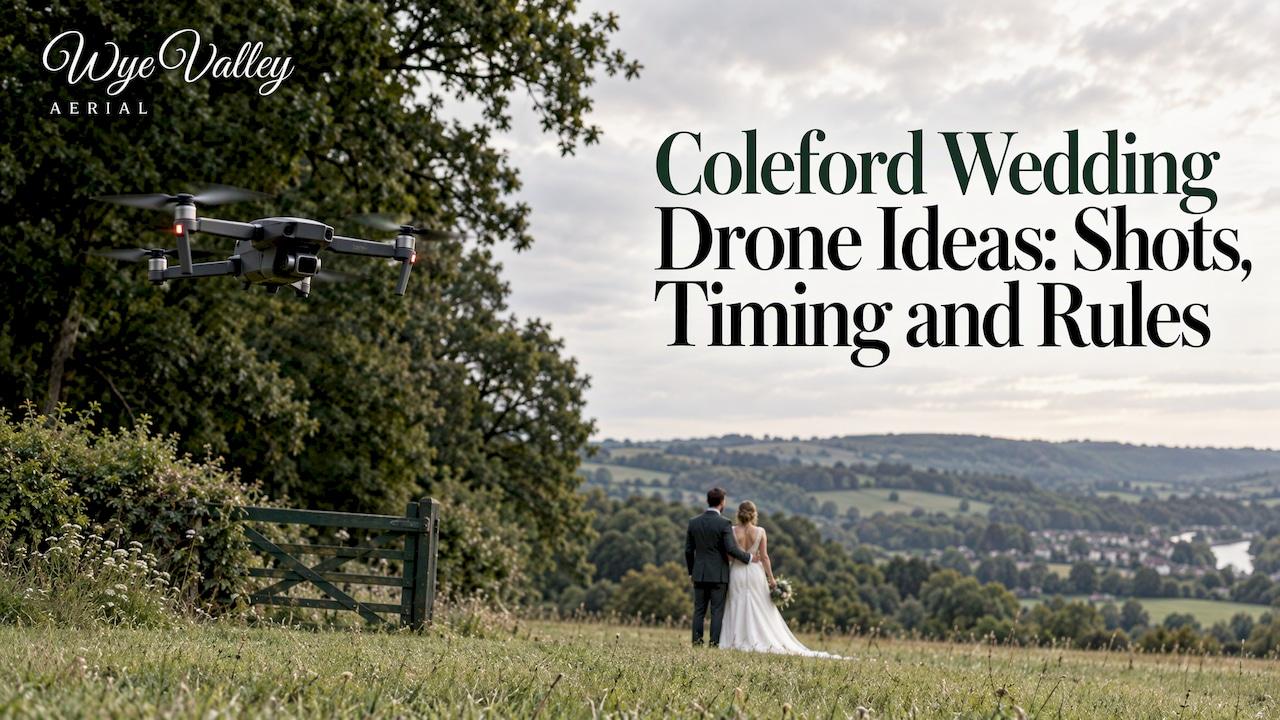
The best wedding drone ideas in and around Coleford are a wide shot that places the venue in the Forest of Dean landscape, a tidy overhead of the whole wedding party, and a slow reveal of the ceremony setting before guests arrive. All three can be flown in a ten to fifteen minute window, away from the ceremony itself, by a pilot who holds the CAA's A2 Certificate of Competency (A2 CofC) and carries insurance. That is how we fly at Wye Valley Aerial Imaging: we agree a shot list with you beforehand, keep flights to quiet moments and deliver fully edited stills or film by download link.
This guide is for couples, wedding planners and venue managers in and around Coleford. It covers which ideas are worth asking for, when to fly them, what the law says about flying near guests, and when to leave the drone in its case.
TL;DR
- Ask for three or four planned drone shots, not a running commentary: a venue-in-landscape establishing shot, a top-down group photo, an arrival or exit moment and a golden-hour wide.
- Schedule the flights in a natural break, such as the drinks reception or just before the meal, and brief the wedding party on where to stand.
- Under CAA rules, a drone must not fly over crowds and keeps its distance from people not involved in the filming, so the plan has to be built around your guests.
- Drone footage works best as contrast with ground-level photography: wide and scenic from above, close and emotional from the ground.
- Weather can move the schedule, so choose a pilot who offers flexible rescheduling and agree a fallback slot.
Table of Contents
- Why Coleford suits aerial wedding photography
- Eight wedding drone ideas that work
- Ground-level or drone: how to mix them
- Planning the flights without disrupting the day
- Weather, light and the Forest of Dean
- The rules: what the CAA says about flying near wedding guests
- When to leave the drone out
- Ideas for planners and venue managers
- Our approach to wedding aerial work
- Perspective: why we plan the flight around the guests
- FAQ
- Sources
Why Coleford suits aerial wedding photography
Coleford sits at the western edge of the Forest of Dean, with the Wye Valley a short drive away. That gives couples something many venues cannot offer: a ceremony or reception set in layers of woodland, river bends, stone farm buildings and open fields. From the ground, most of that is hidden behind trees and hedges. From 40 to 100 metres up, it reads as a single picture.
That is the real value of a drone at a wedding. It does not replace the photographer, and it is not there to film your vows. It shows where you got married, and it does it in a way that no ground-level lens can.
If you are still choosing a location, our guide to Coleford drone photo locations explains where aerial shooting works well and what to check about each place first.
Eight wedding drone ideas that work
Not every idea suits every wedding. Here are the ones that earn their place on a shot list, with a note on when each one goes wrong.
1. The venue in its setting
The classic. A slow rise or a steady wide shot, showing the venue, the grounds and the surrounding landscape. Aerial images are good at showing the venue in context with wide establishing views, which is exactly what a hotel, barn or country house needs for its own promotion too.
Best time: before guests arrive, or while they are inside for the meal. The venue is empty of people, the light is clean, and there is no question of flying near anyone.
Where it goes wrong: flying at midday under hard light, which flattens woodland into a dark green mass. Early evening light in the Forest is far kinder.
2. The top-down group photo
A large group is difficult on the ground. People at the back disappear, someone is always blinking, and a photographer has to climb a chair. From above, a group arranged in a shape, such as a heart, a circle or a simple fan around the couple, looks deliberate and clean. A drone can include more people without as much reshuffling as a ground shot.
Best time: right after the ceremony, while everyone is still together and sober enough to follow instructions.
Where it goes wrong: nobody has told the guests. Agree who will marshal them, and mark the spot. The wedding party is involved in the filming, which is different from a crowd of strangers, but the pilot still plans the flight so that the drone is never above anyone's head.
3. The arrival
The couple's car coming up a lane, or the guests walking to the ceremony across a lawn, is a lovely opening for a film. Done from a distance, it needs no one to change what they are doing.
Where it goes wrong: the shot is planned around the route, but the car runs late. Build in slack, and decide beforehand whether it is a must-have or a bonus.
4. The couple alone in the landscape
A portrait of the two of you, small in a field or on a woodland track, with the full scale of the place around you. It is one of the most distinctive images a Forest of Dean wedding can have, and it takes about five minutes.
Best time: golden hour, when the sun is low, or just after the meal when you slip out for a breath of air.
5. The reveal of the ceremony setting
A slow move from the treetops down to the ceremony arch, or from the lane up to the marquee. It works as a title shot at the start of a short film.
6. The confetti or exit moment, from distance
A wide, slightly raised view of a send-off down a path or avenue. It conveys the scale of the celebration. It must be flown at a distance, not over the guests, so the position of the line of guests matters to the plan.
7. The evening wide
Marquee lit up, fairy lights on, dusk sky. This is a short, beautiful flight, but the light fades quickly, so it needs an agreed time and a pilot who is comfortable with low light.
8. Location stills for the keepsakes
One or two clean aerial stills of the venue make a lovely framed print, an invitation back-cover or a thank-you card image. Ask for these to be delivered separately from the film.
Ground-level or drone: how to mix them
A drone is a wide-angle storyteller. It is not good at faces, hands, tears or the look between two people at the altar. Wedding commentators suggest that aerial work works best when it contrasts wide landscapes with close ground-level portraits, giving the story its rhythm.
So the rule of thumb is simple:
| Moment | Best from the air | Best from the ground |
|---|---|---|
| Venue and setting | Yes | Partly |
| Whole wedding party | Yes | Difficult for large groups |
| Vows and ring exchange | No | Yes |
| Speeches and toasts | No | Yes |
| Couple portraits | Wide scene only | Close portraits |
| Arrival and exit | Yes, from a distance | Yes |
If you are unsure whether you need a photographer, a videographer or both, our comparison of a wedding videographer versus a photographer helps you decide where the drone fits.
Planning the flights without disrupting the day
The most common fear is that a drone will take over the wedding. It does not need to, if you plan the flights like any other supplier slot.
- Agree the shot list in advance. We build a bespoke shot list for each job and tailor it to your site. Name the three or four shots you must have and what is optional.
- Pick the windows. Ask your planner to fit the aerial shots into a specific time slot, ideally a natural break, such as the drinks reception, and to brief the wedding party on where to be and when.
- Choose the launch spot. The pilot needs a clear, quiet take-off area, away from guests and from the ceremony. Walk it with the venue manager in advance.
- Brief the guests. One announcement before the group photo is enough: where to stand, when to look up, when it will be over.
- Have a weather fallback. Wind and rain can stop a flight. Rescheduling flexibly for weather is part of how we work, so agree a second slot rather than hoping for a dry afternoon.
- Agree delivery. Edited stills or film arrive by download link. Ask what is included, so the first time you see the drone footage is not on a Sunday morning after the honeymoon.
The cost depends on how long the pilot is with you and what you want edited. Our guides to wedding drone costs in the UK and wedding drone video costs set out what typically sits behind a quote. Our own jobs are individually quoted, and quotes are free and fixed in advance.
Weather, light and the Forest of Dean
The Forest is open to the weather on its high ground and sheltered in its valleys, so conditions at the venue can differ from the forecast for Coleford town. Two things matter most.
Wind. Most consumer drones have a safe wind limit of roughly 20 to 25 mph, and the figure is lower for small, light models. A gusty afternoon can cancel a flight that looked fine from the car park.
Rain and light. Rain can damage drone electronics that are not protected, and low cloud ruins an establishing shot anyway. Dull light flattens the woodland. If your date is in autumn or winter, plan the aerial window for the brightest part of the day, which is earlier than most couples expect.
As for the season, the Forest is at its most photogenic in late spring (fresh green and bluebells in the woods), in early autumn and in the golden weeks of October. Summer gives long evenings and good late light. Whichever you choose, the flexibility to move a flight within the day is worth more than the perfect date.
The rules: what the CAA says about flying near wedding guests
The legal side is where most couples get caught out, because a wedding is full of people. The Civil Aviation Authority (CAA) is the UK regulator for drones. Here is what matters, in plain terms. The current rules are published in the CAA's Drone and Model Aircraft Code.
Operator and flyer IDs. The pilot needs the right registrations and qualifications for the drone being flown. This is the pilot's job, but you are entitled to ask.
Distance from people. The standard rule is to keep at least 50 metres horizontally from people. People involved in what the pilot is doing, such as a wedding party taking part in a group shot, are treated differently from uninvolved onlookers. For drones between 250g and 500g, a pilot with an A2 Certificate of Competency can fly closer than 50 metres, but still must not intentionally fly over people.
Crowds. The CAA rules prohibit flying over crowds, which means groups of people who cannot move away quickly. This applies regardless of the drone's weight or class. A seated congregation or a packed dance floor are exactly that kind of group.
Newer drone classes. The CAA's guidance on more advanced flying says that certain C1-class drones may fly over uninvolved people from 1 January 2026 to 31 December 2027, but never over crowds. For a wedding, the safe reading is that a drone does not hover over the ceremony.
The practical outcome for you: the plan should keep the drone away from the seated ceremony and the packed dance floor, and place the flights where guests are few, are involved, or are standing clear. Our article on the UK 50 metre rule for wedding drone video goes through how this plays out in a real shoot, and our guide to wedding drone permissions covers who has to say yes.

Permission from the venue and the land
A drone flight is also a land-use question. Many venues have their own policy, and public land such as woodland may be managed by a body with its own rules. Ask the venue before you book a pilot, and ask in writing. If you manage a hotel or estate, our three checks before approving a drone flight set out what to look for. Where a neighbour's garden or property might appear in frame, our guide to filming over private property explains the position, and a drone risk assessment shows what a professional pilot should have prepared.
When to leave the drone out
A good plan includes the moments where the drone stays down.
- Indoor ceremonies and receptions. Flying inside a venue is prohibited at most UK venues and risky in confined spaces. Leave interiors to the photographer.
- Directly over the ceremony. An overhead shot of the vows is intrusive, usually not allowed and noisy. A wide shot from a distance makes the same point with none of the problems.
- Speeches and quiet moments. The sound of a drone carries across a lawn. Fly before or after.
- Tight, crowded spaces. A narrow lane lined with guests is a job for the ground photographer.
The drone is a supplier for the wide picture, and that is where its strengths are.
Ideas for planners and venue managers
If you are planning on someone else's behalf, the same aerial work serves more than one purpose.
- Wedding planners: ask the pilot for a venue-in-landscape set that you can reuse in proposals for future couples, with the venue's permission.
- Hotel and estate managers: a single morning's filming at a quiet time can produce wedding-brochure stills and a short film for your website, which is worth planning around a real wedding if the couple agrees.
- Homeowners hosting a marquee wedding at home: a before-and-during aerial of the garden is a rare keepsake, and the same set of stills is useful if you later sell the property.
Our offering includes property stills, stills with a short film, a half day on site and a full day, so you can match the booking to the size of the job.
Our approach to wedding aerial work
We run Wye Valley Aerial Imaging from the Wye Valley and cover Monmouth, Ross-on-Wye, Chepstow, Coleford and Lydney. Every flight is operated by a qualified pilot with A2 CofC certification and full insurance, with flight plans prepared and CAA rules strictly followed. We provide bespoke shot lists and fully edited stills or films, delivered by download link, and we quote free and fixed in advance.
If you would like to talk through a wedding in or near Coleford, you can see our services and ask for a quote.

Perspective: why we plan the flight around the guests
Most couples ask us for "a drone" when what they want is three or four pictures they cannot get any other way. We start from those pictures and work backwards: where the sun will be, where the guests will be and when the venue is quiet.
A drone at a wedding should be the quietest supplier of the day. It flies in a short window, it does not go near the ceremony, and it leaves you with images of the place that you could not have taken from the ground. We hold an A2 CofC, we are fully insured and we follow CAA rules because a wedding is not the place to find out where the limits are.
That is why we agree the shot list with you first, quote a fixed price in advance and keep the schedule flexible for the weather. The aim is that on the day, you hardly notice we were there, and afterwards you have the whole valley in your album.
Rhys
FAQ
How much does a wedding drone cost?
It depends on the time the pilot spends with you and how much editing is involved, from a short set of stills to a full day. Our jobs are individually quoted, with a free fixed quote in advance. Our wedding drone cost guide explains what usually sits behind a quote.
Can a drone fly over wedding guests?
Not over a crowd. CAA rules prohibit flying over groups of people who cannot move away quickly, whatever the drone's weight or class. For the wedding party itself, a competent pilot plans the shot so that the drone is positioned to the side and kept at a safe distance. Agree the plan with your pilot in advance.
When is the best time to fly a drone at a wedding?
Choose a natural break, such as the drinks reception, or the golden hour before sunset for the couple's portrait. Avoid the ceremony and the speeches. Ask the pilot for a backup slot in case of wind or rain.
Do I need a drone if I already have a photographer?
A photographer covers faces, emotion and detail; a drone adds the wide view of the venue and a clean overhead of the whole group. If your venue is a feature in itself, as many are around Coleford, the two complement each other.
Do I need permission to fly at my venue?
Yes, ask the venue or landowner before you book. Some venues have their own drone policy, and woodland or public land may be managed by a body with its own rules. Ask in writing and share the answer with your pilot.
Sources
- The Drone and Model Aircraft Code (CAA, March 2026)
- Where you can fly, points 3 to 9 (CAA)
- Introduction to more advanced flying (CAA)
- Aerial wedding photography services
- Drone Wedding Shots: 5 Aerial Images You Should Take
- Stunning Wedding Group Shots From Above: a Guide
- Drone Wedding Photography: What to Know Before You Fly
- Wedding Drone Photography UK 2026: Costs, Rules & Shots